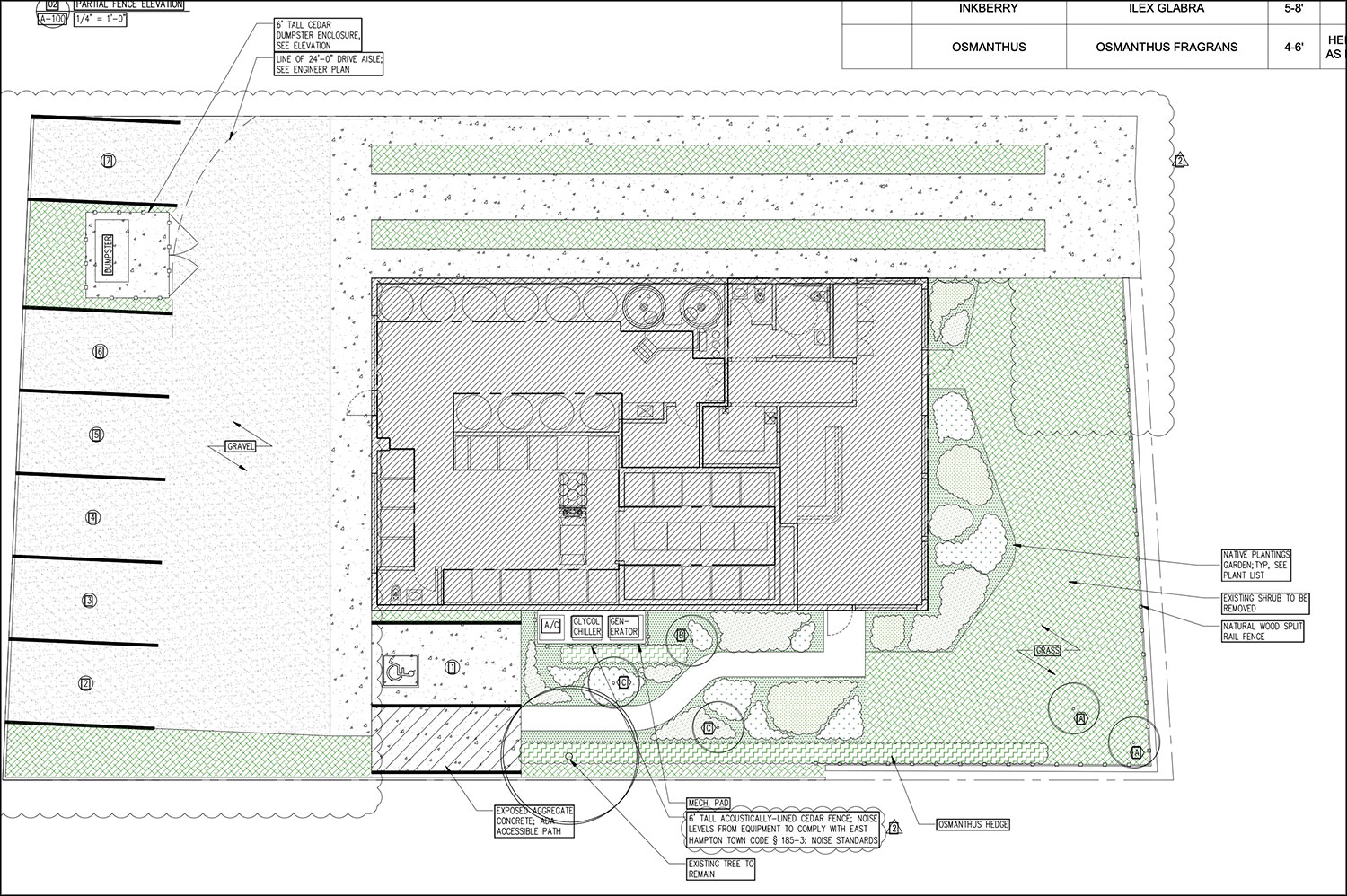
The Springs Brewery traded a big problem — being labeled a bar — for a relatively smaller problem involving total lot coverage, after its owners met with the East Hampton Town Planning Board last week.
Amid the relative chaos in the Building Department last summer, as it operated without a principal building inspector and rumors of a Suffolk County district attorney investigation, came a July determination from Dawn Green, a building inspector, that a planned tasting room at the brewery, proposed for 847 Springs-Fireplace Road, meant that the business must be treated as a “bar or tavern” per town code.
So, when Lindsay Reichart and Gunnar Burke, the owners, spoke to the planning board in August, the conversation was constricted because much, including septic and parking calculations, would be determined by how the town interpreted the building’s use.
And they steadfastly told the board their establishment would not be a bar.
Less than a month after he started working with the town as its principal building inspector, Richard Normoyle overturned Ms. Green’s ruling.
In a letter to Eric Schantz, a principal planner for the town, Mr. Normoyle wrote, “The definition of ‘bar or tavern’ is clearly stated in the town code as a business use or establishment which is primarily engaged in the sale and service of alcoholic beverages for on-premises consumption. The proposed tasting room is a secondary use for this location and not the primary business presented.”
Even with that good news, however, the Springs Brewery is still facing a small case of the spins.
Chris Stoecker, a town planner, told Mr. Burke that grass strips planned for the driveway, which were left off coverage calculations, would lead to rutting and were not appropriate for a commercial driveway.
“It wouldn’t be likely they would last in a grassy state,” he said, given the amount of use the driveway would receive. He recommended paving
Paved or not, he said the whole driveway would need to be counted in coverage, pushing the project well over the 70 percent of the lot that’s allowed to be covered without a variance.
“It does not appear the proposal can be revised to not require a variance,” he said, adding that the Planning Department “would not recommend against a variance in this instance.”
“We interpret the code differently,” Mr. Burke said.
“We designed this ‘ribbon driveway’ to reduce impervious surface area as part of a sitewide strategy to increase permeability on the site,” he said. “That’s currently all asphalt. We’re proposing gravel, which is more permeable, as well as these vegetated strips in the driveway that we do not believe fall under the definition of a structure.”
“We think this strategy meets the spirit of the zoning code by increasing permeability, reducing stormwater runoff, maintaining vegetated space and the rural character of the area,” he continued. “We also think counting the entire width kind of removes any incentive of doing that.”
Whether or not the Planning Department supported granting them a variance, Mr. Burke said they couldn’t afford to lose another year waiting for an approval. “If the ribbon driveway is not accepted as a solution to the coverage issue, then we will revise the layout to reduce demand on the driveway area,” he said, which might include redistributing use in the building and potentially eliminating a parking space.
One last sticking point centered around the tasting room.
Mr. Burke expected seats for 10 to 12 patrons in an area that constitutes more than 15 percent of the total size of the building. That means that even though it’s not considered a bar as far as Mr. Normoyle is concerned, the Suffolk County Department of Health would still use bar calculations for the septic flow.
That might require a larger sanitary system.
Regardless of how the room is defined, Mr. Normoyle suggested in his determination that the planning board “consider requiring conditions or other restrictions to ensure that on-site activities remain consistent with the use proposed in this application.”
In other words, make sure the “tasting room” doesn’t truly morph into a “bar.”
The board followed Mr. Normoyle’s suggestion and asked for a more detailed narrative on the tasting room and how it would be used.
Thus, the application remained incomplete.