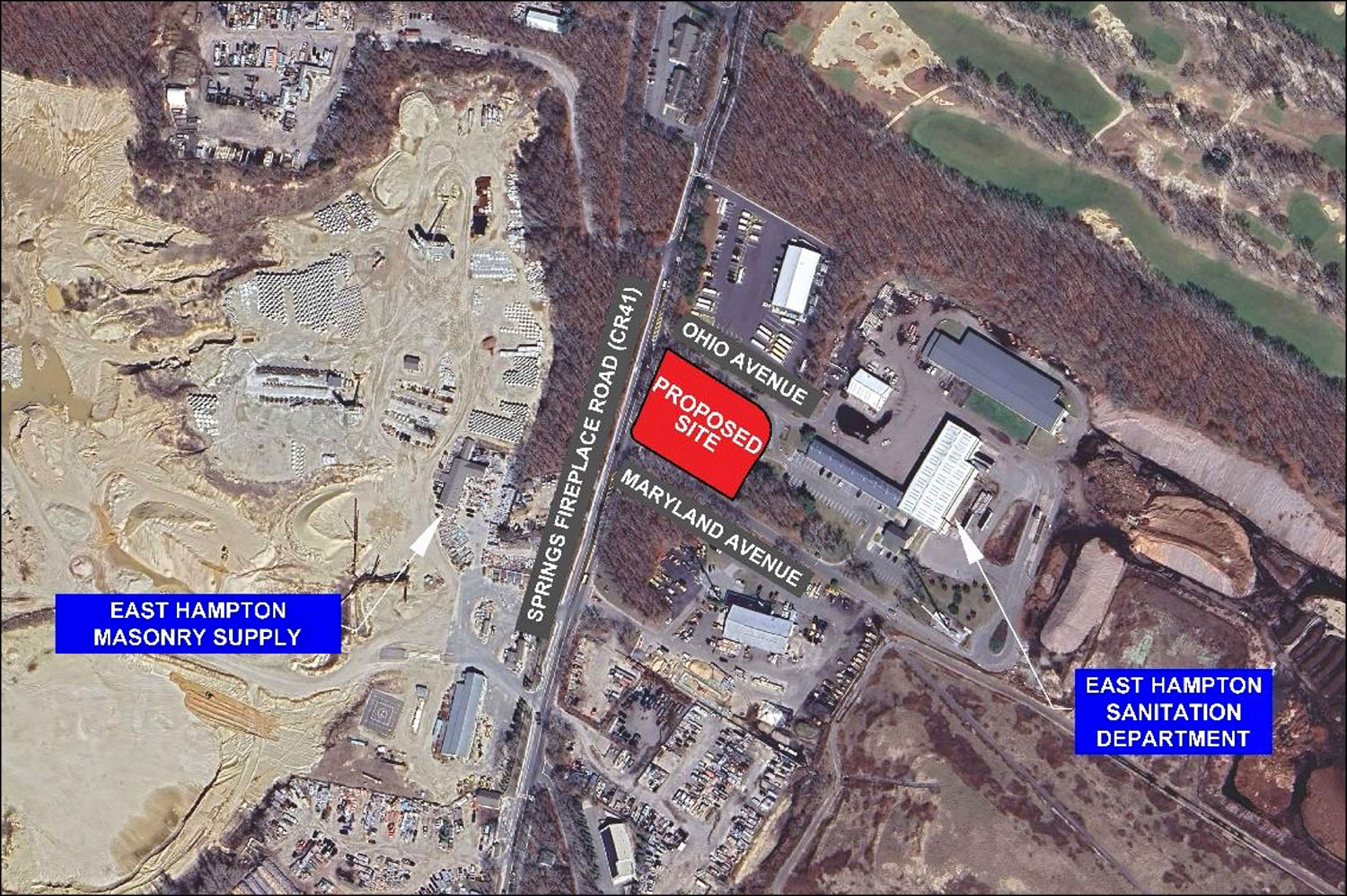
A proposal to place a full-service car wash at 238 Springs-Fireplace Road was in front of the East Hampton Town Planning Board last week for the first time in six years, needing site plan approval and a special permit.
With neighbors like masonry supply yards, the East Hampton Town Highway Department, and the town’s Recycling Center, it would seem like the Springs-Fireplace Car Wash might fit right in. However, its congruous zoning in a commercial-industrial area didn’t stop planning board members from worrying about impacts to traffic flow and, even more, the town’s water supply.
“Over the course of time, the issues that people have had with this is traffic and the groundwater issue,” said Ed Krug, the chairman of the board. “This is a very sensitive area, right? We’re right in a groundwater protection area, which is sort of ironic given it’s the landfill, but this is a really critical area.”
Thousands of gallons of water, supplied by the Suffolk County Water Authority, would flow through the car wash daily. Every week or two the facility would use as much water as the average Suffolk County residential customer uses annually.
The car wash would be capable of cleaning 80 cars per hour.
Nearly 70 gallons of water would be used for each car. Of those 70 gallons, about 11 would be fresh water. The remainder would be recycled until it became too dirty, contaminated with cleaning solvents and road grime, and then stored in tanks.
How many tanks and how often they would be dumped were details not yet worked out.
Drew Bennett, an engineer hired by the applicant, said that information would be on the plans before the Suffolk County Department of Health Services conducts its environmental engineering review. However, in short, he said, it’s expensive to do so.
“Putting those documents together is a very significant endeavor,” he said. “The owner is trying to get some sense of whether this is going to be a go before he makes that investment.”
Mr. Bennett said the car wash would be a “zero-discharge recycled wastewater system,” with safeguards in place to protect the public water supply. However, he found himself caught in a bit of a catch-22.
The board could not move forward without a clear understanding of the environmental impacts. Ultimately, it was up to board members to judge the project’s effect on town resources. Thus far, the board has not determined how lengthy an environmental review will be required, per New York State law.
“We just need some kind of information or study or something to better understand how that water comes to the site, how it gets used, how it gets treated, where excess water goes, you know, that sort of thing,” said Bruce Siska, a planning board member. “And whatever countermeasure there may or may not be to, God forbid something happens, you know all this water is going to take off down the street.”
“I live in Springs and I would love to have a local car wash, but I don’t want sudsy tap water, though, either,” agreed John Thorsen Jr., another board member.
A 7,150-square-foot building would be constructed. While Mr. Siska questioned whether a “huge lounge area” was needed, he also noted that even with it, the building was below the coverage maximum for the parcel. Other than comparing the structure to its maximum allowable size, there wasn’t much discussion or questions raised about it.
The wash bay would be on the eastern side of the lot, with cars entering from Maryland Avenue. A queuing area could handle 14 cars and there would be about 40 parking spaces, 12 of which would be reserved for staff.
It was not clear if a traffic study conducted in March 2024 by Schneider Engineering, to determine traffic impacts at the intersections with Springs-Fireplace Road, would be deemed sufficient.
The study concluded: “Future 2026 build-out conditions demonstrate that the proposed car wash will not have a significant impact on delay at the study intersections,” however no one seemed to believe that.
“I think you should maybe do another traffic study at the height of the season at peak times of travel, just to kind of assuage some of the concerns that we have over here,” said Jennifer Fowkes, the vice chairwoman of the board.
“Traffic does increase in the summer,” Mr. Thorsen deadpanned.
Britton Bistrian, an application expediter speaking for the car wash, did not add much to the conversation other than to argue against adding to an already “significant” 50-foot buffer, previously agreed to by the applicant. “Adding another 10 feet isn’t something we would desire. We want some of the site activities to be seen.”
The buffer was added when the town board made modifications to an urban renewal map, allowing for the entrance and exit on Maryland and Ohio Avenues, as opposed to Springs-Fireplace Road. Ms. Fowkes argued that the buffer was appropriate.
The application was deemed incomplete in the absence of the technical details of the car wash’s operations and storage tank placements. Mr. Krug acknowledged that while the town had no jurisdiction over the engineering approvals, he hoped for a “partnership” moving forward.
“We’re going to keep talking about this,” he said.
A public hearing will be held once the application is complete.