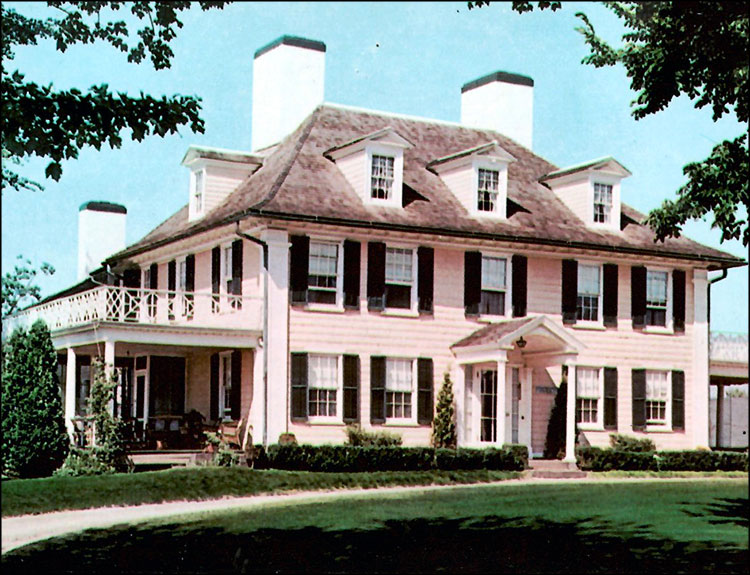
The manor house at Sylvester Manor, which appears on this postcard, was built by Brinley Sylvester (1694-1752) around 1737, after the courts confirmed his inheritance.
Brinley’s grandparents Nathaniel Sylvester (1620-1680) and Grizzell Brinley Sylvester (1635-1687) were the first European settlers to live on Shelter Island, moving there around 1653. Nathaniel came to the island as a partner in a consortium of Anglo-Dutch investors in the sugar trade. He and his business partners grew provisions for their other plantations on Barbados, where land was too valuable to grow anything except sugar.
From Sylvester Manor’s earliest days, its existence depended on the labor of people of color — particularly enslaved people of African descent and enslaved or indentured Indigenous people.
Much has been written about Sylvester Manor as the largest “intact” Northern plantation, but we are still actively working to understand more about the experiences of the people who lived and worked there, including the enslaved and free people of color. As part of that ongoing effort, archaeology students from the University of Massachusetts-Boston’s New England African American Archaeology Lab, under the direction of Dr. Nedra Lee, did fieldwork at Sylvester Manor this past summer.
Dr. Lee and her students conducted important work to understand more about where the free people of color lived, among them David Hempstead Sr. (1774-1843), a capable farm manager, along with surveying and identifying the boundaries of the Afro-Indigenous Burial Ground at Sylvester Manor Educational Farm.
To learn more about Dr. Lee’s fascinating work, join us for her Tom Twomey Series lecture, “Uncovering the Past: Archaeology at Sylvester Manor,” at 5:30 p.m. next Thursday at the East Hampton Library. A recording of the presentation will also appear on the library’s YouTube channel.
—
Andrea Meyer, a librarian and archivist, is the Long Island Collection’s head of collection.