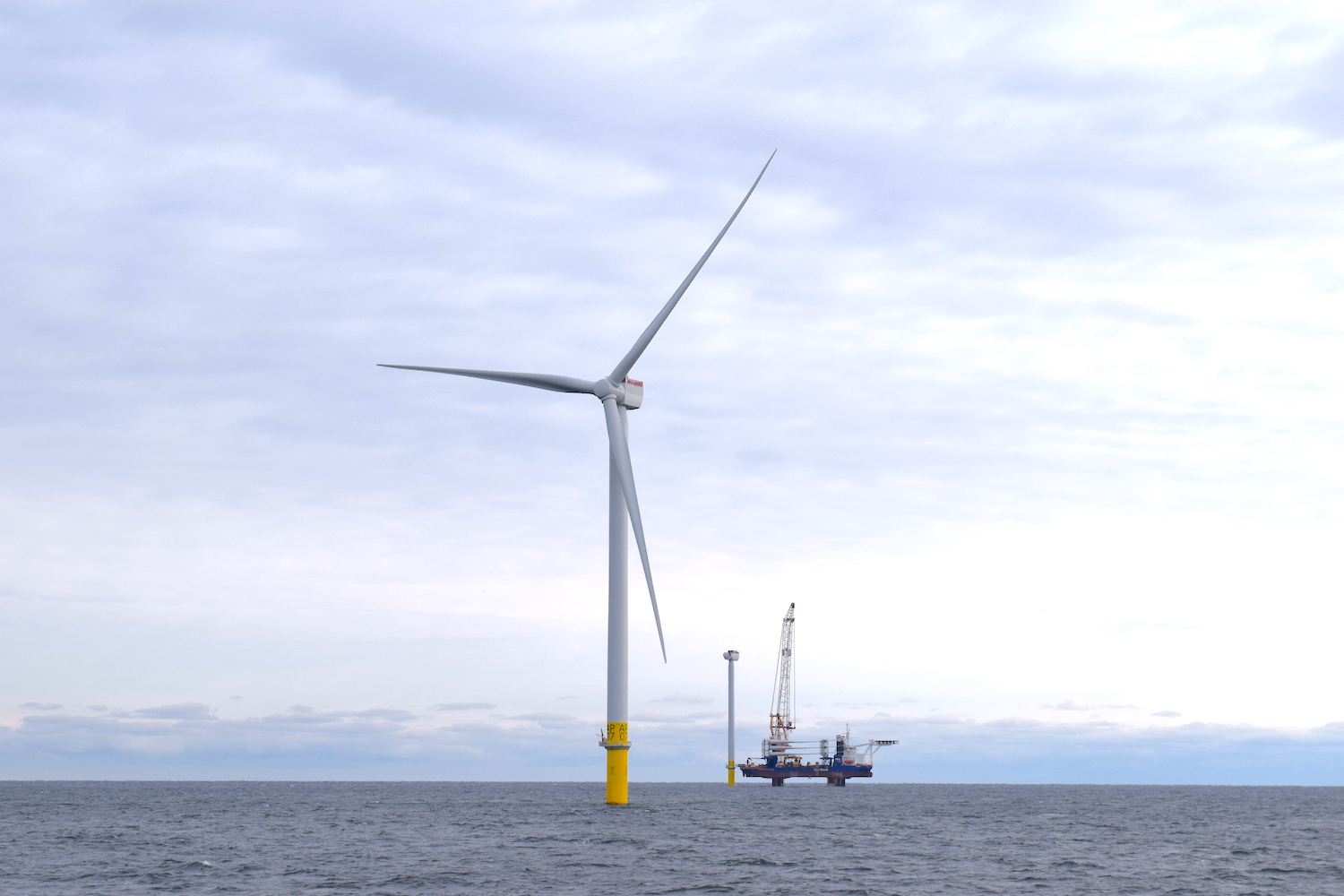
As the Trump administration pledges to appeal all five court rulings that sided with offshore wind farms under construction on the Eastern Seaboard, and Canadian officials call on the industry to shun the United States in favor of the ocean off its shores, developers of South Fork Wind, the nation’s first commercial-scale offshore wind farm, are pointing to its reliable generation of electricity in its second year of operation and during this winter’s extreme cold.
The 12-turbine, 132-megawatt farm, electricity from which makes landfall in Wainscott, achieved a 46.3-percent capacity factor in 2025. “Capacity factor” refers to real-world performance, or the ratio of energy generated versus the maximum theoretical output of an installation running at its full rated capacity around the clock. For offshore wind, typical values are between 20 and 40 percent, reflecting intermittent wind speeds, maintenance downtime, and site efficiency.
In January of this year, South Fork Wind delivered a 52-percent capacity factor, comparable to New York State’s most efficient gas plants. Output at offshore wind farms in the Northeast — South Fork Wind, the smaller Block Island Wind, and Vineyard Wind 1, which is still under construction — is typically at its strongest during winter months, when energy supplies on Long Island are often constrained.
Over the course of 2025, South Fork Wind generated electricity on 99 percent of all days and across 90 percent of all hours, according to its developers, the Danish energy company Orsted and the German company Skyborn Renewables. The developers assert that the wind farm generates electricity sufficient to power 70,000 average-size residences.
Earlier this month, a federal judge handed the Trump administration a fifth consecutive loss in court challenges to its December 2025 order pausing construction of five wind farms along the East Coast. The United States District Court for the District of Columbia granted a preliminary injunction sought by Sunrise Wind L.L.C., another Orsted project, regarding the suspension order issued by the Department of the Interior’s Bureau of Ocean Energy Management. The move allows the construction of Sunrise Wind in federal waters about 30 miles east of Montauk Point to resume immediately while the underlying lawsuit challenging the administration’s order progresses.
The 924-megawatt wind farm’s export cable is to make landfall at Smith Point County Park in Shirley and is to generate electricity sufficient to power nearly 600,000 residences.
The decision follows successful challenges to the administration’s order by the developers of Empire Wind 1, a 54-turbine, 810-megawatt project being built by the Norwegian company Equinor and which is to send electricity to New York City; Revolution Wind, a joint venture between Orsted and Skyborn that is to send electricity sufficient to power 350,000 residences in Connecticut and Rhode Island; Vineyard Wind 1, jointly developed by Avangrid Renewables and Copenhagen Infrastructure Partners, which is nearly complete and has already sent electricity to Massachusetts, and Coastal Virginia Offshore Wind, under development by Dominion Energy.
An Orsted official delivered the statistics on the South Fork Wind farm at the advocacy organization Oceantic Network’s annual International Partnering Forum in Manhattan. It was there that Tim Houston, the premier of Nova Scotia, made a pitch to business executives to invest in offshore wind projects off his province rather than in the United States, where the federal government has repeatedly attempted to kill the nascent offshore wind industry while promoting fossil fuel-derived energy, which scientists say is causing dangerous and accelerating warming of the atmosphere.
“We are a predictable and reliable regulatory jurisdiction,” David MacGregor, associate deputy minister of the Nova Scotia Department of Energy, said at the conference, as quoted in The New Bedford Light, a Massachusetts digital news outlet.
Perhaps demonstrating that the United States under the Trump administration is equally predictable, Interior Secretary Doug Burgum told Bloomberg News that the administration will appeal the five court rulings that thwarted its effort to halt construction of the five offshore wind farms. The administration had cited vague national security concerns, and its December order pausing the wind farms’ construction prompted Gov. Kathy Hochul and the governors of Rhode Island, Connecticut, and Massachusetts to demand that the federal government rescind the order, and prompted the wind farms’ developers to sue the government.
Construction has since resumed on all five wind farms.