As they did one year ago, officials of the New York State Office of Parks, Recreation, and Historic Preservation came to Montauk Downs State Park, where on Tuesday they discussed the effort to address devastation wrought by the invasive southern pine beetle on pine trees in Hither Hills and Napeague State Parks, particularly a reduction in the risk of wildfires. The message was of resilience and the promise that, while current conditions may not demonstrate it, “we are going to make a new forest, and it’s going to be great,” one official said.
The southern pine beetle was first detected in Suffolk County in 2014, and first seen at Napeague in 2021. In August, Gov. Kathy Hochul announced that Parks, Recreation, and Historic Preservation had awarded a $2.2 million, three-year contract for forest management in areas that have experienced a significant impact from the invasive species. The contract focuses on areas near residences, trails, and Montauk Highway while creating access for fire departments to reduce the risk to lives and property in the event of a wildfire.
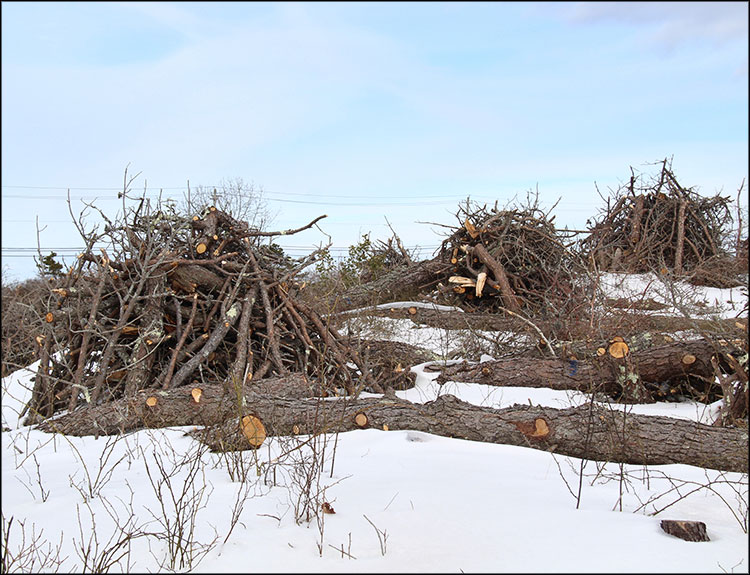
State parks crews mobilized to clear downed trees near the Montauk transfer station and remove stumps, using an excavator when necessary, along parts of the Paumanok Path. A mulcher shreds trees into mulch. The clearing work is directed by a Hazard and Risk Analysis and Fire Management Plan finalized by the contractor, Star Tree Wildfire Protection, with input from the State Office of Parks and other entities.
Pitch pine woodland comprises around one-third of Napeague State Park, where an estimated 40,000 trees, or 80 percent of the forest, have been affected, said Tim Watson, the park director at Montauk Downs. At Hither Hills State Park in Montauk, only 147 of 1,665 acres are considered pitch pine woodland.
“We have over 100 rare species at these parks, including the federally endangered northern long-eared bat,” Becky Sibner, the Parks Department’s forest health specialist, said at Tuesday’s well-attended meeting. In the state, “Hither Hills ranks second for globally rare elements of biodiversity, and Napeague ranks seventh. These are just incredibly special places, and that really factors into how we’re responding to this crisis.”
The density of this maritime pitch pine woodlands, which Ms. Sibner said is atypical, is what made the parklands particularly vulnerable to the southern pine beetle, which can produce up to six generations per year and can kill a tree in two to four months, “which is incredibly fast.”
Cold winter temperatures historically kept the species farther south, “but with climate change, we are seeing it spread north,” she said. “It’s reached as far north as New Hampshire now.” The beetle “is dependent on the summer temperatures, but that’s a really fast-growing population, and large infestations can spread at a rate of over 120 feet per day.” Once present, “it is incredibly difficult to control.”
When detected, the initial management technique is a suppression cut, “where you cut the infested trees and then a buffer around” them, Ms. Sibner said. That effort was unsuccessful here, so in 2022 long-term goals were enumerated: reduction and mitigation of threats to public safety, protection and promotion of rare and vulnerable species and natural communities, and strengthening of ecosystem resiliency to pests and disease. “We’re really trying to balance all of the important pieces of this project, which is in our mission.”
Emergency fuel breaks were created near residences in the winter of 2023 to 2024. “We also followed that up with some understory mastication,” or wood chipping, Ms. Sibner said. “We basically mowed some shrubs next to a fuel break, trying to increase this defensible space. Working from the outside of what we want to protect, which is homes and people, we’re working our way in, reducing fuel coming in so that there’s a larger space that could be defended in the case of a wildfire.” This is likely to be repeated every few years.
In 2024, winter tree cutting was expanded, focusing on hazard trees along trails “because the trails were now going through dead forest.” Trees for a span of 10 feet on either side of the Paumanok Path and in Promised Land were cut, “and then this whole time we’ve been continuing our planning for restoration and long-term management.”
Since the meeting one year ago, the Parks Department contracted with Star Tree, which developed the hazard assessment and recommendations in partnership with the State Department of Environmental Conservation and local fire departments.
Star Tree has cut about 5,600 trees and created slash piles across around 55 acres, Ms. Sibner said, expanding out from past work and priority areas. Piles of dead trees and branches will be disposed of using different tools based on the location and what is feasible, but some will be burned, others will be chipped, and still others will be removed.
While Napeague appears wholly ravaged by the invasive insect, “we’ve got some trees alive in there,” Ms. Sibner said. “They look really good. It’s not a lot of trees, and we don’t know what’ll happen. There’s still southern pine beetle on the site, but they’ve made it this far. They’re pretty well spread out, which helps them, so we’re feeling attached to the idea that we might be able to keep some of the pine trees. And as long as we have those, they’re a seed source, so it’s a real priority to do that.”
“We’re creating a really large defensible area,” she said. “If a wildfire were to happen anywhere along the Paumanok Path in that section, we still have this big area that’ll be much lower in fuel because it’ll be pretty clear.”
In addition to the burn Friday at Promised Land, piles by the Montauk transfer station are anticipated to be removed before the spring, certainly before summer, Ms. Sibner said.
“The weather conditions that you need for any kind of fire are extremely specific,” she said. “This would be a small trial” in conjunction with the D.E.C., “because they have extensive experience with pile burning closer to Riverhead,” she said, pointing to the David A. Sarnoff Preserve, where she said it has been successful. More tree cutting is also planned for this year.
Along with these fuel reduction steps, “the one piece of good news about all of this is that pitch pine actually regenerates very well with disturbance,” Ms. Sibner said. “We do expect to see quite a bit come back. . . . That’s part of our monitoring for this year.” Maintaining an appropriate forest density is also a strategy toward minimizing the risk of renewed destruction by the southern pine beetle, she said.
“I know it still doesn’t look good,” she added. “It’s still not your park, but I hope the vision for this is starting to take shape.”