The inaugural meeting of East Hampton Town’s newly reconstituted Latino advisory committee on Saturday could have fairly been called “Fear and Waiting in East Hampton.”
Much of the discussion centered around the local police force and its potential role should federal Immigration and Customs Enforcement action accelerate on the East End.
All who participated believe that raids, like those seen in Minneapolis, will eventually occur here.
The group focused on preparing for that eventuality.
“We don’t know when, if, or how, but it’s likely it will come,” said Anna Skrenta, who chaired the committee along with Yesenia Quichimbo.
Ms. Skrenta is also the chairwoman of the East Hampton Town Democratic Committee, but assured the participants, “This is not a political exercise at all. I’m not here as the chair of the Democratic committee. I’m here as a community member and a neighbor.”
Still, the undercurrent of politics pulled the conversation specifically in the direction of Donald Trump’s immigration policies.
“I don’t want to use the word afraid,” said Rosa Lourenco, a committee member who has lived in Montauk for 43 years. Lately, she said, she cries every day. “I tell everybody don’t be afraid, just have faith. The same thing happened in 2017, but people forget. Why did they vote for him? I am from Colombia. In Colombia, red is liberal, and here it is different. People are maybe confused about that.”
“Regardless of our legal status, we are not protected,” said Ms. Quichimbo, a real estate broker, who also volunteers on the board of Project Most, OLA, and the Springs Food Pantry. “Our skin color has us getting profiled. I want our police departments, our chief of police, to come out and speak about it.”
She said as a teenager growing up in town she worked as a traffic control
“I always thought of police, as that’s where you go. You get lost you find a police officer. That’s not the case at this very moment and we need to be able to see police as our go-to. We need that oversight. If ICE shows up and tries to go into my parents’ stores, what can they do? Can they call 911? Can the police be there for oversight? Not to stop them [ICE] from what they’re doing, but to make sure they’re following the law.”
Town Supervisor Kathee Burke-Gonzalez, the town board liaison to the committee, tried to clarify what the police could and could not do. Neither Michael Sarlo, the town’s police chief, nor Daniel Munoz, the Police Department liaison (he worked a late shift the evening before, said the supervisor) were present on Saturday, but promised one or both would be at the next meeting.
“Our police can observe, but they can’t interfere,” she said. “If our police officers show up, they’ll have their body cameras, and they will be documenting, but they cannot interfere with the federal action.”
Johanna Sanchez, an immigration attorney and committee member, spoke about how civilian observers are bullied by ICE agents and having their phones taken away.
“I think it’s difficult to see an ICE agent doing that to a police officer, so that would be supportive,” she said.
“Their presence alone would de-escalate a situation,” agreed Ms. Quichimbo. “They’ve been trained and know what behavior is ethical.”
Ms. Burke-Gonzalez said ICE does not let the town know when it is operating in the jurisdiction. “If they take people, they don’t tell us who they took or where they took them.”
Representative Nick LaLota, when asked if the federal government would supply that information, offered a statement in response.
“I understand why families want timely, accurate information when someone is detained,” he wrote. “Transparency helps reduce fear and confusion, and I support sharing appropriate information with families consistent with privacy protections, legal requirements, and public safety.”
“ICE must be able to do its job safely,” he continued. “Cooperation, not obstruction, between federal, state, and local officials is the best way to keep communities safe while respecting the rule of law.”
Another concern of committee members was the lack of Latino representation in town government. According to the most recent census, Latinos comprise 27.2 percent of the town’s population. The East Hampton School District serves 1,702 students; 1,007, or 59 percent, are Hispanic or Latino.
“We want to raise the voices of the Latino members of our community,” said Ms. Burke-Gonzalez. “I like to think of it as one community, not separate communities.”
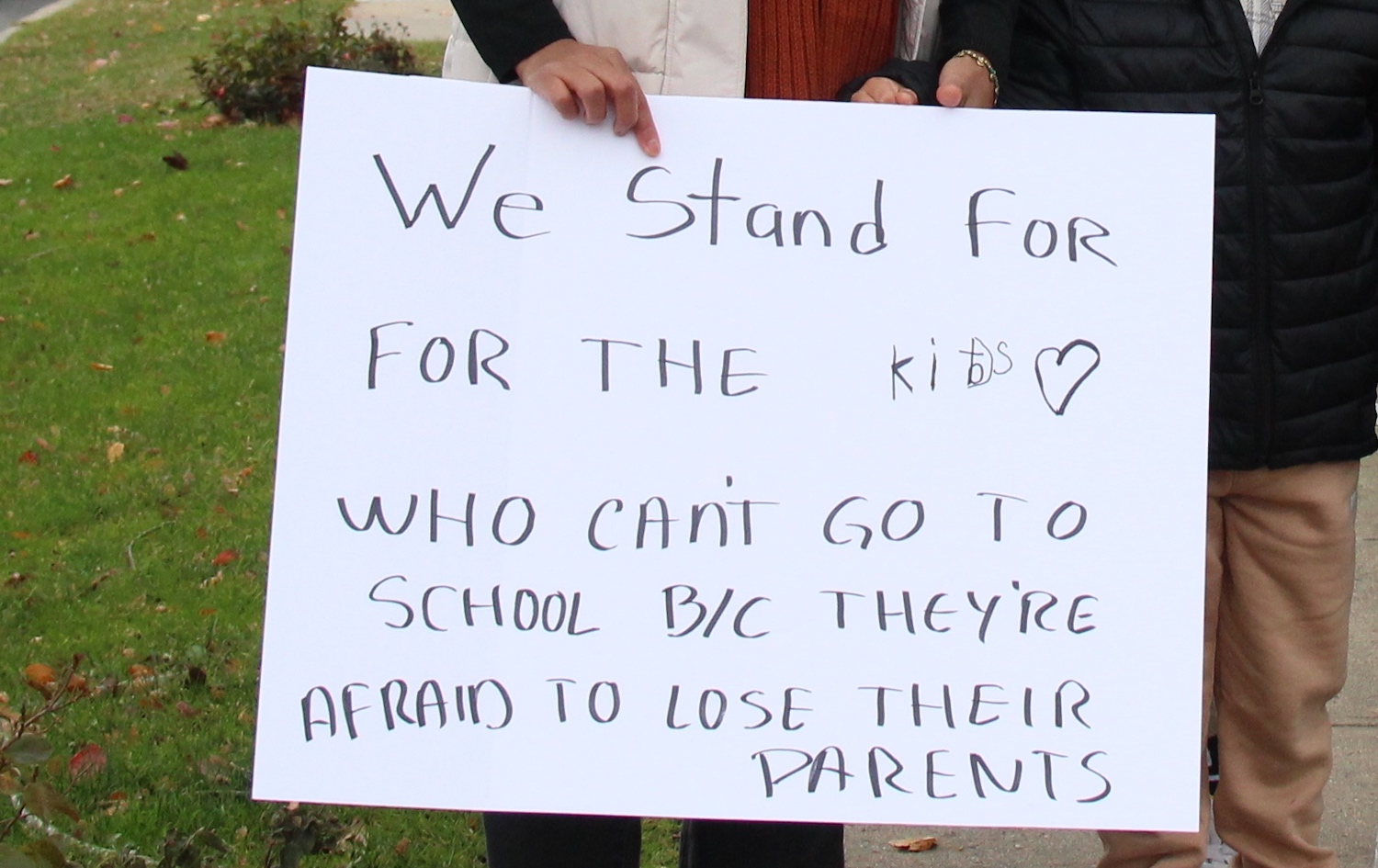
Many others shared concerns about their children.
Ms. Quichimbo told the story of a mother who is now afraid to drive her children to school. “Her biggest fear is ICE coming for her, and her children being forced to witness that. As a mother, I can’t imagine what that must feel like.”
A woman named Jasmine Zoomed into the meeting as she cut hair in a local salon. She told the committee that many of her friends wanted to know if people with citizenship were able to sponsor the children of detained parents.
Ms. Sanchez, again speaking as an immigration attorney, said sponsorship involved a long procedure in New York State. She suggested making a sort of “go kit,” as one may have a “go bag” that can quickly be grabbed before evacuating in advance of a hurricane. She also suggested making copies of important documents and giving them to a trusted friend. That way if someone is detained, they could be found and tracked.
“That’s a way to prepare,” she said. “This whole Trump situation has changed my practice. Now we’ve been doing habeas corpus petitions.” If someone is detained for more than 180 days, she’ll try to fight to get people out of jails by suing federal court, arguing that people are being wrongfully detained. The Department of Homeland Security “has to explain why they are being detained.”
“There are protections, but it’s hard,” Ms. Sanchez said. “The law is law, but the government isn’t following the law. All we can do is the best we can do with the tools that we have. Prepare for the worst.”
It’s unclear if the three men recently detained in Greenport were prepared for the worst.
Mr. LaLota, who previously told The Star that he doubted Minneapolis-style ICE actions would occur on Long Island, provided a statement on the men’s detainment.
“Regarding the recent East End enforcement activity, I have urged federal officials to prioritize individuals who pose public safety threats, while ensuring humane treatment and due process,” he wrote. “It is also worth noting that roughly 70 percent of those arrested under President Trump have pending criminal charges or prior convictions, which helps explain the enforcement focus.”
According to Minerva Perez, the executive director of OLA, which helped identify the men, two had no criminal records at all; the third had a prior arrest for drunken driving. They were detained as they boarded the North Ferry to Shelter Island to commute to work.
“We are not a different race,” said Juan Roldon, a committee member. “We have hearts, we have brains, everything. So, it’s a little hard to understand when they say ‘aliens.’ ”
The next meeting of the Latino advisory committee will be held on March 7 at 8 a.m. at the East Hampton Town Senior Center on Springs-Fireplace Road. It is open to the public.