The ground will be covered in white for this year’s Great Backyard Bird Count, which starts Friday and lasts through Sunday, and that means feeders could be especially active and potentially yield some surprises.
The count is an annual global event sponsored by the Cornell Lab of Ornithology. It tasks citizen scientists, for example, you, with simply observing which birds are outside in this cold month and submitting the data to eBird.
“These observations help scientists better understand global bird populations before one of their annual migrations,” reads birdcount.org, the official website of the count.
Like any bird count, or anything, really, if you want something to think about during this quiet period, you never know what you might find when you pay attention.
Take, for example, the experience of Keith Douglas, who lives in
Mr. Douglas, and his wife, Frances Jones, flew across the world to visit Sri Lanka recently only to find, while they were visiting their faraway and exotic locale, that a faraway and exotic bird was visiting their local and mundane backyard.
Mr. Douglas had installed a Birdfy feeder, which comes with a solar-powered camera.
“My phone alerts me any time there’s activity on the feeder,” he said in a phone call. “I get the greatest birds. The big woodpeckers, the little woodpeckers. I knew something weird was up because it also uses A.I. to identify birds and it told me I had a painted bunting.”
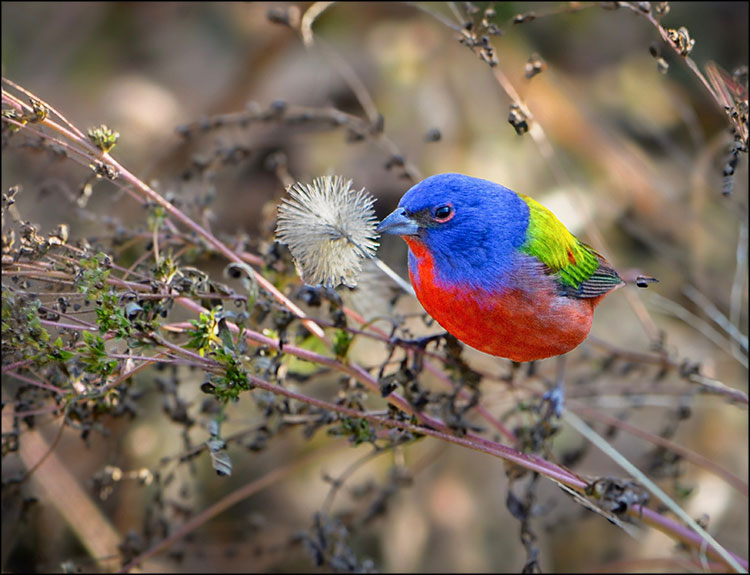
Mr. Douglas reviewed the photos from his camera and sure enough, a male painted bunting was visiting his snow-covered yard in early February.
Painted buntings live in the Southwestern United States. Birders on Long Island are lucky if they get to see one every few years.
Besides feeders, there are other ways to draw birds to your yard. Especially during the frozen stretch we’ve experienced, with nary a moment where the temperature has crossed above the freezing level since the end of January (Long Island’s record is 16 days of subfreezing temperatures, set in 1979), a heated birdbath is essential and compared to a feeder, low maintenance.
They are sold at Wild Bird Crossing in Bridgehampton.
With multiple inches of snow still covering the landscape weeks after the big storm in January, birds have also been attracted to anything that grows tall enough to pierce the thick layer of white.
Abby Lawless, the owner of Farm Landscape Design and the landscape architect responsible for the design of the East Hampton Town Hall campus grasslands, said native grasses are a great asset for songbirds in times like these.
“A lot of our native grasses are quite tall, and there are ways to create slightly curated assemblages of them that go way beyond what a lawn could be that help provide benefits to wildlife,” she said. “The aesthetic tide is changing. We get people asking for meadows who are more interested in the living element of their landscapes.”
A grass like bluestem could provide areas of shelter and also serve as a minor source of seed in mid-February. She said other native plants like helenium or ironweed, which both have the added benefit of being unpalatable to deer, are good options for overwintering birds and insects.