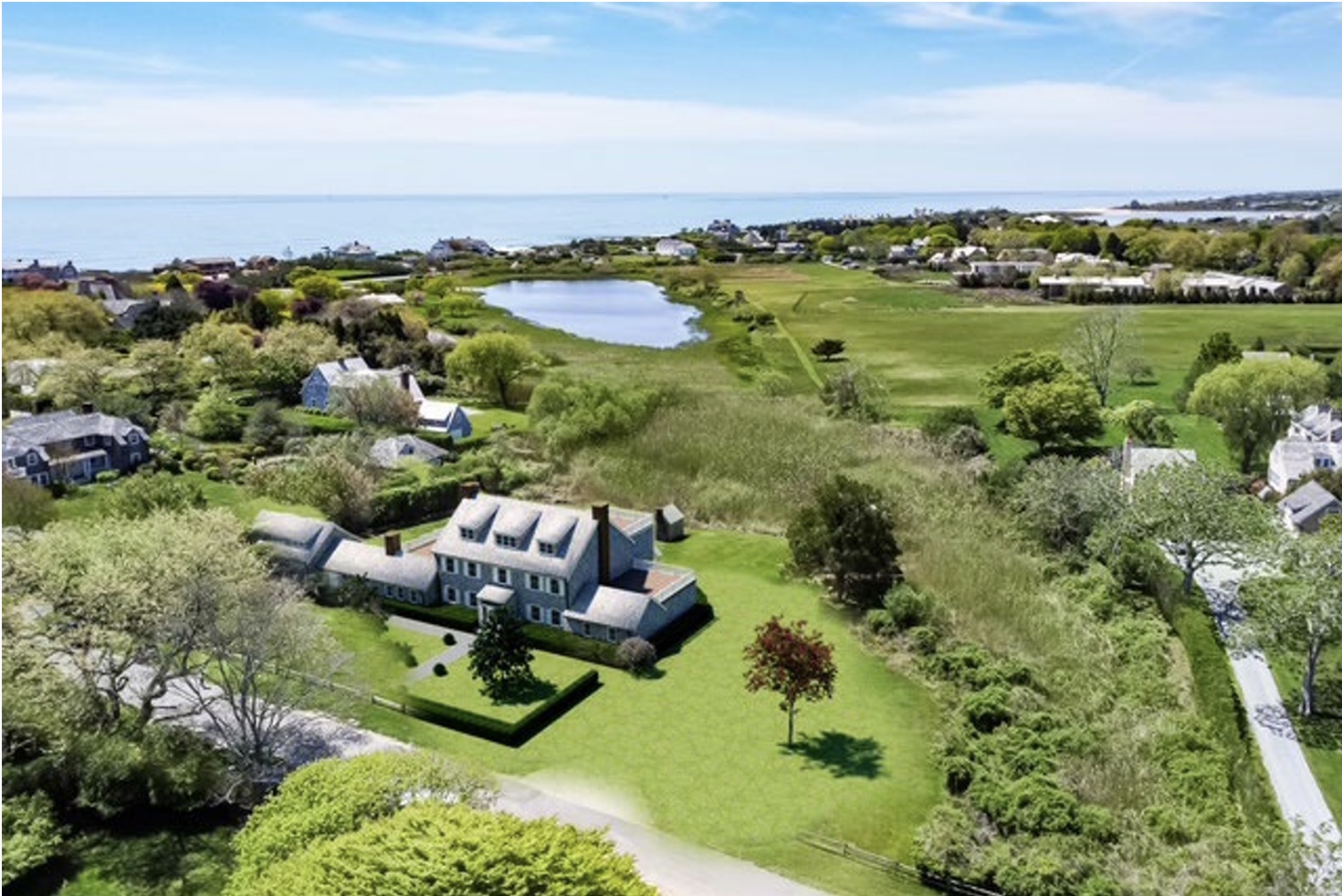
A homeowner’s application for multiple variances and a wetlands permit drew extensive questioning from the East Hampton Village Zoning Board of Appeals on Friday, including concerns about the potential impacts on a nearby residence and on the neighborhood character.
The owners of 15 Jones Road, Doug and Kristin Douglass, seek variances to make alterations and construct additions to the three-story residence, to convert an accessory building into an accessory dwelling unit, to construct a swimming pool and patio, and to install an innovative/alternative septic system.
Wetlands cover just over half of the 2.15-acre property, running along its western and northern borders, and the proposed additions and alterations are all within wetlands setbacks, hence the need for variance relief. The variance would also allow for the removal of phragmites and plant vegetation within and directly adjacent to a wetland, where the required setback for landscaping is 125 feet.
Additional variance relief of 22.2 feet is sought to construct additions to the principal residence 47.8 feet from the front yard lot line, where the required setback is 70 feet, and 32.9 feet to construct additions 17.1 feet from the side yard lot line, where the required setback is 50 feet.
Trevor Darrell, an attorney representing the applicant, told the Z.B.A. that a State Department of Environmental Conservation permit for phragmites removal is already in hand. The invasive phragmites would be “hand-cut” and removed from the site, he said, and a 30-foot-wide native species buffer will sit between the wetlands and yard areas.
Most of the requested setback variances are based on the location of the wetlands and the existing structures, Mr. Darrell said. The interior of the accessory building is to be renovated “in kind,” he said. Its septic system will be removed, and the building would “tie into a new I/A system, which would then obviously capture any nitrogen running into the wetlands and/or the groundwater in this area.”
“The whole property will be contained in a new nitrogen-reducing system.” he added.
At the main house, “the additions that are proposed are mostly going over existing patios,” Mr. Darrell said. The “ultimate plan” is to use the existing structure “as the starting and focal point, and work from there, just to add a few items which would be some habitable space as well as a usable garage.”
A neighbor to the south has expressed concern about the garage, he noted, and “We’ve tried to keep it as low as possible, because there is existing hedgerow on the neighbor’s property, which is pretty substantial.” The applicant has a hornbeam hedge, also described as substantial, “so the two hedges together are double-wide, and also approximately 20 feet tall.” The peak of the garage as proposed is 23 feet from natural grade, 20 feet from the foundation.
The proposed improvements would not result in an undesirable change in the neighborhood’s character, the lawyer maintained, nor are the requested variances substantial.
He faced several questions from Joseph Rose of the board, however, and the discussion was somewhat hampered by the absence of Billy Hajek, the village planner.
“That there are conditions on this property that warrant consideration that one might not otherwise give to a property of this size is clear, as a result of the wetlands,” Mr. Rose began. But “I’m most concerned about the garage issue, and I think the neighbor’s concerns are legitimate.” Given the substantial wetlands, “we’re talking about, effectively, a one-acre site, in terms of its developable capacity.”
The setback regulations would be 40 feet for a one-acre parcel, Mr. Darrell said. The point of his questioning, Mr. Rose said, was that, given the constraints of the site, the degree of “intrusion into the side-yard setback for the garage is substantial, even taking into account treating it as a one-acre site . . . I think the garage is extremely substantial in terms of its setback variance being sought.”
The main house and garage form a “144-foot-wide continuous structure, which is a substantial presence across the Jones Road frontage,” he added. “It’s hard to indicate that that’s not a substantial variance” impacting the neighborhood’s character “because . . . you can see through, now, from Jones Road back to Lily Pond, through that area now.”
“Not really,” Mr. Darrell objected, as there is an existing shed, fence, and trees. The applicant has spoken to the southerly neighbor “to try to see if there was anything that we could do to alleviate some of the concerns,” he said, though James McMullan, the board’s vice chairman, who was presiding, commented later that “they haven’t been able to really connect yet to have a meaningful discussion.”
The other residence is nearly 150 feet away, Mr. Darrell said, “and when you’re looking from that angle, the hedgerow sits at least 20 feet high. So you wouldn’t see the garage component.” The applicant is willing to include additional plantings to screen any visual impact on the neighbor, he said.
“There are substantial issues here that may well be able to be sorted out,” Mr. Rose said, “but . . . we’re not going to do it, I think, at this meeting.” The board decided to keep the hearing open; it meets next on March 6. “That would be, I think, the best course of action at the moment,” said Mr. McMullan, “because there are some other questions that need to be answered as well.”