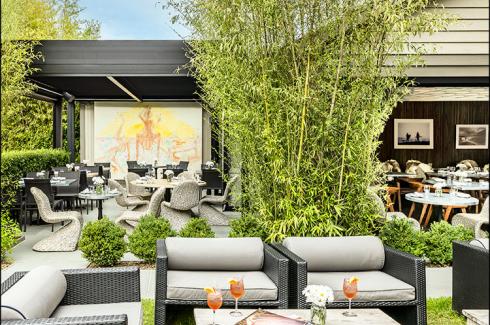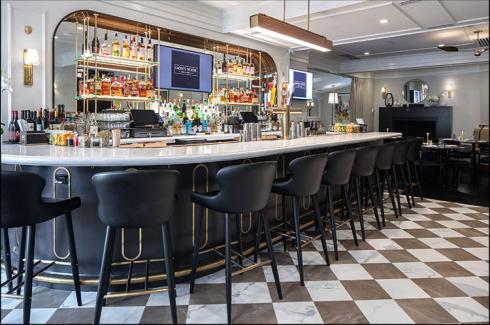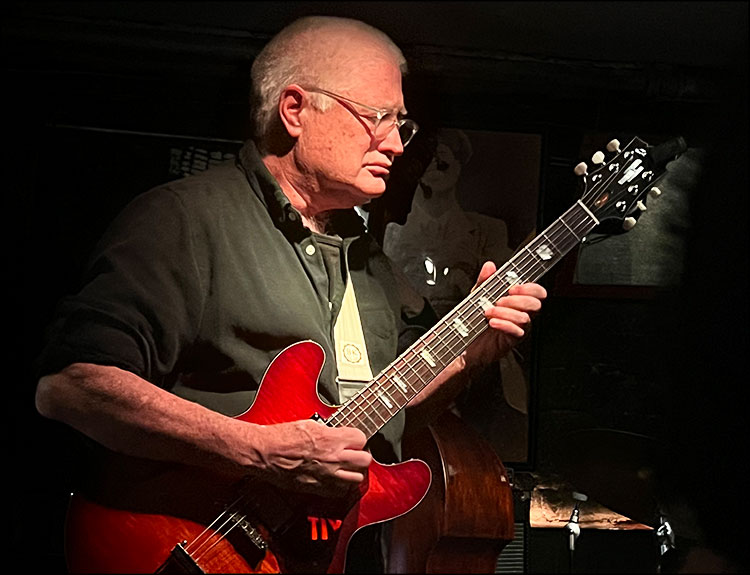
“Sometimes you have to face a challenge,” Peter Watrous told The Star in a recent discussion with the guitarist related to the pianist Thelonious Monk. The challenge at hand: two sets of mostly Monk music, on Saturday from 6 to 8 p.m. at the Sagaponack Farm Distillery.
Thelonious Sphere Monk, who died in 1982, was a singularly idiosyncratic composer and pianist, known for compositions including “Blue Monk,” “Straight, No Chaser,” “Well You Needn’t,” “Ruby, My Dear,” and “ ’Round Midnight.” He was an essential figure in the development of bebop and an eccentric one — both as composer, often using dissonant tones and complex harmonies, and as a performer, sometimes stepping away from the piano to dance or simply twirl in place as a bandmate played a solo.
Watrous, the music curator at the Arts Center at Duck Creek in Springs, is well versed in these characteristics of Monk’s unique genius: He was a longtime jazz critic for The New York Times, also writing for The Village Voice and The Nation. Previously, though, he attended the Guitar Institute of Technology in Los Angeles before earning a degree at the University of Massachusetts, Amherst, which has a jazz program within its department of music and dance.
His studies allowed him to play with professionals like the saxophonists Marion Brown and Archie Shepp. “I was in a college program,” he said, “but people would come through and need musicians, so I would play with a lot of good people. I got firsthand experience from that.”
Upon leaving The Times, “I started playing guitar again,” Watrous said, “which I hadn’t done in 30 years or something. I worked at it really hard, took lessons, played with as many people as possible, and then got to a point where I started playing at Smalls,” in Manhattan’s Greenwich Village, as well as Ornithology and Bar Bayeux, both in Brooklyn. “Three of the best in the city for jazz,” he said.
Many in his demographic left New York during the Covid-19 pandemic, he recalled, and he found himself playing with younger musicians, “and they’re incredibly well trained, a really high level of virtuosity,” indicating “a real step forward in jazz education.” He performs two or three nights per week in the city. He also has a house in Sag Harbor and occasionally performs at Duck Creek.
Monk’s music “is really hard, and unbelievably satisfying as well,” Watrous said. Monk “was one of the first in the jazz world to start writing music that wasn’t meant to be sung, which allowed a ton of freedom melodically and harmonically. Previously, people who composed often wrote as if they were writing to get a hit, which meant somebody had to sing it. Monk is writing a highly pure form of music not dependent on words, on having a hit, on being sung. As well, it’s fantastically complicated at times, yet beautiful at the same time. Monk was a master of harmony, and each composition seems like a master class in how to play jazz in a certain way. Also, rhythmically it’s incredibly sophisticated.” His compositions “are surprising, with all sorts of twists and turns.”
With Benjamin Young on bass and Angus Mason on drums, Watrous will play Monk compositions spanning early selections like “Little Rootie Tootie” through later tunes, “Green Chimneys” among them. The latter, and another, “Locomotive,” are “almost like pre-minimalist compositions,” he said. “Only a couple of notes, but repeated in the same way you might hear in American minimalist classical composers like Steve Reich.”
“I love playing at the Distillery,” Watrous said. “It’s a great place to play.”