For two decades, the artist Keith Mayerson has created his nonlinear narrative series, “My American Dream,” which captures in paintings the breadth of American culture, from its landscapes, families, politics, cultural icons to its art history.
The first body of work, “Heroes and Villain” (there’s only one — guess who?), started with a 2018 photograph by Pete Souza of Barack Obama looking at a painting at the Whitney Museum of the twin towers on fire. “9/11 was really the beginning of the series,” Mayerson said during a phone conversation from his house in California. “I really wanted to make an America we can still believe in, the hopes and aspirations, democracy with a lower case ‘d.’ ”
Chris Byrne, the owner of the Elaine de Kooning House, was working at Marlborough Gallery when a show of Mayerson’s opened there. Since taking over the de Kooning property in 2010, he has hosted residencies for more than 30 artists. One of those was Mayerson, who began his tenure there in the spring of 2019.
“What’s interesting about the ‘My American Dream’ project is that it’s very democratic in terms of the source material,” Byrne said. “It’s really like everything in the orbit.”
Many of the paintings created during that residency can be seen in “My American Dream: Capturing a Glimpse of Lee and Jackson, Elaine and Bill, and Their Circle,” which is on view through June 13 in Springs at the Pollock-Krasner House and Study Center. Since those works focused on the de Koonings, the current show, which Byrne has curated, also includes new works made especially for this exhibition that bring Lee and Jackson into the mix.
Because Mayerson is a graphic artist and cartoonist as well as a painter, he had been contracted by the publisher Fantagraphics to do a graphic novel about James Dean. “I thought I would do James Dean during the residency, but when I first visited I thought that was ridiculous, because Elaine had lived there and was such an important character in the Ab Ex movement,” Mayerson said.
He noted that, like Dean, he dives into his characters like a method actor. “I got ‘Ninth Street Women’ (Mary Gabriel’s book whose five subjects include Lee and Elaine) and started reading it and going down the rabbit hole online.” That trip involved watching documentaries, reading, even listening to de Kooning’s original vinyl records, which were still at the site. “I found her DNA on them, like hair follicles, and really tried to channel her,” listening to her music while painting.
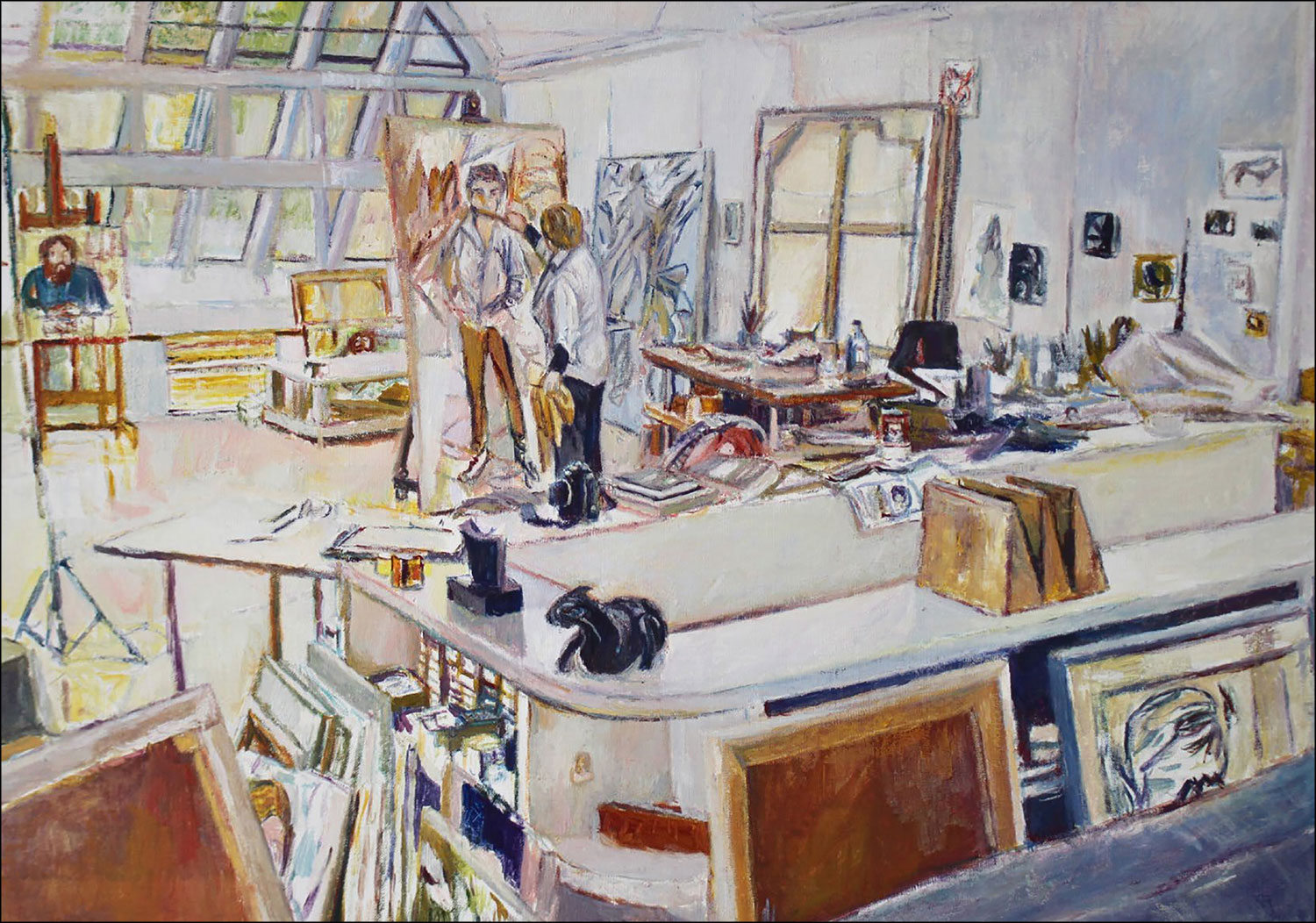
While the first painting in the series, her gravesite at Green River Cemetery, is not in the show, “to have her beckon me into the studio,” he painted an image of Elaine painting in the studio that he appropriated from a movie of her last years. He placed his easel exactly where the camera had been.
For another painting in the show, “Unerased de Koonings,” a nod to Robert Rauschenberg’s “Erased de Kooning Drawing” (1953), Mayerson appropriated a photograph by Hans Namuth of Elaine and Willem on Leo Castelli’s studio porch in East Hampton. Elaine sits and Willem stands, one of his “Women” paintings between them. Using the photograph as evidence, “Elaine tried to prove she wasn’t the women in those paintings,” Mayerson said. “The irony about that image is that she’s wearing the same cigarette pants as the woman in the painting, and she clearly is the woman in the painting.” Willem destroyed the work after he did it.
The show also includes a portrait of Pollock painted from his high school senior photograph, a plein-air painting of the Pollock-Krasner house and barn, and a remarkable painting from a famous Nina Leen photograph, taken in 1950 for Life magazine, of 15 members of the New York School. Hedda Sterne is the only woman. Mayerson’s painting now belongs to the Whitney Museum.
He painted the Pollock-Krasner property at the invitation of Helen Harrison, then its director. As for the new paintings, it was his idea to do them for the Pollock-Krasner exhibition. The original series from 2019 focuses on Elaine and Bill, “and for the current show I wanted to bring out Lee and Jackson,” he said.
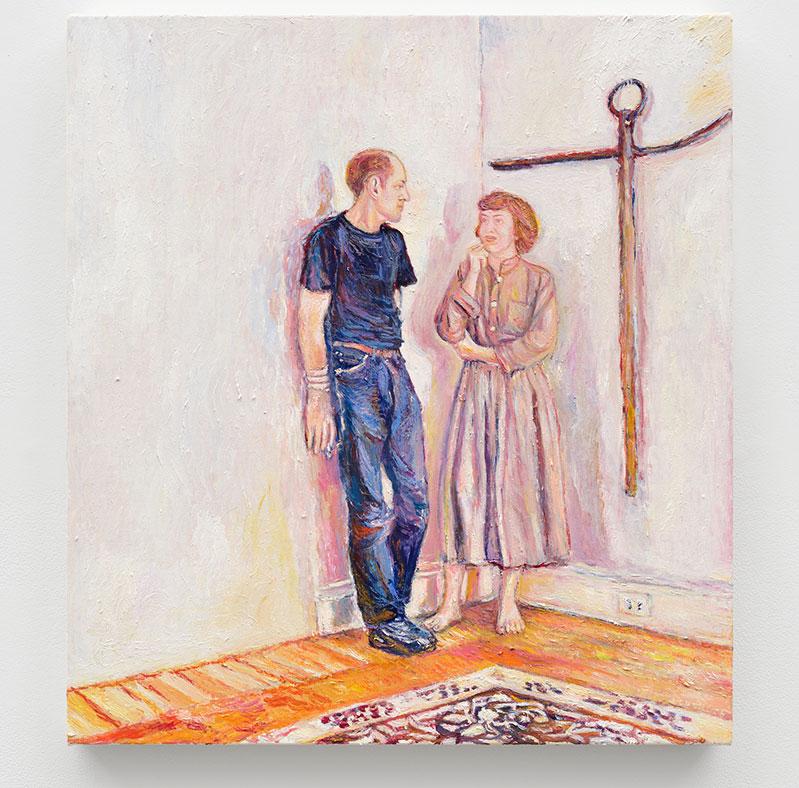
Already installed are two paintings of the couple from this year, one taken from their wedding by the artist Wilfrid Zogbaum, the other, by Namuth, of them in a corner of their house with an anchor on the wall. Of the wedding painting, Mayerson said, “I know a lot about Jackson and was very inspired by him, and of course Lee, but he was really a vulnerable guy. I think he hid a lot with his machismo, but he was so reliant on Lee and of course she helped support his career and inspired him.”
Meanwhile, Mayerson is working on more new paintings that will be added to the exhibition. One source is another Life magazine story from 1949 that asked about Pollock, “Is he the greatest living painter in the United States?” Mayerson is reinterpreting some of the paintings in that spread. “I’m immersing myself in those works and I don’t know if I’ll have to take the last one with me on the plane, but I’ll get it there.”
Citing the upcoming show of Krasner’s and Pollock’s work at the Metropolitan Museum, set to open in October, Mayerson said it was “cosmic serendipity” to try to “pay homage to them in the very place where all this happened. To have a show here was something I could only dream about in 2019.”
While Mayerson compared the Pollock-Krasner House to Memphis’s legendary Sun Studio, the birthplace of rock-and-roll, Matthew Ward, the executive director of Pollock-Krasner, said, “This site is usually viewed with such gravitas and reverence, but it’s also a living site and people come here and enjoy themselves, and there’s mirth. I like that Keith’s work puts that mirth and that light and that liveliness back into the subjects.”
Among the artifacts at the Pollock-Krasner House are a vintage turntable and receiver that belonged to the artists, and a shelf filled with the records they listened to. One suspects Mayerson will put a few LPs on that turntable when he comes to the house later this month, and perhaps be tempted to embark on another painting.
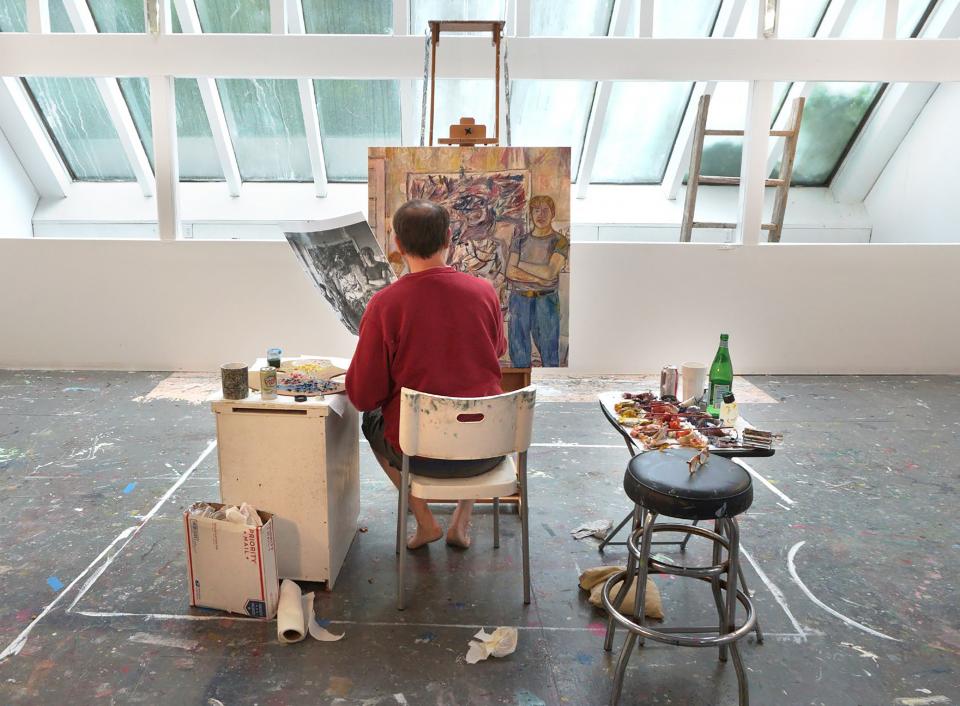
A tenured professor at the Roski School of Art and Design at the University of Southern California, Mayerson’s work is in the collections of the Whitney Museum of American Art, the Museum of Modern Art, the Los Angeles County Museum of Art, the San Francisco Museum of Modern Art, the Museum of Contemporary Art, Los Angeles, and the Cleveland Museum of Art, to name a few.
In addition, Mayerson and Byrne co-edited the anthology “Frank Johnson, Secret Pioneer of American Comics Vol. 1.” The first-ever publication of Johnson’s work, it was released by Fantagraphics in 2024.