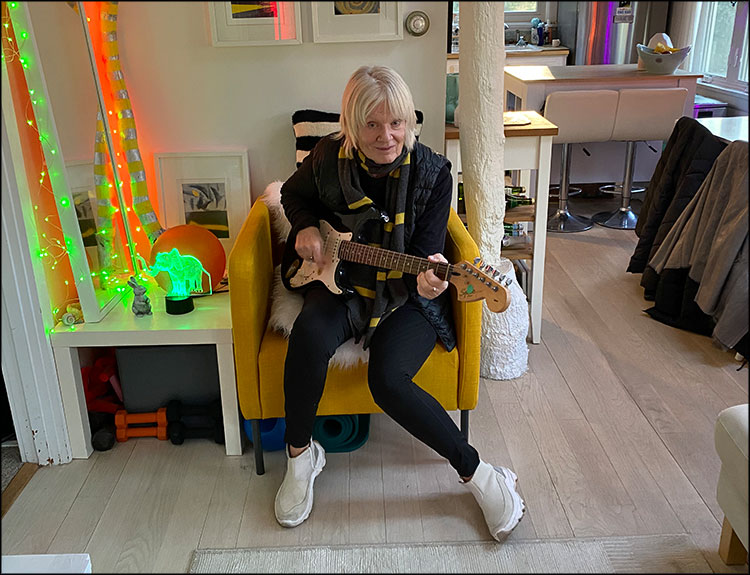
It’s not unheard of for a musician to paint or an artist to make music, but it’s rare to find both pursuits in balance. Pat Place has pursued both, sometimes at the same time, sometimes not, but, as she told a visitor to her Springs home, “Art and music saved my soul, basically.”
Still in her 20s, she was showing her work in New York City, where in 1980 her photographs were selected by Cindy Sherman for a group show at Artists Space. And that was a year after she co-founded Bush Tetras, a post-punk “no wave” band from New York that 46 years later is booked to play a gig next month at the Great American Music Hall in San Francisco. So, yeah, balance.
Both passions began in Chicago, where she was born and raised. “I was always drawing and I was also tuned into music,” she said. “I was an arty kid and kind of got into trouble, so I wound up hanging out in the art department all through high school. That was where my friends were.”
When she was 10, she saw the Beatles on “The Ed Sullivan Show.” “I told my parents I wanted a guitar, and they got me an acoustic. It had very high action, which is why I couldn’t play it, but I didn’t know that at the time. So I didn’t stick with it.”
Jump forward to 1967. “The first album I actually bought with my own money was Jimi Hendrix’s ‘Are You Experienced.’ I heard ‘Purple Haze’ on the radio and I thought, ‘What? Who is this?’ Music was so great then. But I really didn’t think of playing.”
She opted for visual art and enrolled at Northern Illinois University. Many of the professors from the Art Institute of Chicago taught there as well, and Josh Kind, whose wife, Phyllis Kind, had an influential gallery in Chicago, taught art history. “We went through the ages, and by the time we hit Dada and Marcel Duchamp, I thought, ‘This is so cool.’ ” She had had four years of life-drawing and painting classes, but she wanted to do conceptual art.
She finished her B.F.A. during the summer of 1975 at Skidmore College in Saratoga Springs, and while there she earned a scholarship to videotape the visiting artists. They included Lynda Benglis, Larry Poons, and Jackie Winsor, one of her heroes in art school.
As the program at Skidmore drew to a close, one of the other students said that she was subletting a loft in SoHo for the rest of the summer and invited Ms. Place to come as well. “So I ended up on Prince and West Broadway in the loft of Lucy Lippard,” an influential curator and critic whose books Ms. Place had read in art school.
“I just thought I had arrived. And in a certain way I had, but of course I had no money.” After the sublet was up, she got a job at Pearl Paint, a legendary outpost on Canal Street where, according to artistsnetwork.com, “any artist could get just about anything and get it on the cheap.” She worked there for a year and lived in various places downtown until, in 1977, she found a rent-stabilized apartment on Sixth Avenue between Spring and Prince Streets, which she still has.
During that period, when her brother died at the age of 28, “I lost it.” She quit Pearl Paint and, “There I am, 23, on unemployment, what do you do? You go to CBGB’s every night, of course,” she said, referring to the legendary music club on the Bowery.
“It was crazy because it was Television, the Ramones, Talking Heads, Blondie, Patti Smith, I could go on and on.” The punk bands gave way to what are now known as the no wave bands, such as DNA, Mars, and Teenage Jesus and the Jerks. The latter band was started by James Chance with Lydia Lunch in 1976. A year later he formed the Contortions, one of whose original guitarists was Ms. Place.
She met Chance at CBGB. “He asked if I played an instrument. I said yeah. But I didn’t.” She borrowed a friend’s bass and played for a couple of weeks before the band’s first gig. The Contortions played regularly at Max’s Kansas City and CBGB, and had shows in Toronto, Chicago, and Boston. “The whole thing fell apart in Paris. We got stranded because James and the band’s manager decided to keep all the money to buy drugs.”
Ms. Place and the other band members, including Don Christensen, another artist-musician, who recently moved from Springs to Italy, made it back to New York after a week of sleeping on mattresses in an empty apartment. “Don and Jody [Harris] started the Raybeats and I started the Bush Tetras in 1979” with Laura Kennedy, Cynthia Sley, and Dee Pop.
The band’s debut seven-inch EP, “Too Many Creeps,” was released in 1980 on 99 Records and reached number 57 on the Billboard club play chart. The follow-up, “Things That Go Boom in the Night,” was issued in 1981 and hit number 43 on the U.K. Indie Chart.
Also in 1981, the Bush Tetras opened for the Clash at the Bond International Casino in New York for two nights. Topper Headon, the Clash’s drummer, took them to Electric Lady Studios and produced their EP “Rituals,” which reached number 32 on the Billboard club chart.
The band toured both in the U.S. and Europe, and when they weren’t touring they were rehearsing and playing in New York and doing some recording in between. “It burned me out,” Ms. Place said. “With the alcohol and drugs in that world we all got a little messed up because we were so young.” The band broke up in 1983.
During the years between the breakup and their reunion in 1996, Ms. Place focused on painting and “making this weird jewelry, little trinkets.” She also created, starting in 1981, “The End,” a series of over a thousand photographs of end titles from movies she captured from television. In 2008 she showed photographs from that series at the Jane Kim Gallery in Manhattan.
Artinfo.com said of that show, “Presented in winter 2008, they seem full of contemporary relevance: The end of the Bush nightmare? The end of economics as we know them? That’s up to you. Regardless, it’s wonderful to have the opportunity to invite a new audience to see the work of one of New York City’s key underground figures.” The show was also recommended by Roberta Smith of The New York Times.
Another series from those years was “Rock and Roll Kisses,” made up of photographs she found online of people kissing, among them Ozzie and Sharon Osborne, Tommy Lee and Pamela Anderson, Sid Vicious and Nancy Spungen, Keith Richards and Patti Hansen, and David Bowie and Lou Reed.
After the Bush Tetras formed again, they made their first full studio album, “Beauty Lies,” in 1997 for Polygram Records. “It was really fun, Nona Hendryx produced it and she brought in Darlene Love, so we had Nona Hendryx and Darlene Love singing backup for the Bush Tetras.”

Rolling Stone called the album “incredibly tight, hardheaded, muscular, confident, hooky, and funny,” while The Los Angeles Daily News thought it “finds the band in top form, still turning out funky pop gems powered by Pat Place’s slash-and-burn guitar.” According to AllMusic, “Place’s guitar is more controlled and less slashing, though she can still work up a good old art-noise head of steam.”
While the days of nonstop touring are in the past, gigs still come to the band. In 2024 they played the Mosswood Meltdown in Oakland, Calif., which is hosted by the filmmaker John Waters. On her Instagram, Ms. Place wrote, “Had a lovely chat with John, who gave us a hilarious and grand introduction, and got to hang with the awesome Penelope Houston from the Avengers. And Fred and Kate from the B-52s,” who headlined the event. They also played in New York in October with ESG, the same band they’ll be playing with next month in San Francisco.
As for her guitar playing, when she started with the Contortions she played slide guitar, which involves moving up and down the fretboard with a metal or glass tube or a finger. “Those no-name bands all played slide, so I thought, ‘Okay, I can do that.’ “ When she started playing with the Bush Tetras, “I was just making chords up. But somehow it worked. I did eventually learn more, and when I played a lot in the 1980s with a lot of different people and different kinds of music, I learned. But I’m not trained. I just go on intuition, I pick the guitar up and trust the process.”
Ms. Place bought her house in Springs, a stone’s throw from Gardiner’s Bay, in 2011, and she swims in the bay five months out of the year.