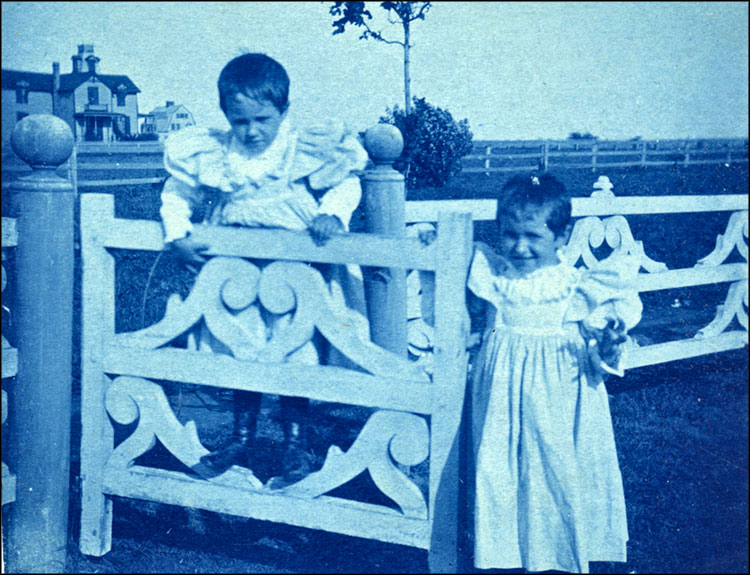
This cyanotype photograph shows Dorothy MacKay (1889-1974) and Ruth MacKay (1889-1975), the twin daughters of Emily McIlvaine DuBois MacKay (1849-1945) and the Rev. William Richard MacKay (1846-1896), playing on the gate to their house in East Hampton. The reverse of the image bears the date April 4, 1892, roughly a week before the twins’ third birthday. Beyond the decorative gate and wide-open fields, the MacKay house is visible in the background.
The twins were the youngest of the MacKays’ five daughters, preceded by Emily (1873-1974), Laura (1876-1981), and Mary (1880-1975). Other photographs from our collection of MacKay family photos and letters show the family in bathing costumes at the beach and playing tennis. Many of the photos show Cottage Avenue as a dirt road, as this one does.
While the family resided in Pittsburgh, where William MacKay was the minister of St. Peter’s Episcopal Church, they traveled each year to summer in East Hampton, typically by rail. The family rented in the neighborhood that came to be known as Divinity Hill for the numerous ministers who summered there. The MacKays bought their home on Cottage Avenue in 1887. The MacKay house, like several others in Divinity Hill, was built by the firm Dan Talmage’s Sons in the mid-1870s.
In 1896, the architect Joseph Greenleaf Thorp and George A. Eldredge, the premier builder of East Hampton’s summer colony, drew up plans to renovate the MacKay house for William MacKay. However, he died of typhoid in May 1896, which postponed the work until 1899.
MacKay family letters reveal how deeply he loved East Hampton. His family buried him in Cedar Lawn Cemetery. His wife continued to return to the house with her daughters, even after she moved from Pittsburgh to Boston. Her eldest daughter, Emily, married Julian Burroughs, whom she met in East Hampton, and went on to bring her own daughters here.
—
Andrea Meyer, a librarian and archivist, is the Long Island Collection’s head of collection.