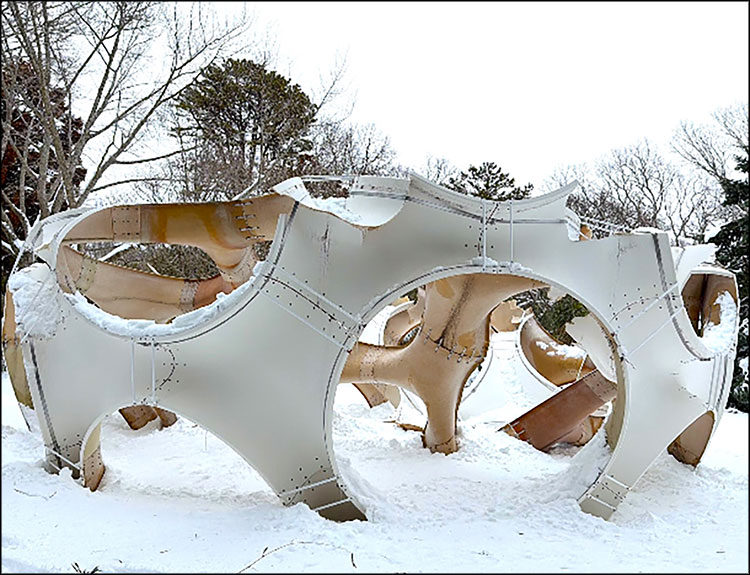
Two important cultural venues in East Hampton Town, LongHouse Reserve and the Brooks-Park Arts and Nature Center, have suffered severe damage as a result of last week’s blizzard.
Buckminster Fuller’s iconic “Fly’s Eye Dome,” produced by his student John Kulick and installed at LongHouse in 1998, collapsed under the weight of the heavy snow. One of only five extant, it was acquired in 2017 by Jack Lenor Larsen, LongHouse’s founder.
“We are shocked by the collapse of the ‘Fly’s Eye Dome,’ a monument at LongHouse that epitomizes our mission to inspire living with art in all forms,” said Louis Bradbury, president of the board of trustees. “We are working with our insurance carrier for storm damage coverage and will launch an emergency fund to restore the dome. Due to the continued pattern of heavy snow and cold temperatures, it will take time for LongHouse to assess the scope of this project and the extent of other damage to the property, trees, and plant life. Clearing and replacing the ‘Fly’s Eye Dome’ will be an enormous undertaking, at significant cost and requiring in-depth research. We thank our community in advance for patience and support.”
Alastair Gordon, an artist, filmmaker, and architectural and cultural historian, spoke about the structure at LongHouse last summer. “Fuller’s iconic ‘Fly’s Eye Dome’ was a final utopian expression of his lifelong quest to create an autonomous dwelling machine — a ‘high-performance shelter’ for the world’s housing market. He envisioned a structure that could be cheaply mass-produced in a factory and delivered to a building site by helicopter.”
Mr. Gordon went on to characterize it as “a powerful symbol of what the future might have been had we heeded Fuller’s warnings about ‘Spaceship Earth’ and its diminishing resources.”
At LongHouse, the “Fly’s Eye Dome” was not only a landmark but also a gathering place and the site of talks, concerts, sound baths, and, most recently, a site-specific installation by the artist Alice Hope.
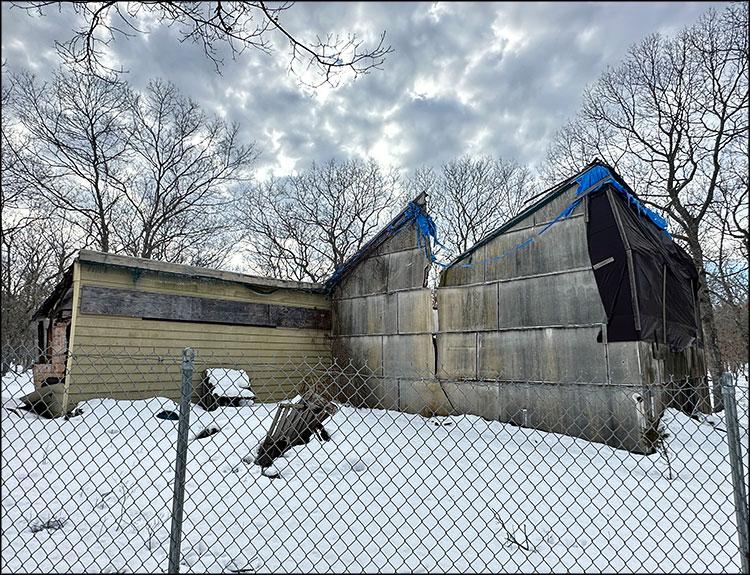
In Springs at the Brooks-Park property on Neck Path, the partial collapse of the James Brooks studio was discovered on Sunday by Scott Bluedorn, an artist and board member of the Brooks-Park Arts and Nature Center.
James Brooks and his wife, Charlotte Park, Abstract Expressionist painters and integral members of the New York School, first leased a house and studio in Montauk. After it was damaged by Hurricane Carol in 1954, they moved the cottage to their 11-acre property in Springs, and Brooks built a studio there two years later.
The parcel was acquired by the Town of East Hampton with community preservation fund money in 2013 with the intention of demolishing the existing structures. However, a group of Springs residents lobbied for the preservation of the buildings. Efforts to restore the structures continued, and establishment of the arts and nature center, a nonprofit, followed in 2022.
In addition to being designated a local historical landmark in 2014, the site was listed as an endangered historic site by the National Trust for Historic Preservation, the Preservation League of New York State, and Preservation Long Island. A chain-link fence was installed around 2023 to help limit access and deter further vandalism, but the residence has not been similarly protected.
“Given the site’s international significance — as the former home and studios of James Brooks and Charlotte Park, its status as a local historic landmark, and its recognition on regional, state, and national preservation lists — we are especially committed to working collaboratively with the Town of East Hampton to explore options for stabilization, restoration, and community use of this important site,” said Mr. Bluedorn.
Both venues will share updates as they become available.