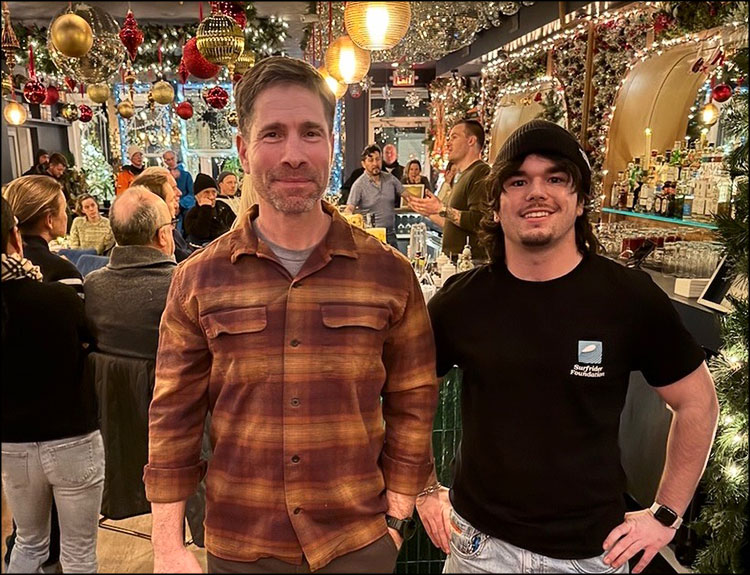
More than 40 people filled Rosie’s restaurant in Amagansett last week when the Surfrider Foundation’s Eastern Long Island chapter hosted the second in a series of surf safety sessions that covered best practices to successfully face emergencies that can arise in the water.
Lt. Col. (Ret.) Jonathan Joseph, a Marine Corps officer for more than 20 years who served multiple deployments in combat in both Iraq and Afghanistan, among other countries, and Daniel Secor, a graduate of the United States Army Special Forces Medical Program and former Navy Special Operations Medic, brought long experience to a discussion that emphasized preparation, mind-set, and teamwork in potentially dangerous situations.
“The ocean is such an unforgiving and unpredictable place,” the chapter’s Christina Blaustein said in introducing the speakers, “whether you surf, swim, paddleboard, or sail.”
“Anytime you step into the ocean, I would classify that as a high-risk activity,” Mr. Joseph said. In combat, he said, there are often “a lot of things that you can prevent from happening. I really do feel that the same applies to life and our activities.”
A systematic, disciplined approach to identifying and mitigating risk is a good place to start, he advised, suggesting that those entering the ocean ask questions such as “What’s the current like? What’s the tide like? What’s the surface wind like? What’s the size of the breakers? . . . Just things to think about as I’m visualizing what I’m
If a person is injured, “what am I going to do about it? Or, if I’m caught in that situation, what am I going to do about it? By doing that, you have a point of departure, because you’ve already thought about it, and you’re way ahead of everybody else.” Seconds equal minutes, he said, “and minutes equal life.”
Confidence, he said, comes from training and then experience, and “part of experience is understanding what your true skill level is. . . . Am I about to put myself in a situation that far exceeds my experiences and/or my training and/or my skill levels in crisis?” Fear can be healthy, he said, and confidence doesn’t always equal capability.
He discussed casualty evacuation and planning for a worst-case scenario. Regardless of the situation or its severity, “What is the plan to get to these folks and then get them to the next higher level of care?” It should be very simple, he said, “and it needs to be incredibly flexible, so that if the situation changes . . . you can still execute that plan.” When things “go sideways,” he said, “the situation rapidly devolves into chaos. Your plan will bring order to that chaos.”
A means of communication, including primary, alternate, contingency, and emergency channels — or PACE — is foremost, he said. In a crisis, assessing the situation is also important. “You always have a little more time than you think,” he said. Knowing immediate actions to take, collectively or individually, can help save a life. When calling 911, “be prepared to clearly explain where you are located.” If a surfer is injured in the water, “how do I get them from the point of injury to the beach, and then from the beach to a vehicle or the ambulance” and ultimately to an emergency medical professional. “Take action yourself,” he said, “and get the person who’s injured closer to that help that you can get them. You’re saving time.”
Mr. Secor, an upcoming graduate of the Mayo Clinic Alix School of Medicine, covered first-aid fundamentals. Reliance on those fundamentals even by those with minimal training, he said, “can have positive effect and can help people in emergency situations . . . when that help matters and it needs to be timely.”
Surfers being hit by a board, often their own, is the most common injury they face, he said. The most common injuries that land people in the hospital are “head and neck injuries, which tells me that people can have some pretty significant bleeding from lacerations, and they can have concussions.” Soft-tissue injuries and hypothermia are among other hazards, he said.
He uses the “MARCH” system, he said, to prioritize assessment and assistance. “M” stands for massive bleeding, “A” for airway, “R” for respiratory, “C” for circulation, and “the ‘H’ is a catch-all,” he said, for situations including head injury and hypothermia.
When other people are on the scene, “if you’re the one person who’s most calm, be a leader, start telling people what to do. . . . Don’t say ‘somebody call 911,’ pick a specific person and say ‘you go call 911. You come here and help me do this,’ because you can save a lot of time when you start enlisting the help of people around you.”
“Scene safety is always first,” Mr. Secor said. “The last thing you want to have happen when you’re trying to help somebody is you also get hurt. . . . You have to be a tremendously good swimmer to grab a person that is actively drowning and pull them out of the water. They will try and pull you down. . . . Is the surf super dangerous? Should you call for help before you try and help that person?”
Identifying the source of a massive bleed, and quick action, can mean life or death, he said, and may require removing a wetsuit. “First thing you do when you find that is just apply direct pressure, just push as hard as you can, right where you see the bleeding coming off them. It might not completely stop it, but at the very least it’ll slow it down.” Tourniquets are important to have on hand, he said.
Keeping wool blankets and towels in one’s car is an easy way to be prepared to help in the event of hypothermia, he said, and anyone who experiences a loss of consciousness should go to an emergency department and get checked out. “Never let perfect get in the way of good enough,” he said. “You use what you can use.”