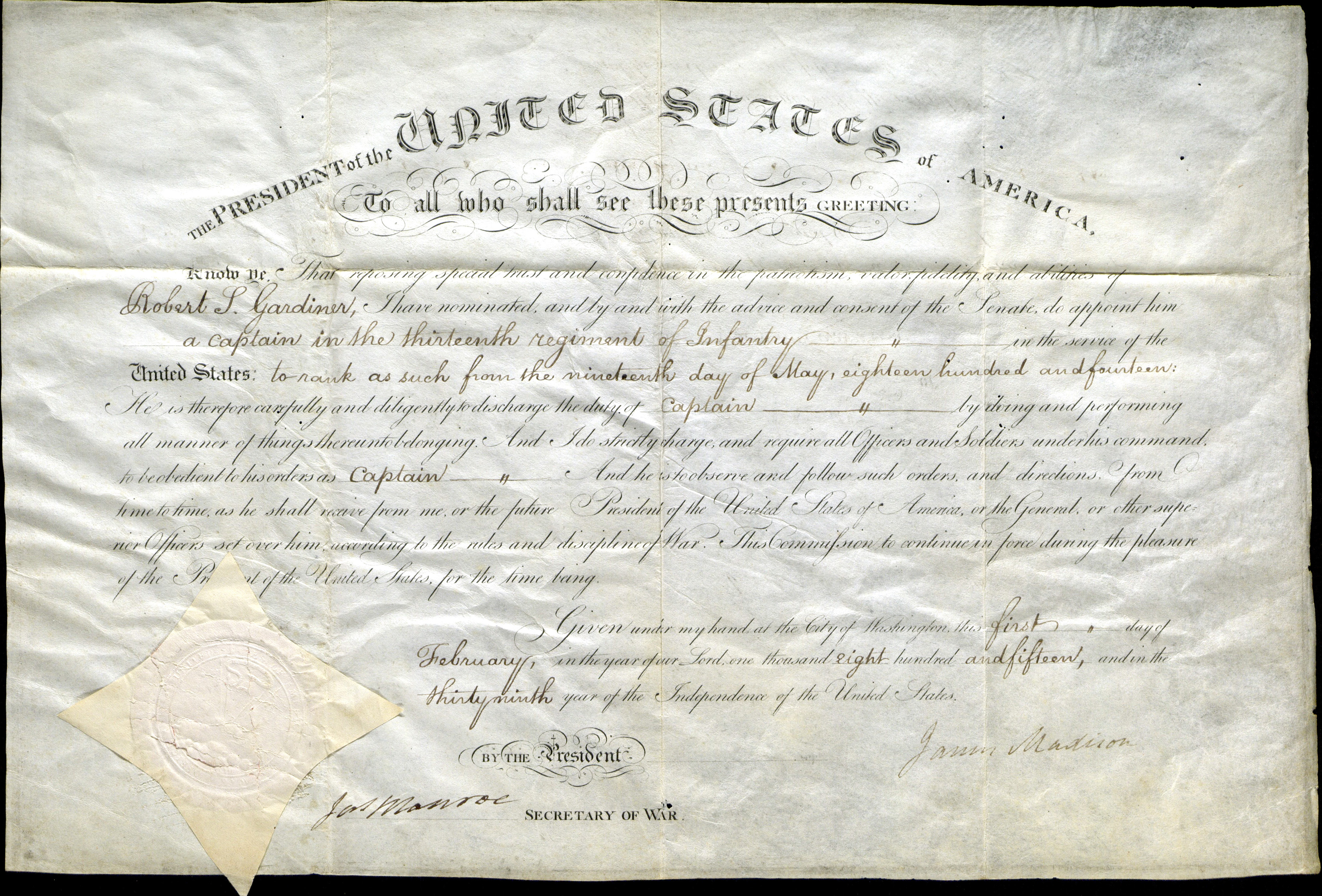
For many collectors, a U.S. president’s signature is a coveted find. This document, which appointed Robert Smith Gardiner (1786-1824) as captain of the 13th Infantry Regiment during the War of 1812, is signed by two presidents: James Madison and James Monroe. When Madison was president, Monroe served as his secretary of war, becoming president after Madison completed his second term in 1817.
Although both James Madison and James Monroe came from Virginia and had little association with eastern Long Island, Robert Smith Gardiner had strong ties to the area. Gardiner was the son of Dr. Nathaniel Gardiner (1759-1804), who was a nephew of Gardiner Island’s fourth proprietor, David Gardiner (1691-1751). His mother was Elizabeth Dering Gardiner (1762-1801), daughter of Sylvester Manor’s Thomas Dering (1720-1785).
Both of Robert’s parents came from families that worked for independence during the American Revolution. His father served in the American Army as a surgeon, and his maternal grandfather was a member of the New York Provisional Congress and Provincial Convention. Following in his forefathers’ footsteps, Robert’s service during the War of 1812 granted him the rank of captain.
Not much is known about that service or his life after the war. A July 8, 1815, letter to Sag Harbor’s customs master, Henry Packer Dering (1763-1822), who was his uncle, indicates that Robert was in western New York immediately after the war. There is little information from between 1815 and 1823 about Robert’s whereabouts or occupation, but a letter from one of his sisters, Elizabeth Gardiner Brumley (1788-1863), documents that he was living in New York City by 1823.
A year later, Robert died at 36 years old, unmarried and without children. His will granted all his “goods, chattels, and credits” to his brother-in-law, Reuben Brumley (1779-1860). The will also indicated that he had worked as an accountant at some point after the war.
Despite the gaps in Robert’s story, this document speaks both to his legacy of service and how well connected he was.
—
Megan Bardis is a librarian and archivist in the Long Island Collection.