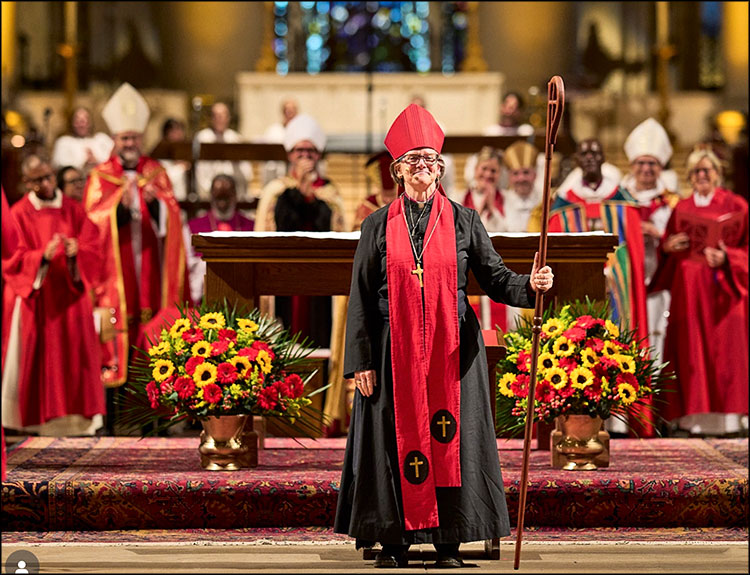
The Rev. Dr. Katrina Foster’s August 2025 return to St. Michael’s Lutheran Church in Amagansett, where she served from 2010 to 2015, was more than a visit by the church’s former pastor. It was, rather, part of a series of consultations with some 142 pastors in her new role: bishop of the Metropolitan New York Synod of the Evangelical Lutheran Church in America.
Following her election in May, her installation service took place on Nov. 22 at the Cathedral Church of St. John the Divine in Manhattan. Many parishioners from St. Michael’s and Incarnation Lutheran Church in Water Mill, where she also served from 2010 to 2015, had traveled by bus to attend the installation.
The service is archived on YouTube. “I’m playing congas when the gospel choir is singing,” said the bishop, who as pastor at St. Michael’s brought a cross-section of music into the church, as The Star wrote in a 2013 profile. At the time, she had welcomed a Sunday afternoon jam session to the church after it had outgrown the now-defunct Crossroads Music store in Amagansett Square. “After an 11 a.m. service that includes the pastor’s fervent singing on a selection of hymns,” The Star wrote, “one is likely to find her behind a drum kit, jamming with the guitar-toting musicians grouped around the church’s baby grand piano.”
Her love of music may or may not be uncommon among clergy. Her remarkable track record in reversing physical deterioration, financial decline, and dwindling attendance at the parishes to which she was assigned is, however, uncommon, as is an indefatigable nature, particularly in the service of taking the church’s message to the masses. One year ago, The New York Times dubbed her “the church fixer” in an article detailing an ambitious restoration and renovation of St. John’s Lutheran Church in Brooklyn’s Greenpoint neighborhood, where she served following her time at St. Michael’s and Incarnation.
When she arrived at St. John’s, the presiding bishop “was well into the process of closing that congregation,” she told The Star. “It is one of the most beautiful sanctuaries in New York City,” but the crumbling 1891 neo-Gothic church, The Times wrote, had “holes in the walls, plaster falling from the ceiling and loose paint chips everywhere.” Along with restoration of the church’s interior, replacement of plumbing and electrical systems, and renovation of the bathrooms, then-Pastor Foster oversaw a more than fivefold increase in its membership. “I was there 10 years,” she said. “They got healthy and financially sound enough that they could have me as a regular pastor.”
Now Bishop Foster, she oversees 160 Lutheran congregations in and around New York City, including all of Long Island and north to West Camp, a hamlet in the Town of Saugerties.
“My trip out east is part of what I do as my normal vocation as bishop,” she said last week. Until Dec. 21, “I concentrated on completing hourlong one-on-ones with every pastor on the active roster. Rather than having my pastors come to the city, I went to them where they are.” She also preaches in a different congregation every Sunday, she said. “Because I want to be as close to my pastors and our people as possible, I am constantly going out into the synod.”
“We are all walking together,” the bishop said. “What I hope we’re walking together on is this vision I had laid out for our synod to focus on evangelism — sharing the good news of Jesus, discipleship, focusing on practices Christians have done for two millennia to strengthen our faith.” And, she added, “financial stewardship, because Jesus spoke most about the Kingdom, and second most about matters of wealth. We have done a great disservice by not talking about the thing that affects people’s lives most.”
As she has transformed once-declining parishes, she is working toward “a total transformation of the congregation, moving from fear to faith, scarcity to abundance, being mute to being joyful, sharers of the good news.” She spoke of “pragmatic ministry. . . . What I have said to people is, ‘Don’t talk to me about Jesus, show me Jesus.’ If your neighbor is hungry, don’t tell him ‘Jesus loves you’ and then walk away. Because he does, I’m going to help feed you. Then we figure out, how do we stop hunger to begin with?”
That mission extends outward at a time when the New Testament’s exhortations to treat the stranger with love and respect are at odds with federal government policy regarding immigration. The bishop and her wife, Pamela Kallimanis, live in the Bronx, the borough in which she served 16 years at Fordham Evangelical Church (which, The Times noted, grew from 20 to 120 members during her tenure, but closed in 2023). “I and my wife have made a conscious decision,” the bishop said. “We will be voices of justice. That is our call.”
“On my floor,” she said, “I’ve got Christians, Jews, Muslims, atheists, families, single people. At least five languages are spoken on my floor. Living in a rich diversity, why am I supposed to be afraid of people who speak different than me? It doesn’t make sense.”
She referred to Dietrich Bonhoeffer, a German Lutheran pastor and anti-Nazi dissident who was arrested and imprisoned in 1943, and executed amid the Nazi regime’s collapse two years later. “He was one of the first to speak out against what was happening,” the bishop said. Today, “we have faithful pastors and priests and rabbis who are standing together in solidarity, together across our faiths, to point out the very basis of what is required of us.”
As bishop, she pledged, “one thing I will do in the new year is be out more” at places such as Federal Plaza Immigration Court in Lower Manhattan, the site of numerous protests against inhumane conditions and illegal detentions of migrants in 2025. Also planned are rapid-response teams, “so when [Immigration and Customs Enforcement] shows up, pastors show up with our shirts that identify us as priests, and we directly stand before ICE agents and make them see what they are doing. We will not engage in violent confrontation at all, but we will stand in solidarity with the bodies of those people whom God has made in his image and likeness, who we are so cruelly, cruelly terrorizing.”
It is her nature, seemingly, to rise to a challenge, to stand against injustice and inequality. In 2007, she risked being defrocked by disclosing that she had married Ms. Kallimanis in a religious ceremony. At the time, the Lutheran Church allowed openly gay pastors but forbade same-sex relationships. “When I came out on the floor of our churchwide gathering,” she told The Star in 2013, “I put myself right in the cross hairs.” Ultimately, she said, bishops “put together a Band-Aid resolution that basically said, ‘Bishops may choose to not defrock an otherwise qualified candidate or pastor.’ It was a small Band-Aid; it was a huge step forward.”
“The only thing that helps me to make sense of the world,” she said last week, “is by being of maximum loving service to God and neighbor. When we do that collectively, we are absolutely wealthy, healthy, and free. Any time we reject that, we are poverty-stricken, sick, and enslaved.”
As bishop, she is regularly among the people, the congregations, the pastors, and the churches. “What I am interested in,” she said, “is, can we concentrate people and resources in a catchment area and really grow those around evangelism, discipleship, family ministries, and places we left behind, as it were.” This may include the building of affordable housing, such as happened at St. Michael’s during her time there, and day care centers. That, she said, “meets a need and is income-producing to support the ministries. Those are really long-term visions, goals that can only happen when there is trust and buy-in.”