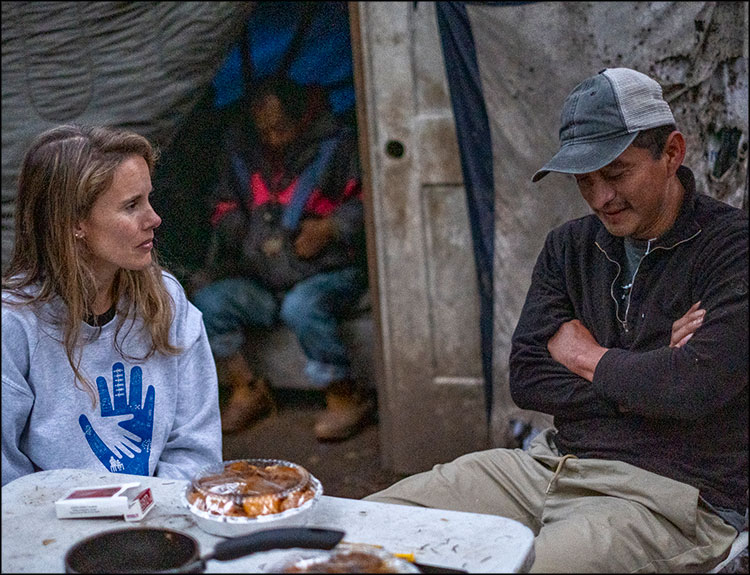
Soon after moving to Water Mill with her family in 2015, Marit Molin became aware of a largely unacknowledged population underpinning the complicated Hamptons economy.
“I was just very surprised about the level of poverty that exists,” Ms. Molin, a social worker originally from Sweden, said last week. “So many people just think of it as a very wealthy place, and it is, but there’s also a lot of people that struggle.”
In the summer of 2018 she founded Hamptons Art Camp, for children between the ages of 6 and 12, after noticing local children spending their high-season vacations in their parents’ cars at job sites. Forty percent of campers attended tuition free.
With the onset of Covid in early 2020, Ms. Molin shifted her focus. “I reached out to different communities and told them that I couldn’t fund-raise for the camp, but asked what I could do to help them,” she said. “And all of them said they needed food.”
She began by raising funds to buy meals from local restaurants whose patronage had dropped dramatically during the pandemic, which she would then deliver to the struggling communities — simultaneously creating work for kitchen staff who would otherwise have been laid off, and providing hot food to locals in need. The camp morphed into Hamptons Community Outreach, which is dedicated to meeting basic critical needs to help break cycles of poverty.
“And the more I was out in the field meeting people,” Ms. Molin said, “the more I found out about the needs.”
In December 2022, she learned of a homeless encampment in the woods of Southampton, where a group of laborers were sleeping outside in tents in dangerously low temperatures. “It was so incredibly cold, I couldn’t even believe it,” she said. “I visited them, and since then I’ve been getting to know this community very well.”
The main problem, she recognized, is the lack of affordable housing here. A day laborer working four to five days a week can make about $1,600 per month, Ms. Molin estimates, but it is almost impossible to find a place for even $1,000 a month anywhere in the vicinity. “It’s just very hard for people to break through.”
Hamptons Community Outreach is now divided into four programs: food delivery, home repair, crisis intervention, and child-centered outreach. Each is focused on offering specific practical support where it is most needed, sometimes through direct appeals on social media.
“Our client is in need of a bike in order to get to his job as a day laborer,” read a post on the organization’s Instagram page in September. “Wheel size 26. He would prefer wide tires, as he will be biking to work throughout the winter. Can you help?” A month later, an update informed followers that the man had received an e-bike, allowing him to commute from Southampton to Sagaponack for work “safely and on time.”
“It’s not complicated with them,” said Eric Komoroff, an owner of Barryville General, a specialty food market that also sells a selection of apparel and home goods. He met Ms. Molin in August 2024, while opening the store’s Southampton location with his wife and their business partner, and they have been working with Hamptons Community Outreach ever since.
“Almost immediately after we opened, we arranged for weekly donations of food that was either sitting on the shelves, that we had extras of, or things that maybe had only a few days left until the best buy,” he said. “We knew that by giving them to Marit they would be eaten immediately, because she serves a community that’s so in need.”
Last month, when it came time to move out of Barryville’s original location on Hill Street, Mr. Komoroff had to figure out what to do with their inventory until they reopened in a new location. “It happened to be right before Thanksgiving, and there also happened to be that horrible food stamp problem going on in the country. And so we just thought, the food has already been paid for — why don’t we just make a big donation of all of this?”
He texted Ms. Molin, and she started sending over families who’d been cut off from their SNAP benefits. “It’s a humbling experience, if you’re hungry. And we would say, just take a cart, you know. Take whatever you want,” he recalled. “And that just felt very real and connected — it was real people helping other real people in the ways that we could. We happened to have food, so that’s what we could do, and Marit was the facilitator of that.”
The evening before the store closed, volunteers helped pack up everything left on the shelves, ultimately filling seven trucks with food that Hamptons Community Outreach was able to distribute just before Thanksgiving. “Sometimes you give things to organizations and you feel like maybe it’s sitting in a warehouse somewhere,” Mr. Komoroff continued, “and that’s not the case at all with them. The food immediately goes to people who need it.”
In addition to the organization’s specific needs highlighted on Instagram, Ms. Molin says they can always use donations of warm coats, gloves, sweaters, pants, socks, work boots, and backpacks. They welcome any local businesses and professionals willing to volunteer services — doctors, dentists, restaurant owners able to donate leftover food at the end of the day — which the group will help facilitate.
They can always use funds, of course. They have worked out a discounted rate of $150 per night at a motel in Southampton; each room can provide three people with emergency shelter when temperatures are particularly dangerous. The motel also houses their “shower events,” where people who have been living without shelter can take showers, get haircuts, see a nurse, and pick up food and warm clothing.
Many of their clients need legal help, too — Ms. Molin has heard from multiple laborers who were denied pay at the end of a workday, for example. She was recently contacted by a woman who was sold a car that broke down within two weeks — but that falls outside of the organization’s services.
Notably, they provide assistance regardless of immigration status — no questions asked — a point for which Ms. Molin has received criticism.
“We don’t focus on that,” she said. “We focus on their needs. We have neighbors that are struggling, and I am focusing on helping those struggling neighbors. Our job is to reduce human suffering, and we will help everyone.”