Turns out, it’s not just Santa who is keeping an eye on you.
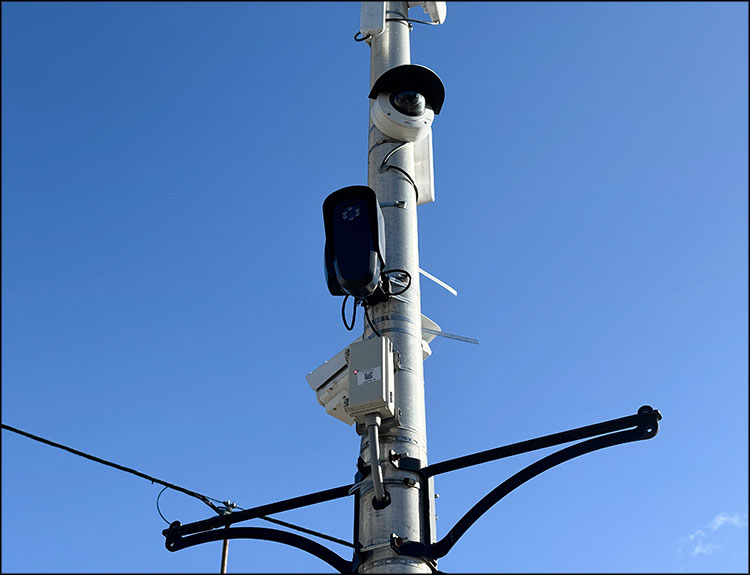
East Hampton Village is now home to 14 Flock license plate reader surveillance cameras, which amounts to one for every 108 full-time residents, if you go by the 2020 census data.
The data they receive from passing vehicles is retained for 30 days, as it is by Suffolk County.
Most of the cameras, 10, were installed last winter and were paid for by the East Hampton Village Foundation.
The idea to place them came from Edward Pantzer, a member of the foundation’s board of directors. He owns a house in Palm Beach, Fla., and last December, told the East Hampton Village Board that they were effective in stopping crime.
Ten might feel like a lot in the small village (five square miles), especially given the fact that East Hampton Village (like Palm Beach) has a very low crime rate, significantly below the national average for violent and property crimes.
The other four cameras in the village were installed by Suffolk County.
The technology the Flock cameras use has proven controversial nationally with those concerned about civil liberties. Others have questioned how they’re being used by United States Immigration and Customs Enforcement. They’ve even sparked some recent lawsuits.
San Jose, Calif. (180 square miles), has 500 Flock cameras, about one for every 2,000 residents, and the municipality is being sued by the American Civil Liberties Union, whose lawyers claim “the city’s nearly 500 cameras create a pervasive database of residents’ movements in a surveillance network that is essentially impossible to avoid,” according to 404 Media.
At the same time, they’re heralded by local police, who credit them with better enforcement and faster investigation solving.
“I don’t see it as a civil liberties issue,” said Jeff Erickson, the chief of the East Hampton Village Police Department. “You’re driving on a public road. The technology has helped us solve crimes quickly. I think it acts as a deterrent. We have cameras at every entrance and exit. I think it’s fantastic.”
Jennifer Dunn, a detective sergeant in the department, said that since April when the cameras went live, they’ve aided in 70 arrests, mostly for drivers who are unlicensed or have suspended registrations.
“If there’s a warrant out for someone that’s logged in the system, for example known gang members, patrol officers will get alerts in real time within seconds of a car passing a camera,” Sergeant Dunn said. The cameras have also helped find missing people.
The East Hampton Village Police Department is able to filter out certain queries. “Immigration-type searches or reproductive care, it’s not used here for that,” she said. “They’re not getting hits from our cameras using those reasonings. We are not sharing data with ICE, for example.”
Suffolk County Chief Deputy Sheriff Christopher Brockmeyer has said the county got involved with Flock after it was approached by the company. It received 25 cameras in a pilot program and has since expanded to over 60 cameras across the county.
“The technology has proven useful,” he said. “We worked with our partner agencies to pick locations to deploy the initial 25. Since then, we received a grant from the state that allowed us to deploy a larger number. We continue to work with partner agencies to further pick locations.”
If an officer is conducting an investigation, he or she may “query” the Flock cameras for a specific license plate. Often witnesses don’t get a full license plate number, however. The Flock technology can detect other details about a vehicle, such as make, model, or other unique markers like bumper stickers or roof racks.
The technology was instrumental in solving a grand larceny case at Louis Vuitton in East Hampton Village. The thief drove away in a red Jeep with a Trump bumper sticker, but no one got a license plate number. The other descriptors were enough for Flock.
“There was one choice. We were able to go right to the house and get the products back,” Sergeant Dunn said.
Another time a rented bike was left unlocked overnight at Main Beach. It was reported stolen. The Flock camera picked up someone taking the bike and placing it in their car.
“We backtracked from there,” said Sergeant Dunn. “We were able to get the license plate. We contacted the subject. He had brought the bike back to Khanh Sports where it was rented. That one had a happy ending. We’re not just randomly looking up anything. No one has the time for that,” she said.
Victims have also learned to use the Freedom of Information Act to query the cameras at specific dates and times to determine who might have caused a hit-and-run. “We don’t want people getting away with causing damage and leaving the scene,” said Sergeant Dunn.
“It’s a tool, just one of many we use,” Deputy Sheriff Brockmeyer said. “It speeds up the process of investigations when it comes to solving crimes. Especially when you don’t catch the person on the scene that committed the crime. Feedback from our partner agencies has been very positive.”
Minerva Perez, executive director of Organizacion Latino Americana, understands the law enforcement component to the Flock program, but nonetheless is concerned about transparency and the process of how officers retrieve the data.
“Every one of those queries needs to be a list that is public and published,” she said. “If there is an active investigation, maybe that becomes a FOIL request, but there needs to be transparency. There should be nothing to hide. If it’s working well on the enforcement side, it also needs to work well on the accountability side. What does the process look like before the village says ‘Yes’ to sharing their data?”
“We have to put a reason in before we access the data,” Chief Erickson said. “Our dispatchers have access to the system. Our patrol officers have access.”
“In anything we do, especially in law enforcement, we have to be careful that the mission and the means to get it accomplished isn’t trampling on the rights of the people,” Deputy Sheriff Brockmeyer said, noting that the sheriff is an elected official.
“You lose the support of the people if it devolves into something unintentional. As chief deputy, we’re there to serve and protect the public, not to follow their movements each and every day, that’s not the intent of the tech,” he continued.
“It’s not like we’re tracking people’s movements indefinitely. These cameras don’t have facial recognition. It’s vehicle-based only. Of course, as A.I. becomes more advanced, that’s something we’ll be discussing in the near future. The capability is there.”