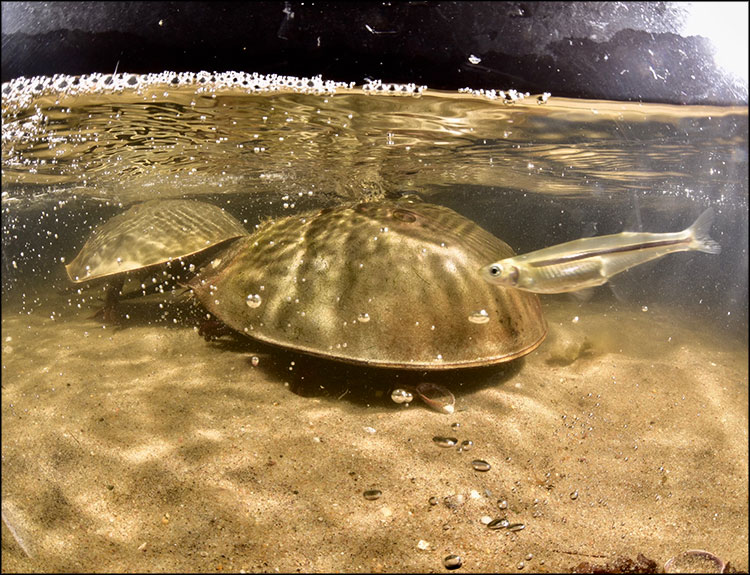
One year after vetoing similar legislation, Gov. Kathy Hochul signed the Horseshoe Crab Protection Act on Friday, which will phase out the harvesting of the ancient species for bait.
The Atlantic States Marine Fisheries Commission rates New York’s horseshoe crab population as “poor” since 2019, and a 2025 study by the Maritime Aquarium, a Norwalk, Conn., aquarium focused on Long Island Sound’s ecosystem, found annual reductions in the population of 2 to 9 percent there.
The Horseshoe Crab Protection Act amends the state’s environmental conservation law to extend the authority of the Department of Environmental Conservation to manage crabs by enacting the prohibition.
“Horseshoe crabs are a vital keystone species to New York, often called living fossils, and are important to our environment,” the governor wrote in a memorandum on Friday. “Last year, I vetoed similar legislation due to concerns that this bill could have unintended consequences on the commercial fishing industry and biomedical advancements.” The effective date of the bill “did not leave those industries enough time to transition to alternatives.”
“I have reached agreement with the Legislature to enact changes to allow for such a transition,” the governor wrote. “On the basis of this agreement, I am pleased to sign this bill.” The bill she signed had passed overwhelmingly in the Assembly and Senate in June.
The law mandates a 25-percent reduction of the annual quota of 150,000 in 2026, a 50-percent reduction in 2027, and a 75-percent reduction in 2028, before taking full effect in 2029.
In New York, where all permitted harvesting of horseshoe crabs is for fishing, a primary cause of their depletion is for bait to catch whelks and eels. Medical harvesting is prevalent in Delaware Bay, where the crabs’ unique blue blood is used by the biomedical industry to test for infection-causing bacteria in injectable drugs. A synthetic alternative has been developed and is in use, however.
New Jersey adopted a moratorium on the harvesting of horseshoe crabs in 2008, and Connecticut adopted stringent regulations to boost the crab’s populations in 2023.
The environmental advocacy organization Save the Sound applauded the passage of the Horseshoe Crab Protection Act, saying in a statement on Saturday that it “mirrors the protections already in place in Connecticut, creating consistent conditions around the entire coast of Long Island Sound to support the restoration of this 450-million-year-old species across our region.”
A D.E.C. sampling showed a sharp decline of the horseshoe crab population in the Peconic Bay system from 1992 through 2022. But for the past few years, the East Hampton Town Trustees, who conduct annual surveys of horseshoe crab populations in Northwest Harbor and Napeague Harbor, have documented numbers that oppose that decline.
“The trustees wrote a letter in support of her original decision,” Jim Grimes, a deputy clerk of the trustees, said of the governor’s 2024 veto of legislation to phase out harvesting of horseshoe crabs. The governing body, which has jurisdiction over most of the town’s waterways and bottomlands outside of Montauk, reiterated its position to the governor more recently, Mr. Grimes said.
Of the law’s passage, which was sponsored in the Assembly by members from New York City and Westchester County, Mr. Grimes said the trustees “thought it was unfair and probably inaccurate to point the finger of blame at our local fishing community, and the issue of harvesting horseshoe crabs for medical purposes has never occurred in New York. It’s a nonissue.”
The law, he said, “very simplistically identified the baymen as a culprit in the decline of the population. . . . We’re not even sure that’s the case locally, because if you take the data that our board has collected over the last 10 years, in the last four years the counts that we do annually during breeding season have increased exponentially.” The highest nightly counts in the annual surveys have increased from around 300, four years ago, to more than 2,200 this year, he said. “It contradicts the population projections,” he said, while acknowledging that “that’s data collected only over four years.”
“It’s unfortunate for the local baymen,” Mr. Bock said, “especially considering how our observations conflict with the claims of the bill’s sponsors.”
“It’s like so many things,” Mr. Grimes said. “It’s very easy to have that feel-good moment — ‘we’re going to help the environment, prohibit the harvesting of horseshoe crabs for bait’ or whatever. I get that, but at the same time, what I cannot ignore is the impact it has on people — families and local individuals that I know and grew up with. If it’s being done with a good purpose at the end, I can stomach it, but if it’s being done to satisfy some Queens and Brooklyn council people to make them look good to their constituents, I have a problem with that. To me, that seems very unfair. I have a hard time looking some of our local baymen in the eye on something like this and saying it was a good move.”
Mr. Aldred pointed to habitat loss as a driver of horseshoe crabs’ decline. “One thing that’s not mentioned, unfortunately, that I think is a very significant contributor, is development, the use of the shores by people,” he said. “That was never mentioned” in discussions as to reversing the species’ decline.