Some people seem to want you to feel bad about missing New York’s glory days. “You just had to be there,” they’ll say gleefully, memories of their 20s made even sweeter held up against your sorry excuse for a youth. “There was a different energy.”
From the vast countercultural heights they climbed in the ’70s, these East Village veterans survey the city’s descent into yuppie hellscape with satisfied contempt. They rubbed shoulders with Basquiat at SoHo lofts, and you’re waiting in line to get into the Museum of Ice Cream. They saw Patti Smith play to an intimate crowd at CBGB; you’re watching a projection of Renee Rapp from the nosebleed section of Barclays Center. They danced with abandon till dawn at Studio 54; you sway self-consciously to “Sweet Caroline” with belligerent frat stars at Paul’s Casablanca.
Having missed the window, they suggest, you sadly won’t ever know the meaning of fun.
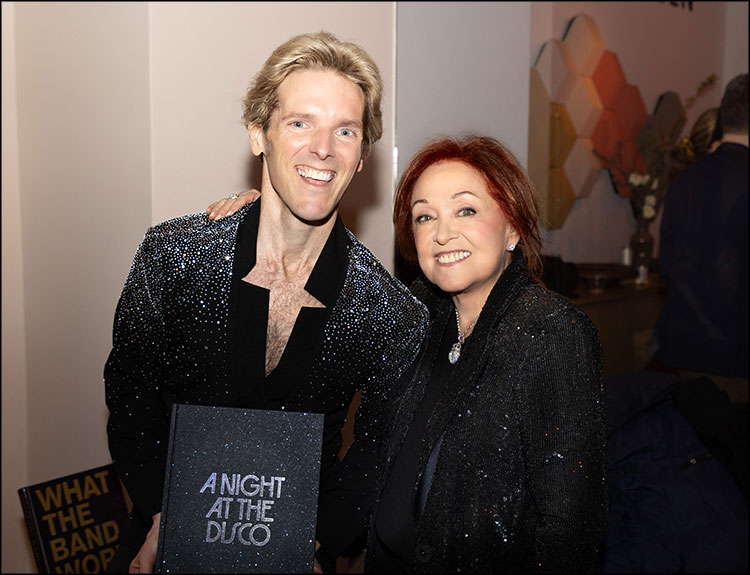
The authors of “A Night at the Disco” do not do this. Rather than falling into blind sycophancy that assumes a chasm between the disco era and everything else, Alice Harris and Christian John Wikane situate it inside a historical context of musical cross-pollination. In so doing, they are able to pay tribute to an admittedly special age without insisting on its exceptionalism.
Released by ACC Art Books in March, Harris and Wikane’s second collaborative coffee-table book (the first, “What the Band Wore,” from 2023, made it onto The Wall Street Journal’s 2026 list of the 20 best coffee-table books) surveys the evolution of disco music from 1970 to 1979. The authors take a loose definition of the genre, extending its boundaries beyond classic anthems like Donna Summer’s “Love to Love You Baby” and Cheryl Lynn’s “Got to Be Real” to include all the popular four-on-the-floor tracks that jockeys spun at discotheques in the ’70s.
The book marks the beginning of disco’s golden age with Sly & the Family Stone’s “Dance to the Music,” and then follows contributions to the genre throughout the decade by artists like James Brown, the Jackson 5, KC & the Sunshine Band, Village People, and Parliament-Funkadelic. By ordering artists chronologically — based in part on polling that Vince Aletti, a journalist, compiled in the ’70s of what D.J.s across the country were playing — the book gives the reader the impression of disco as a patched quilt, sewn together through close contact of diverse influences.
“There was this groundswell of innovation that was happening in the discotheques,” said Wikane, a music journalist and East End native. “So as the decade progresses you see that artists like Herbie Hancock, who, even though we think of him as jazz-fusion, was also experimenting with a beat that kind of owed itself to what was happening in the clubs — that sort of a four-four beat. And then at a certain point even the Rolling Stones were recording songs that had a club influence.”
To Wikane and Harris, disco as music is inextricable from disco as club. It’s a confluence of factors — open space, enthusiastic crowd, dim lighting, danceable rhythm — conspiring to swallow up the individual into a larger whole.
“It’s fantasy. You sort of escape to this other place,” Wikane said. “When the syncopation is all around you and you’re dancing, it’s like you yourself become a percussion instrument.”
“It’s about freedom,” said Harris, who worked at Casablanca Records in the ’70s and has resided in East Hampton part time since the late ’90s. “Freedom to dance, freedom to express yourself, freedom to move, freedom to just exhibit your inner soul.”
Readers can glimpse this freedom through the book’s beautiful, high-resolution photographs, some of which are sourced directly from the artists themselves and have never been published before.
The overall effect is not one of wistful nostalgia, but rather hopeful celebration. The party doesn’t have to end, and by breaking down some of the elements that contributed to disco’s heyday, “A Night at the Disco” encourages readers to continue to chase the freedom and abandon that defined the era.
“I mean, look at the young crowd today,” Harris said. “Look how everybody’s jumping around to Bad Bunny and Harry [Styles] and Sabrina Carpenter and Dua Lipa. Alfa Anderson,” the late singer of the band Chic, “says that the world puts you in a box, but when you’re on the floor dancing and you grab somebody’s hand, it doesn’t matter whose hand it is.”
Wikane will discuss the book with Khary Simon, vice president and executive creative director at Hearst, at BookHampton in East Hampton Friday at 6 p.m. Tickets are $10.