A chat with August Gladstone, a Springs native at present living in Los Angeles, brings to mind Walt Whitman’s 1855 “Song of Myself” and its defining declaration, “I am large, I contain multitudes.”
Fifteen months ago, the recent Emerson College graduate told The Star that he had moved to Los Angeles to launch a career in film, television, and comedy. He did just that, and then added poetry to his disciplines. He is also a musician, songwriter, and clown, he said.
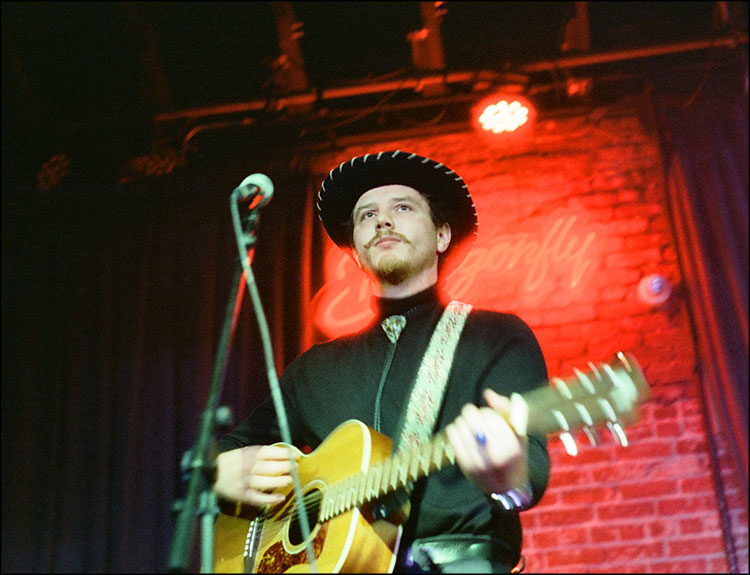
Lately, music and songwriting have come to the fore. Mr. Gladstone will perform music from his upcoming album, “The Golden West,” and his 2025 EP, “Commodore,” on Sunday at 6 p.m. at the Masonic Temple in Sag Harbor. Performing with him will be Paul Vespe, a longtime friend, on guitar, and Mr. Vespe’s sister, Liz Vespe, on fiddle. Tickets are $20 and available at masonicmusicseries.com and at the door.
Directing his creativity toward music was an outgrowth of his poetry, which itself was a means of escape from the pressures of screenwriting, he said. “I went to school for screenwriting, and did a lot of sketch comedy in school with the goal to be a comedy writer. That was really my first brush with writing. I came out to Hollywood, started working in the industry, and realized there was such a logjam in that world. My means of escaping was writing poetry, which I felt was much more immediate and acceptable. I could share something, and the work had immediate value.”
“Then I realized,” he deadpanned, “that nobody reads poetry.”
With inspiration from Leonard Cohen and Jim Morrison — Morrison and the Doors’ largely spoken-word “An American Prayer” “hit me at the right time,” he said — as well as Townes Van Zandt, Bob Dylan, Woody Guthrie, Blaze Foley, and the Canadian indie band Timber Timbre, his poetry transitioned to lyrics.
When a listener to the folksy, organic “Commodore” offered the observation that the music is at once earnest and ironic, Mr. Gladstone readily agreed. Storytelling and comedy, put to music — he contains multitudes, after all. In “Priestess,” for example, he sings of a woman he found “singing train-car sermons / Several shots deep from a flask of religion / I got to talking about yearning / She told me to shut the fuck up.”
Upon the nobody-reads-poetry realization, he said, “I started setting poetry to music, taught myself guitar — a couple of cowboy chords — and progressed from there. But really, I try with my songs and my poetry to always walk the line between humor and irony and sincerity. I like my work to vacillate between the highs and lows of human experience. That’s the most honest way I can be with myself as an artist and as a person, trying to embrace the complexity and back-and-forth nature of what it’s like to live.”
He does still work in film. “The Law Brothers,” an independent comedy pilot that he wrote and stars in, was released on YouTube last month. “I’m trying to do it all, all the time,” he said. “I am a performer at heart, growing up with my parents,” Josh Gladstone, the creative director of LTV Studios, and Kate Mueth, founder of the performing arts and social advocacy organization Neo-Political Cowgirls. “I feel very comfortable performing, it’s second nature to me. Going to school for more structured film writing, and the production I did, I haven’t lost the passion for that. But over the past six months or a year, music has been going really well. It is my preferred means of expression, because I feel like it’s the perfect combination of everything I care about. I can make a song that’s funny, poetic, meaningful, and don’t have to sell it to Netflix to have people see it.”
Music is going so well, in fact, that he is now working with the producer and musician Mark Hart, who was a member of Supertramp and Crowded House and has toured with Ringo Starr. He is a “renowned musician who’s reached incredible heights of success,” Mr. Gladstone said. Mr. Hart produced “Commodore” and “The Golden West,” and Mr. Gladstone has written lyrics for Mr. Hart’s projects. The producer is “a saint, a mentor, an incredibly kind and giving person,” Mr. Gladstone said. “He has 50 years’ worth of guitars next to gold records. I’m where I need to be.”
In a world where “everything is so digitized, and everyone is trying to make themselves as identifiable, recognizable, and commodifiable as possible, I want to make work that is a little off-kilter, offbeat, stuff you’re not necessarily going to see from other people,” he said. “Even if that is with the trappings of a traditional-sounding folk song, I want there to be some aspect which is toying with absurdist comedy, or some strange element of melancholic fantasy storytelling.”
Last summer, he was an artist in residence at the Woodstock Byrdcliffe Guild. “It’s the oldest and longest-running residency program in the country,” he said. “It’s what jump-started my career in terms of taking a chance to marry the different aspects of myself, which had been developing separately, to one comprehensive person. I wrote a book of poetry, a couple of songs, and it was amazing. It was beautiful and freeing and gave me so much space to explore my own expression.”
About Sunday’s performance at the Masonic Temple, “There’s no venue so unique, interesting, and steeped in the culture of Sag Harbor and our community,” he said. “I’m honored to be playing there on the winter solstice — this new album is very spiritual and existential, and very much about faith, whether religious faith or faith in living.” The temple, he said, is “a perfect, strange, offbeat, surreal venue to house this style of folk.”
“I’m excited to be sharing my work,” he said. “I hope people will tune in, that their interest is piqued, and they will check my website,” augustgladstone.com, “my film and poetry and music, all in one. The arts are my life, and I want to be as involved with them as I can.”
—
This article has been changed from its original and print versions to correct the time of Mr. Gladstone's performance, which will be at 6 p.m.