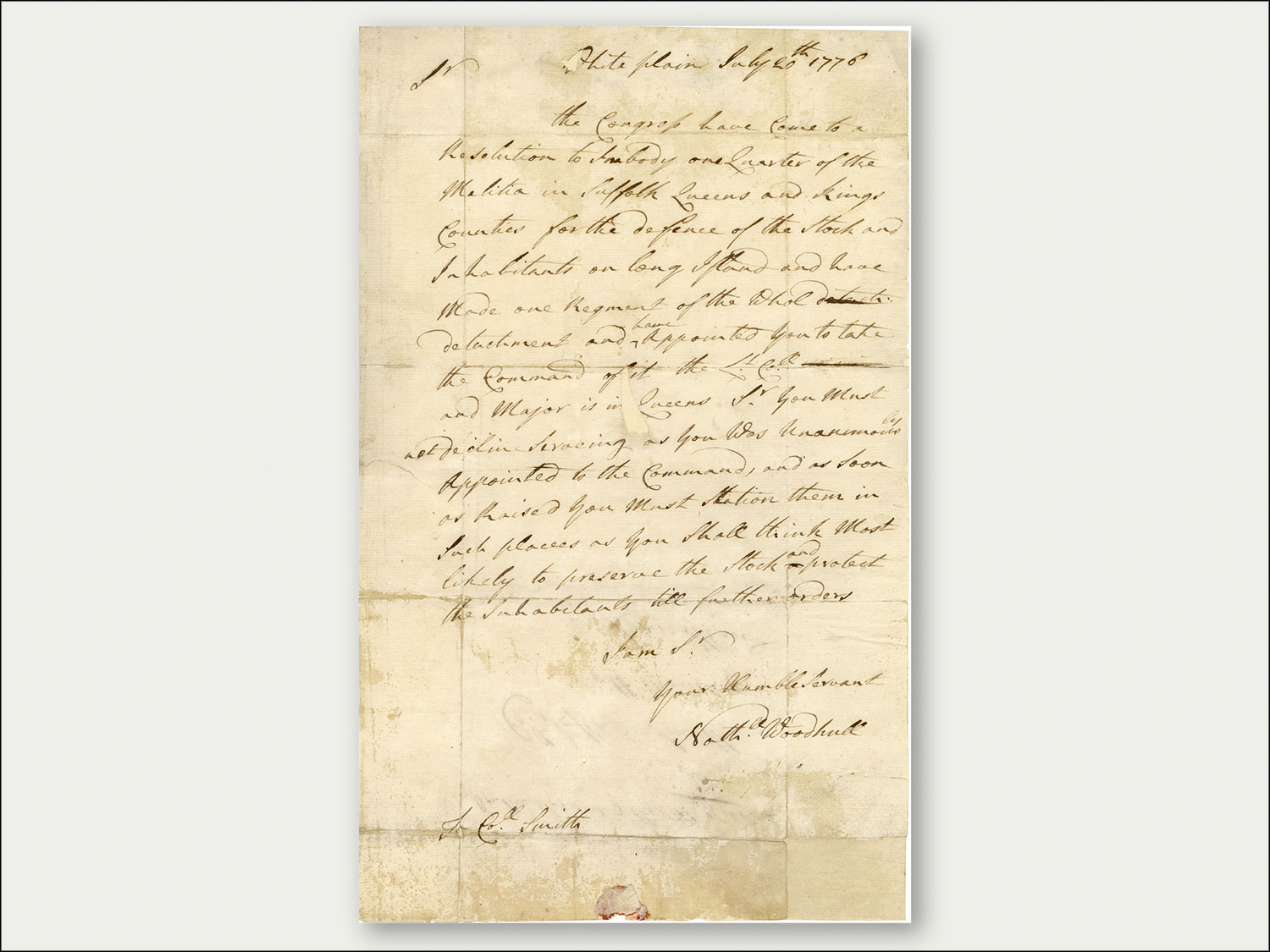
This letter, written 250 years ago by Gen. Nathaniel Woodhull (1722-1776) of Mastic to Col. Josiah Smith (1723-1786) of East Moriches, is dated July 20, 1776. At this point Woodhull was both the president of the New York Provincial Congress and the brigadier general of the New York Militia.
Woodhull informed Smith that the Provincial Congress had activated a quarter of the militia from Suffolk, Queens, and Kings Counties and combined these troops in one regiment under Smith’s command “for the defence of the Stock and Inhabitants on long island.” Woodhull insisted, “Sir, You Must not Declin[e] servicing. . . .” Which hints at how huge an ask this order was.
The situation was dire — the Continental Congress had just declared independence, and the mightiest navy in the world was anchored off Manhattan, poised to invade. More than 280 ships amassed near where the Verrazano Bridge is now, looking as though “all of London was afloat.” Smith was ordered to station his new regiment where it could best protect livestock and inhabitants from British forces.
A number of East Hampton farmers and weavers, like those in Capt. Ezekiel Mulford’s company muster roll, with familiar names like Baker, Conklin, Dayton, Dominy, Hand, Isaacs, Miller, Sherrill, and Stratton, moved with Smith toward the armada marauding Manhattan.
Between Aug. 22 and Aug. 29, Smith and his regiment witnessed extensive fighting during the battles for control of New York City and Long Island. Following a chaotic American retreat, Smith’s regiment disbanded and returned home. With Long Island’s occupation, Smith was captured, imprisoned, and later paroled. Like many of his men, he spent years as a refugee in Connecticut. Smith fared better than Woodhull, who was mortally wounded on Aug. 28, while driving cattle east from Brooklyn to keep them from falling into British hands.
In honor of our country’s 250th anniversary this July 4th, consider visiting the Mulford Farm or joining East Hampton Town and Village Historian Hugh King and the East Hampton Historical Society on a walking tour to see where some of East Hampton’s patriots lived during the Revolution.
—
Andrea Meyer, a librarian and archivist, is head of collection for the Long Island Collection.