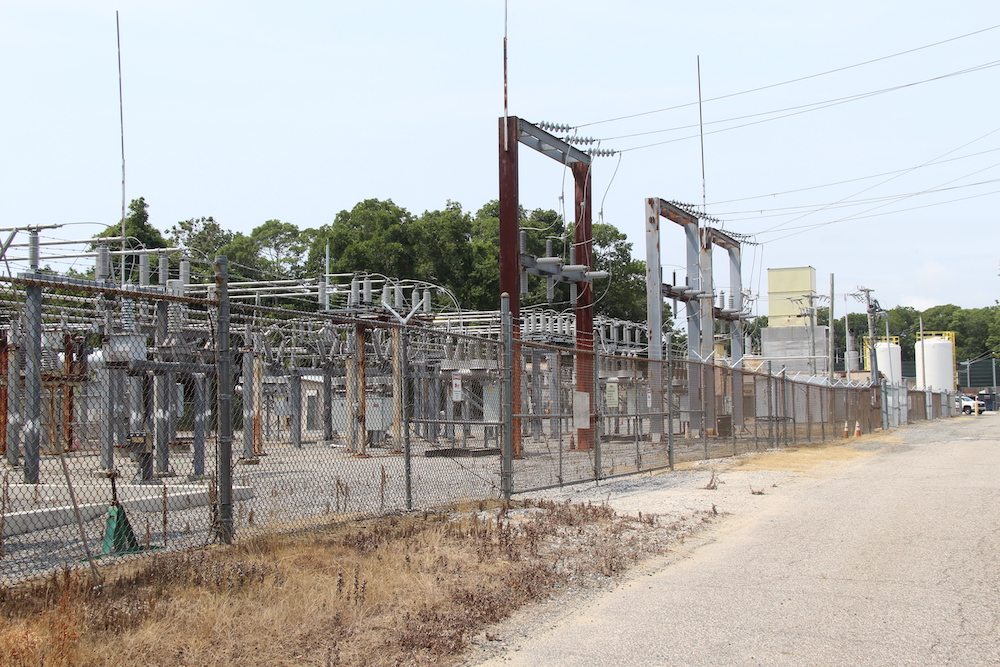
The Town of East Hampton added to recent pressure on NextEra Energy Inc., the owner of a battery storage center at 3 Cove Hollow Road, with a “demand letter” a week after Ed Romaine, the Suffolk County executive, and East Hampton Village Mayor Jerry Larsen called for operations at the energy facility to be suspended.
A June lawsuit by the Suffolk County Water Authority against NextEra alleges that at least two of the water authority’s drinking water wells have been impacted by forever chemicals following a 2023 fire at the East Hampton Energy Storage Center.
The fire led to “thermal runaway” and fire suppression sprinklers ran for 30 hours straight. A flood of 2.2 million gallons of water was released and mixed with perfluropropionic acid (PFPrA) from the battery storage systems. With no on-site containment, much of that water ran down Cove Hollow Road toward the what the water authority calls its Bridgehampton Well Field. (The well field is misnamed; it’s located north and east of the intersection of Cove Hollow and Buckskill Roads; there is no Bridgehampton Road.)
Those wells have tested positive for PFPrA, an ultrashort-chain PFAS compound, at levels close to 400 times higher than what New York State says are safe to drink.
In her letter to Brian Bolster, the president and chief executive officer of NextEra Energy Resources L.L.C.; John Ketchum, the chairman, president, and C.E.O. of NextEra Energy, Inc.; Zoe Yujnovich, the C.E.O. of New York National Grid, and Sally Librera, its president, Town Supervisor Kathee Burke-Gonzalez called for changes at the facility that would protect the groundwater in the event of another fire.
For example, within 30 days she called for a revised final emergency action and safety plan to be submitted for approval to the town board.
“The revised plan must describe the suppression systems as actually installed; state, with a documented methodology, the maximum volume of suppression water a worst-case thermal runaway at full installed capacity could generate; specify how every gallon of that volume will be collected, contained, characterized, and lawfully disposed of, with zero discharge to soil, groundwater, surface water, Cove Hollow Road, or any adjoining property,” she wrote.
One might fairly question why such calculations weren’t part of the original review.
“The planning board had no reason to expect that 2 million gallons of water would be used to extinguish a fire, and even if it did, because the applicant represented that ‘no liquid is within each battery cell that could spill’ and ‘all runoff and drainage’ would be contained on site as an ongoing condition, there was no reason to believe that an issue could be caused,” Patrick Derenze, the town’s public information officer, wrote in an email, when asked if the issue should have been flagged by the Planning Department. “While the planning board does its own analysis, like all Planning Departments, it relies on the representations of applicants.”
The New York State Department of Environmental Conservation and the Suffolk County Department of Health are both investigating the source of the chemicals. However, last week Mr. Romaine was adamant that the source was the battery storage facility.
For Supervisor Burke-Gonzalez, the source wasn’t the important point.
“D.E.C. has not determined a source, and I will not prejudge its conclusion,” she wrote. “But I am not waiting for it, and I want to be clear why the town’s demands do not depend on where D.E.C. lands. D.E.C.’s update explains that ultrashort-chain PFAS were not previously monitored by any public water supply in this state, that they are not listed as hazardous substances or emerging contaminants at any level of government, and that the laboratory methods for detecting them are new and not yet certified.”
“The town is therefore not suggesting you should have told us about PFPrA in 2017,” she continued. “That is not the failure. The failure is that you knew (or should have known) that a lithium-ion fire at this facility could be met with water, knew (or should have known) that thermal runaway opens cells, and that therefore building containment for transformer oil and nothing else was not likely to contain runoff on site. That was knowable by you in 2017, and the condition it produced, a water-suppressed battery building with no capacity to hold what comes out of it, on a surface designed to infiltrate, above the only drinking water this community has, exists today exactly as it existed on May 31, 2023. Now that this has come to our attention, we direct that containment is imperative.”
Indeed, in 2017 when it reviewed the application, the Planning Department and the planning board were told by TRC Environmental Application, which helped shepherd the site plan through the review process, that the battery electrolyte was “a non-aqueous organic solvent and, therefore, no liquid is within each battery cell that could spill.” While that could be true, and the containment vessels, 550 gallons and 176 gallons, were designed to hold the electrolyte, the planning board never questioned how much water could be released by the fire suppression system, and where it might end up.
“Nothing else on the site would have held anything,” wrote the town supervisor. “The yard is crushed rock and road base over native soil. The approved plans show no permanent drainage or collection structures of any kind.”
Supervisor Burke-Gonzalez also called on the company to provide “new engineering controls capable of containing all fire water and runoff, complete and certified technical information, a hazardous-waste management plan, and an independent study of whether the facility remains necessary for the East End electric grid,” according to a press release.
“In conducting its SEQRA analysis and in granting site plan and special permit approval, the town materially relied on the representations made by the applicant,” she added. “Based on recent information, the town understands that the applicant’s representations to the town may not have been accurate.”
The town’s demands come with deadlines: 30 days to develop a revised emergency action and safety plan, and 60 days to submit stamped engineering plans to protect environmental resources in the event of a future fire.
Mr. Derenze, when asked if the tough talk would extend to NextEra’s similar facility a stone’s throw from Fort Pond in Montauk, wrote: “We are investigating the issues with respect to the Montauk facility and may send a letter relating to that facility shortly.”