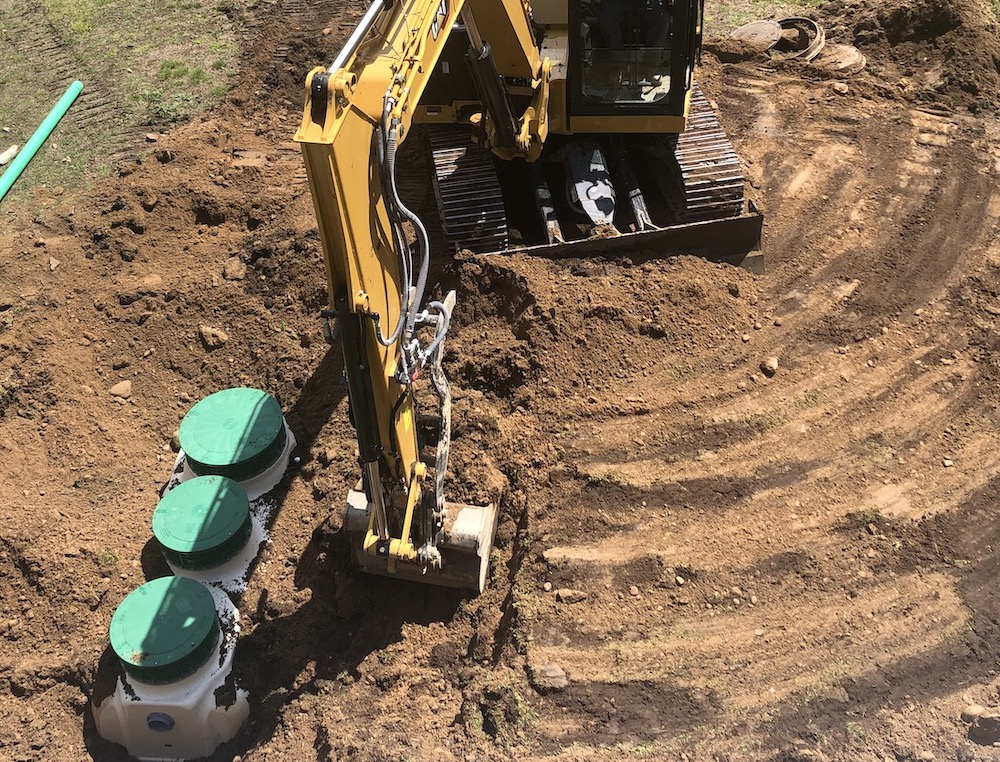
Nitrogen is not only the greatest threat to our lakes, ponds, and harbors, the Wainscott Citizens Advisory Committee was told on Saturday, but studies have shown that even a low level of nitrate in drinking water is associated with increased risk of cancers.
Tom Varley, watershed manager at the New York State Center for Clean Water Technology at Stony Brook University, outlined the environmental benefits and financial incentives to replacing a conventional septic system with a nitrogen-reducing, innovative/alternative system.
Suffolk County’s public water is in the top 5 percent of nitrate levels in the country, Mr. Varley said, and a majority of nitrogen comes from onsite septic systems. “So we have to reduce the source of the nitrogen entering the water body,” he said. But conventional systems do not remove nitrogen. Suffolk’s new discharge standard for I/A systems is 19 milligrams per liter, a fraction of conventional systems’, he said. Even a conventional system for a residence used only seasonally has nitrogen discharge equivalent to one with an I/A system that is occupied year round, he said.
The Center for Clean Water Technology has been working on ways to reduce nitrogen further, Mr. Varley said, including development of a wood chip box polishing unit, for further water filtration, that is added to I/A systems, which in combination remove nearly all nitrates. East Hampton Town awarded the center a grant to install eight such units. It has installed five, and is looking for three more sites. Two were installed at Georgica Pond “and we have great results,” he said.
Property owners can take advantage of several grant and rebate programs to upgrade their septic systems. The county’s Septic Improvement Program offers up to $20,000, paid to the installer, with preferential consideration given to properties with existing system failure and in environmentally sensitive areas. The state’s Septic System Replacement Program offers 75 percent of eligible costs up to $25,000, and the town’s Septic Incentive Program offers up to $20,000 for properties in a water protection district, or $15,000 outside of one, in the form of a rebate post-installation.
“So for the people that live around the ponds, you’re eligible for $65,000,” Mr. Varley said. “If you’re a little farther away from the pond, you’re eligible for $60,000.”
The average cost for an I/A upgrade in eastern Suffolk is $36,000 to $37,000, sometimes as high as $42,000, “so you potentially can have all your costs covered through these grants,” Mr. Varley said.
The seven approved I/A technologies work a little differently from one another, he said, “and that’s where I can come in, to guide you on how the grant programs work.” Mr. Varley provides assistance to homeowners on the upgrade process at no cost, including education, assistance with grant applications, and guidance to select an engineer for system design and a system installer. “If you give me permission to act as your agent, I can actually do these submissions for you,” he said of grant applications.
The installation itself “is really the quickest part of the job,” he said, usually completed in a day, with a possible second day to complete grading.
“One of my jobs, also, is to promote the installation of the most environmentally protective system,” Mr. Varley said, “and I encourage people that, if they can, to put on the wood chip box polishing units to lower the nitrogen even further.”
The county requires a three-year service agreement with the contractor, who will check the system twice a year to ensure it is functioning properly, and the property owner is required to secure a service agreement each year thereafter. The average annual cost is $500, Mr. Varley said.
Fifty-six I/A systems have been installed on properties around Georgica and Wainscott Ponds, he said, with 29 more “that I have been working with, trying to get them to move ahead with the installations.”
Bruce Wayne Solomon told his colleagues on the citizens committee that he has been working with Mr. Varley on his own septic upgrade plan. Mr. Varley “is the man that I highly endorse to shepherd you through this process,” he said.
“If we really want to make a difference, we need more people to do the installs,” Mr. Varley said, noting that there are some 360,000 septic systems in Suffolk County. “To date, since the program started, maybe around 8,300 installs have been done,” he said, because “it’s only mandatory if you’re doing major construction or a new build. So we need to get voluntary installs done.”