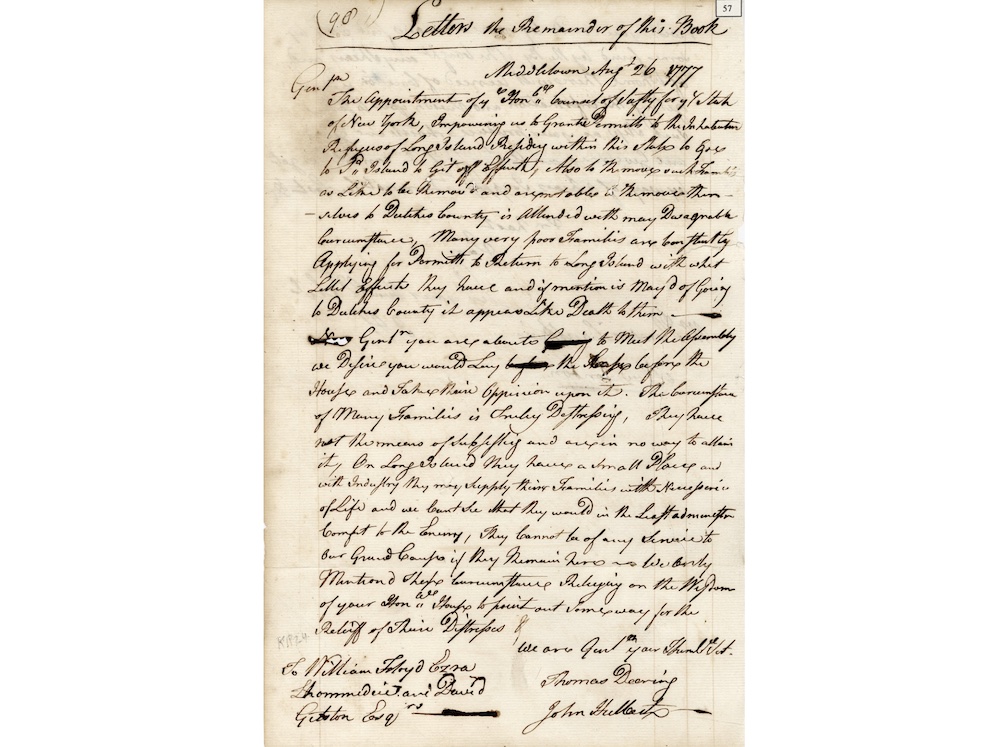
Thomas Dering and John Hulbert co-authored this letter on Aug. 26, 1777, replying to the New York Council of Safety’s letter appointing them as the representatives responsible for issuing permits for the refugees in Connecticut who’d fled Long Island’s British occupation. After Long Island fell to the British Army in September 1776, a large number of Long Islanders left the occupied Island for Connecticut. As time went on, people needed permits to cross between territory controlled by different armies. Many refugees returned to check on their property or retrieve possessions.
Dering and Hulbert’s appointments reflected their prior leadership roles in the efforts for independence, which meant they could be trusted to ensure permits weren’t enabling theft or spying. They addressed their reply to William Floyd, Ezra L’Hommedieu, and David Gelston, who were local members of the New York Council of Safety, a precursor to the state’s legislative body.
Middletown, where Dering and Hulbert stayed in Connecticut, hosted a large community of Long Island’s refugees during the occupation. The letter tries to convey the desperate situations they witnessed among their exiled political compatriots. Historians disagree on the number of Long Islanders who fled British occupation, but 20 to 25 percent of the total population is a conservative estimate. Hulbert and Dering emphasized that their fellow Long Islanders constantly requested permission or passes to return to the Island to check on their farms and “enterprises.”
The Council of Safety hoped Dering and Hulbert would encourage more refugees to move to Dutchess County in New York, near the council’s meetings in Kingston, farther from the coastline and less vulnerable to raids. In a sentiment that might be relatable for some East Enders today, Hulbert and Dering replied that displaced Long Islanders felt resettling in the Hudson Valley was equivalent to death.
For those who remained on Long Island for the seven years of occupation, life was not easy. It is well documented that British soldiers commandeered local cattle, food, and housing, no matter the residents’ provisions or needs.
To learn more about the experiences of East Hampton’s residents during the occupation, you can join the East Hampton Historical Society and the Long Island Collection on Friday, April 24, at 6:30 p.m. at the library for Leah Lebec’s free Tom Twomey series presentation of her father’s dissertation on “East Hampton in the American Revolution.”
—
Andrea Meyer, a librarian and archivist, is head of collection for the Long Island Collection.