In its first century, East Hampton had only one house of worship, but behind every steeple and stained-glass window that followed is a story of determination and perseverance. Most Holy Trinity Catholic Church is a good example of this, as evidenced by its origins.
On Jan. 30, 1891, John J. Flannery (1852-1927) sold a half-acre on Buell Lane to the Rev. John Loughlin (1817-1891), Bishop of Brooklyn. Over the course of the next three years, a small but determined group of congregants, led by the Rev. Lawrence J. Guerin (d. 1897) of Sag Harbor worked tirelessly to raise money, finally opening East Hampton’s Roman Catholic Church in September 1894.
Father Guerin originally named the parish for St. Philomena, his late sister’s namesake. On June 17, 1962, after St. Philomena was removed from the General Roman Calendar, the parish became known as Most Holy Trinity.
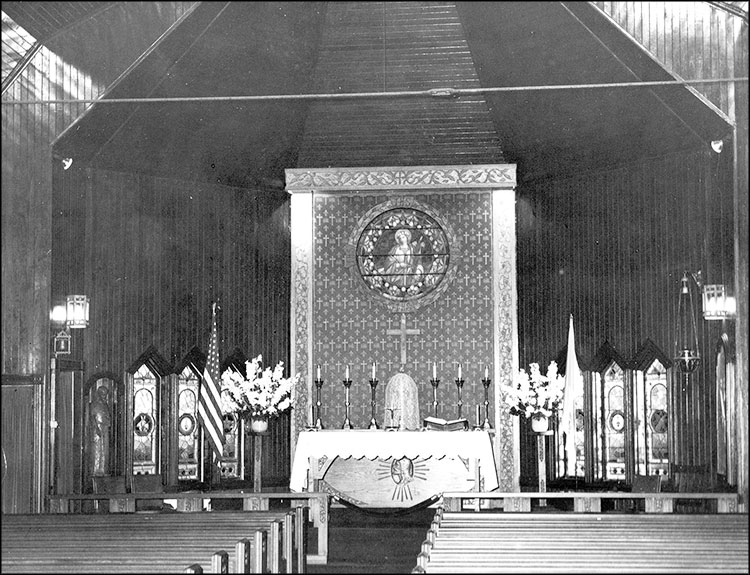
This photograph, lent by the McGuirk family, shows the altar inside Most Holy Trinity as it appeared sometime between 1964 and 1975, based on the photo technology and the direction of the missal on the altar, which reflects changes in Catholic worship adopted in 1964 after the Second Vatican Council.
Note the round stained-glass window that tops the altar. Depicted is the eponymous St. Philomena, who appears holding an arrow, a sword, and lilies. As the story goes, Philomena was the daughter of a Greek king who took a vow of chastity, and upon refusing the marriage proposals of a Roman emperor she was tormented and killed, earning her martyrdom.
The arrow and sword she holds represent the torture she endured, while the lilies represent her unbroken vow of chastity. While the church stopped using St. Philomena as a namesake in 1962, her presence still looms large over the altar and from Buell Lane, where the window is visible from the sidewalk.
—
Julia Tyson is a librarian and archivist in the Long Island