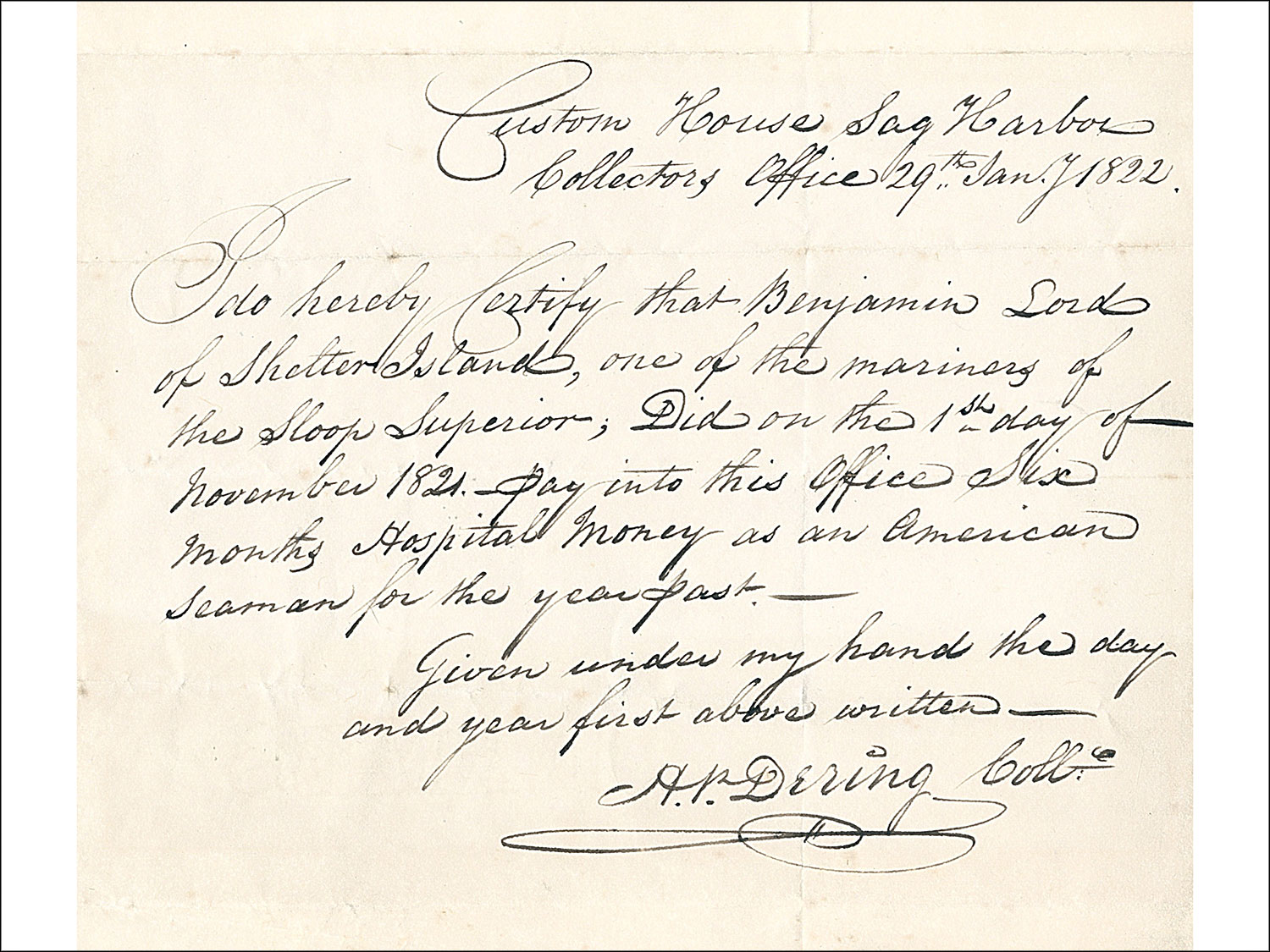
On Jan. 29, 1822, Henry Packer Dering (1763-1822), the Sag Harbor customs collector, issued this “acknowledgement” that Benjamin Lord, “an American seaman” from Shelter Island and the sloop Superior, had paid “into this office six months Hospital Money . . . for the year past” on Nov. 1, 1821. The document is part of Preservation Long Island’s collection.
This Benjamin Lord may have lived in Connecticut in 1822, since none of the records for the Lord family on Shelter Island seem to include a Benjamin. It’s possible Lord was residing on Shelter Island only temporarily, or that his residency was simply misidentified, since Lyme, Conn., was home to a Benjamin Lord (1756-1823) who would have been in his 60s when Dering made this record.
What exactly was “hospital money” and why did “an American seaman” need to pay it? Seamen from the American colonies were first taxed as early as 1729 to fund the Royal Hospital for Seamen at Greenwich, in England, which was built under the direction of Queen Mary II in 1692.
Here in this new independent nation, Congress passed an act in 1798 creating the first public health service, the Marine Hospital Service. The early republic’s economy and international relations relied heavily on mariners, who often became sick while traveling far from their homes and families. Most port cities had few if any public hospitals, and sailors were often paid in full only at the end of their voyages, making it difficult to find affordable hospitals capable of dealing with sick mariners.
Seamen came from all states and territories and could get sick anywhere, making their health care an important early application of the United States Constitution’s interstate commerce clause. Congress established a series of marine hospitals, for the most part in port cities, through this act. The hospitals were funded by taxing seamen 20 cents a month, or about $5.39 today.
The marine hospitals continued into the 20th century, although the taxing shifted, reflecting changes in American industry.
—
Andrea Meyer, a librarian and archivist, is head of collection for the East Hampton Library’s Long Island Collection.