It wasn’t a formal public hearing, but nonetheless, the public was heard at Tuesday’s East Hampton Town Board meeting regarding a petition to rezone two parcels of land at 152 Three Mile Harbor Road and 33 West Drive.
If the rezoning is approved, it could lead to a 79-unit condominium development, the largest in the town.
The public, in short, said no.
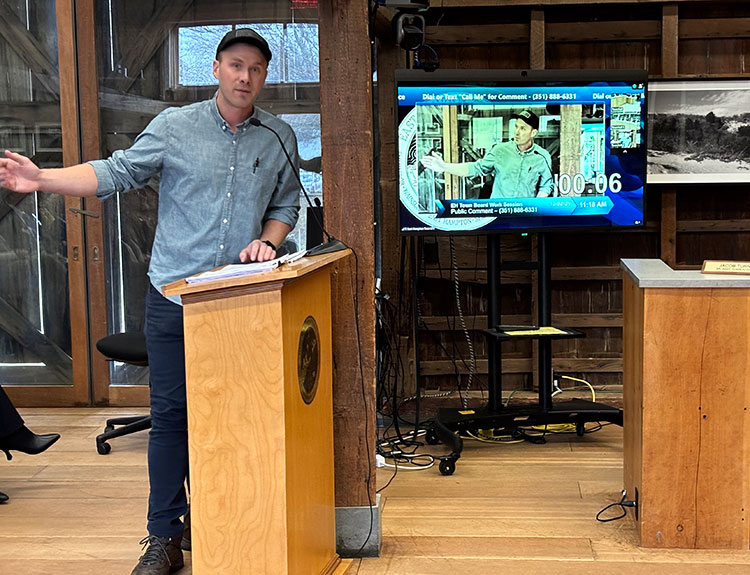
It took nearly an hour and a half for that no, which dominated the public portion of the meeting. Sixteen residents spoke against the development, with only two, Kirby Marcantonio, the developer, and his lawyer, Christopher Kelley, speaking in support.
Mr. Marcantonio asked the board to consider placing an affordable housing overlay designation over the two parcels, which he and three partners are in contract to buy. Doing so would allow for increased density on the land, up to 12 units per acre. The town maximum is for 60 units on any development.
But because both lots are large enough to receive the A.H.O. designation (3.57 acres and 3.1 acres, respectively), they could be developed separately, even though they’re acting as one development, Eric Schantz, a principal planner for the town, said in a memo. “To achieve the yield of 79 units (which is permissible based on the combined acreage of both lots) the applicant would require a variance from the zoning board of appeals for relief from the special permit criteria,” he wrote.
If the board agreed to place that designation, Mr. Marcantonio proposed a linear development spanning the length of the lots between Three Mile Harbor Road and West Drive, with an entrance and exit at each. A single sewage treatment plant would serve all the units: 46 two-bedroom duplexes of 800 square feet, and 33 three-bedroom duplexes of 1,200 square feet.
Mr. Marcantonio has touted a unique ownership structure for what he’s calling an affordable housing complex. Each unit could be purchased individually, he hoped by local businesses, and then rented to their employees at below market rates. Using this development method would introduce private money to help solve the affordable housing crisis, he claimed.
Further, he said the developments would lead to improvements in the neighborhood, at his cost. Public water would be brought in, and West Drive, which he described as a somewhat improved dirt road, would be paved. The septic system alone would cost $2.5 million and would “make everybody else’s residential septic look like a Model T.”
“We’re willing to put $30 million on the line to make this work,” he said.
Councilwoman Cate Rogers said she couldn’t support placing the affordable housing designation over the parcels for the simple reason that she believed the units didn’t meet the town’s definition of affordable housing. She said Mr. Marcantonio was proposing something different and suggested a new section of the code to deal with “employer sponsored housing.”
“I don’t think an affordable housing overlay approval is appropriate,” she said.
“Seventy-nine units is too ambitious and runs contrary to the 60-unit cap for any given site regardless of lot size,” Katie Casey of the East Hampton Housing Authority said. “This proposal is an open market commercial, for-profit enterprise under the guise of affordable housing, in an attempt to benefit from preferential town code, swift expediting, and waived fees.”
Nearby residents weren’t sold either.
Brian Niggles, whose family owns 160 Three Mile Harbor Road, the immediate neighbor of the potential development, and also Round Swamp Farm just up the road, questioned the increased density. “What was once three-acre zoned land — that’s one unit for every three acres — would now be considered to have 12 units for every one acre. It’s a massive project that would destroy the neighborhood,” he said.
Like others, he worried about the process.
“It concerns me that the town is hearing such a lengthy application that obviously had much time and effort put into it behind the scenes. The community has only just found out about it. The applicant’s attorney has requested that the approval be issued by next week, December 9th. Otherwise, the project will not go forward. Furthermore, traffic — 160 parking spaces are proposed. If you count how many cars are in the parking lot of the Buzz Chew dealership right now, there are about 160 cars. So, picture putting a car dealership’s worth of cars in the middle of the Three Mile Harbor Road neighborhood.”
Albert Lester cut to the chase: “It’s just disgusting that people would even think about doing this.”
“Affordable housing is defined by income-based eligibility and regulated rents typically under federal or state programs to ensure compliance with affordability standards,” said Diane Jordan. “The proposal is intended for business owners purchasing homes to rent to their employees without any government oversight, income verification, or rent regulation. This is not affordable housing,” she continued. “It is a private rental arrangement with no enforceable standards or long-term affordability guarantees.”
“Additionally, the request to change town code and create a new administrative structure would require hiring permanent, full-time town staff to enforce compliance. Those salaries will come from taxpayer dollars. Why should taxpayers subsidize oversight for a private business model?”
“How can you buy property for $5.5 million, put $30 million into it, and expect to make it affordable?” asked Charlie Niggles. “Somewhere in here there’s a whole lot of something that doesn’t sound right. If you want to change some zoning, make it so we can put housing in our barns. You’re not going to house all the people that work here. You just can’t.”
Indeed, it might have been just that detail that prevented the board from holding a vote.
Just before it seemed they would rule 3 to 2 against the proposal, with Supervisor Kathee Burke-Gonzalez, Councilwoman Rogers, and Councilman David Lys lining up against it, Brittany Toledano, the deputy town attorney, tabled the discussion.
“It may need a resolution?” asked Ms. Burke-Gonzalez.
“Because the town board is hearing it, we have to determine whether or not we have to notice a public hearing at this point,” Ms. Toledano said, citing all the back-and-forth. Tabling it would make sure the board complied procedurally before a “final action” took place. “Final action being a denial of the petition,” she explained.
Still, despite all the public comment, it wasn’t enough.
After the presentation on the application, the board decided to take a five-minute break to allow people to disperse. The hallway outside filled up, and some emotions ran high.
“Leaving the door open for this thing to happen is scary,” said one man, who wondered when it would next be discussed.
“I will buy it tomorrow and I will put six people in it,” Lisa Niggles yelled to Councilman Ian Calder-Piedmonte, who supported the rezoning.
“If you want to talk more about it, I’m happy to, but this is not the process,” he replied, before walking back into the meeting room.
“This is not right. When I was offered to buy it, I was told I could put up one house, and I can’t afford a three-million-dollar lot, to put one house,” Ms. Niggles said. “I most certainly would have bought that land if I thought I could have had even six lots for my sons. To put 79 units when we were told to move our chicken coop on our farm because it was ‘oversaturated’? If the Maidstone Club wants them for their employees, let them build them on their golf course.”
So, while most would agree that there is an affordable housing crisis in East Hampton, it became clear that not everyone, and especially not the Niggles family, agrees that the solution is 79 condominium units with its own sewage treatment plant at 152 Three Mile Harbor Road.