The plan for the 1.12-acre Wainscott Green and a park to honor and commemorate the L.G.B.T.Q.+ community that was something of a pioneer on the East End was endorsed by members of the hamlet’s citizens advisory committee on Saturday, following a presentation on the plan by Tom House, president of Hamptons Pride.
The green, on the site where the Swamp nightclub and the Annex restaurant stood for almost 25 years, also honors the late Rick Del Mastro, who is remembered in part for an effort to see that a car wash was not permitted to be constructed there. Mr. House, who worked at the Swamp, had introduced a plan to the committee two years ago, before it was presented to the East Hampton Town Board. It has changed little since then, he said.
“We want this installation to be beloved and used, and we see it as having three audiences,” he said. They are the residents of Wainscott, those of the larger town, and the L.G.B.T.Q.+ community, he said, noting that in addition to the Swamp, the hamlet’s Main Street once hosted the Attic, another gay-owned and operated club, and “there used to be some gay-friendly clubs along Main Street. I don’t know if you know this, but it was known affectionately as the Miracle Mile. It’s got over 50 years of L.G.B.T.Q.+ history right along that stretch.”
Grace Jones and Cissy Houston and her daughter, a teenage Whitney Houston, performed at the Swamp, Mr. House said, and the club was also frequented by “choreophiles, people who just love to dance. There were — we used to say ‘straight people,’ now we say ‘allies’ — a lot of allies, especially women, who came to dance in a place where they could just dance. There wouldn’t be a lot of guys hitting on them. . . . It remains distinguished as the last and longest-running gay club in the history of the Hamptons. It’s also the longest-running club in the history of the Hamptons, period, of any stripe.”
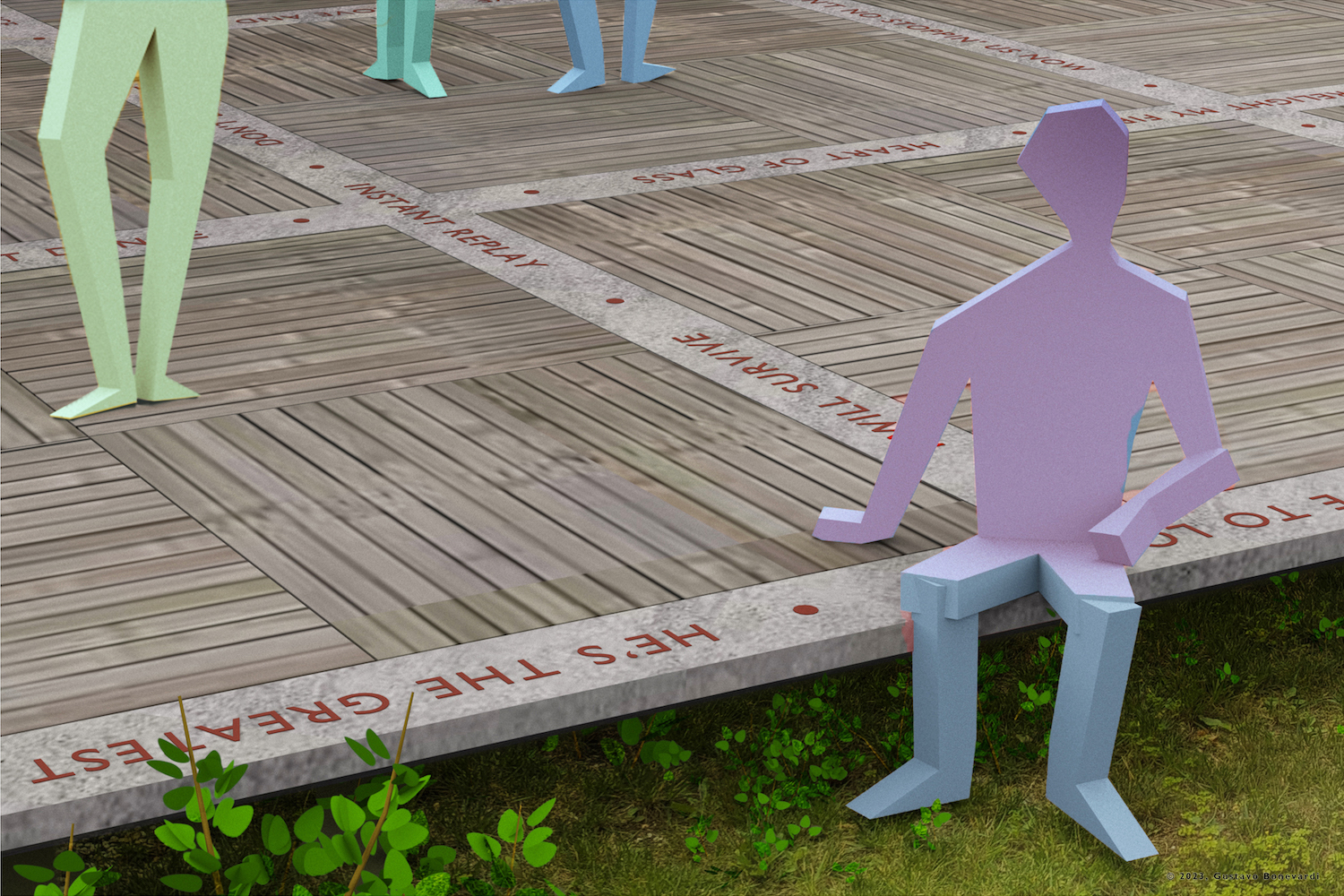
The plan calls for a memorial, designed by Gustavo Bonevardi, an architect and artist, on the southeast corner of the park. “This is a combination of outdoor social area, historical marker, and memorial garden,” Mr. House said, showing slides during the virtual meeting depicting a raised “dance floor” where the actual one stood, a long bench bordering it, and “glass triangles” comprising stacked pink balls — the mirror ball being an iconic image of the era — that represent the symbol first used to persecute gay people in Nazi Germany, later co-opted “as a color and a form associated with civil rights, pride, and celebration,” Mr. House said. A shaded memorial garden will provide “an opportunity to pay tribute to the staggering number of East End souls lost to the AIDS pandemic,” he said.
In 2020, after the Swamp and Annex structures had been demolished, Mr. House wrote a “Guestwords” in The Star to advocate for a memorial to their significance and those who patronized the establishments. “The idea,” Mr. House said, “was that history was being forgotten a little bit, and we needed to bring it back.” The essay got the attention of Ken Lustbader, an East Hampton resident and co-director of the NYC LGBT Historic Sites Project. While the nightclub is gone, Mr. Lustbader wrote to the town board in 2023, “its memory and significance contributed to and continues to elevate the intangible benefit of pride and community. These benefits will be reinforced by the design, on its original site, that commemorates its past and invites new recreational activities.”
Mr. Lustbader went on to explain the significance, in Mr. Bonevardi’s design, of the pink triangle. “The Town of East Hampton is at the forefront of national efforts to acknowledge an underrepresented history of its L.G.B.T.Q.+ community.”
A draft management plan for the park was originally approved by the town board in 2019. Earlier this month, the board held a public hearing on amending the plan to add the proposed commemorative structures. “When we first presented to the board in November 2023, it was received warmly, but there was nothing official,” Mr. House told the committee. He predicted imminent approval, “and that’s what we need in order to move forward” with construction.
“It remains a modest proposal,” Mr. House told the committee, the dance floor structure occupying 2 percent of the park. He stressed that the project would be funded by donations to Hamptons Pride, at no cost to the town or to the hamlet. “We’ve established a record of successful fund-raisers,” he said, including an annual summer benefit at LongHouse Reserve in East Hampton, “to ensure project completion and ongoing maintenance.”
The presentation was warmly received. “Certainly,” said Hersey Egginton, the committee’s chairman, “the members of the C.A.C. who are present are in support of the current design.”