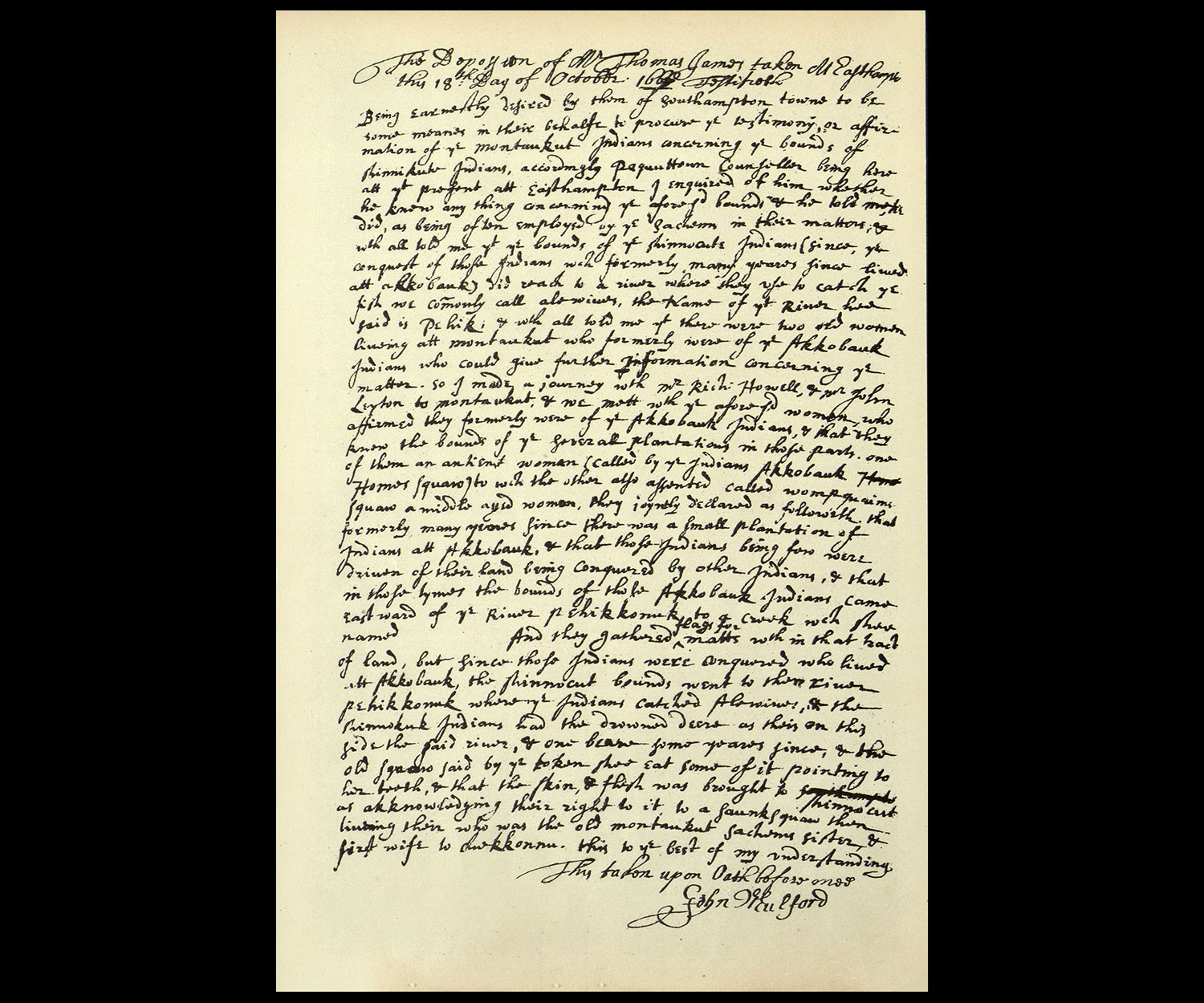
This photostat of a deposition taken on Oct. 18, 1667, from East Hampton’s first minister, Thomas James, is one of the earliest records we have of “Ackobuak,” or “Accabonac,” as a place name. Today Accabonac is generally accepted to originate from an Algonquian or Montaukett word for “root place,” or a place with good ground roots. Thomas James is one of the earliest sources to connect the name Accabonac to a group of Indigenous people who once lived within East Hampton Town.
In this deposition, the Accabonac people first come up when an Indigenous leader, or “counsellore,” who James calls “Paqultoun,” or Paquatoun, directs him to “two old women” living at Montauk, who were formerly “Ackobuck Indians.” Paquatoun told the reverend these women were experts on territorial boundaries.
James describes the Accabonac people as a smaller Indigenous group that was “driven of[f] their land [after] being Conquered by other Indians.” According to the archaeologist Gaynell Stone’s map of native Long Island, the Accabonac people probably lived near modern Accabonac Harbor, closer to what is now Louse Point.
The true focus of James’s deposition was the pre-contact boundaries of the Shinnecock people. According to the reverend, all the Indigenous people he spoke to recognized the Shinnecock land boundary as a river where they used to catch alewives called “pehick konuk” or “Pehikkonuk.” Today, this is the Peconic River.
The Accabonac women James spoke with also described the process of acknowledging the territorial boundary with a bear and a deer that were killed on the riverbanks and taken to the Shinnecocks.
For those interested in the origins of local place names, please join us tomorrow night at 7 for David Cataletto’s Twomey Series lecture, “Landmarks and Legends: East Hampton Unveiled.”
—
Andrea Meyer, a librarian and archivist, is the Long Island Collection’s head of collection.