The bartering has begun. A plumber installing sinks and toilets at a Montauk motel in the throes of gentrification showed up late, sunburned, and begging his employer’s indulgence.
Bass and Blues, Big and PlumpThe bartering has begun. A plumber installing sinks and toilets at a Montauk motel in the throes of gentrification showed up late, sunburned, and begging his employer’s indulgence.
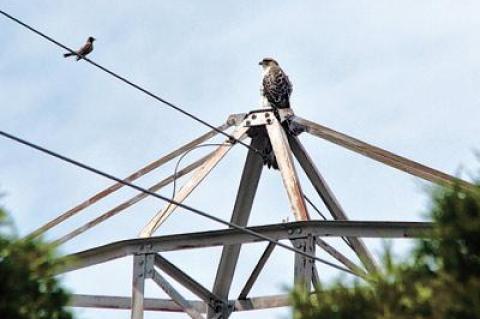
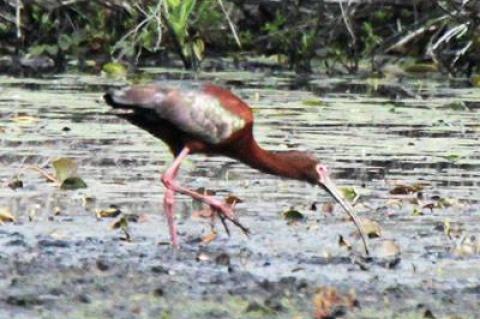
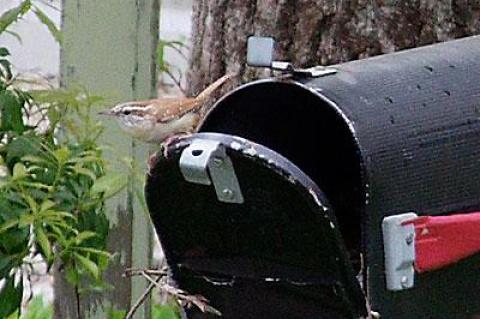
Nature Notes: On BarcelonaOrioles, towhees, great-crested flycatchers, rose-breasted grosbeaks, catbirds, and a ton of warblers have all come back to roost. The most spectacular avian visitor in a while was the white-faced ibis that was seen and photographed at Scoy Pond in the Grace Estate nature preserve over the weekend by and Pat Lindsey and Angus Wilson.
Nature Notes: Maddening MillenniumWe birders are always looking for the odd bird, not the familiar one. Yet it’s the familiar ones that provide us with the most information, the ones that quiet us down when things go awry, and at this point in civilization, they often do. On Friday, it was the sweet song of the Baltimore oriole heralding his return that set my mind at ease; on Sunday it was the wheezy nonsensical notes of the catbird, gone from my brain since August 2011, that did the same.
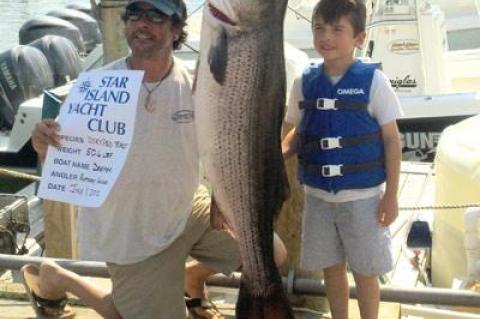
Ready, Set, Shoot-OutThe Montauk SurfMasters spring shoot-out tournament will begin at one minute after midnight tonight, or tomorrow morning, however you want to think of it. And, according to the few surfcasters who have already ventured to their favorite haunts, striped bass are schooling and ready to be caught.
Bill Gardiner took his surf rod to a secret spot somewhere in Montauk in the dark over the weekend where he found lively action with a few nice fish in the teens.
It’s Like a Parallel UniverseReading this week’s press release from the State Department of Environmental Conservation was like waking from a wonderful, liberating dream and realizing it was all true.
“These regulation changes reflect improvements to populations of scup, black sea bass, and summer flounder,” reported Kathy Moser, the D.E.C.’s assistant commissioner for natural resources. “The scup population is particularly robust at this time, and we encourage anglers to get out on the water and enjoy the increased opportunity for anglers to bring home freshly caught fish.”
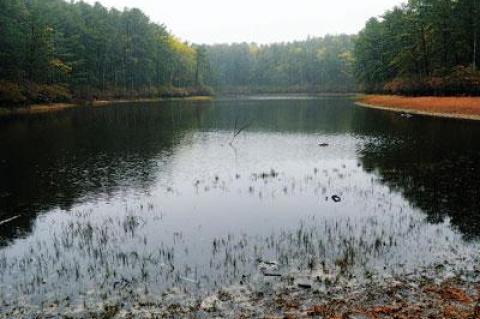
Nature Notes: Long Island’s PondsWe are in the midst of a deep drought. Yes, we had almost three inches of rain locally two Sundays ago, but a drive by Chatfield’s Hole on Two Holes of Water Road showed that it hardly made a difference. The pond level was so low, that there were two ponds, a largish one to the north, a small one to the south. The small one had a tiny island in its center covered with the northern shrub of the heath family, leatherleaf.
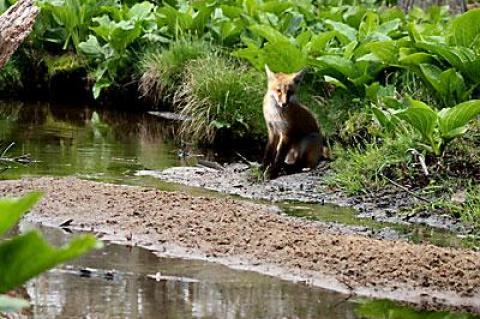
Nature Notes 04.26.12On April 10 I went with some friends to the meeting of the Long Island Botanical Society held at Stony Brook University. When we were approaching the campus from the north end of Nichols Road, a red fox streamed across the road from east to west with outstretched tail. When we arrived back at Warren’s Nursery in Southampton (our starting point), a red fox ran across Majors Path into the nursery, its tail in the same position. That made sense, there is an active den with fox kits at that site.
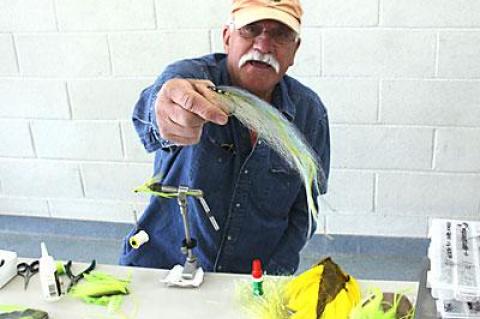
On the Water 04.26.12Alfonso Marino stopped casting into the Georgica Pond gut as the water flowed into the sea. He stopped casting flies and watched in awe as Mother Nature did her spring thing shortly after the pond was opened to the sea on April 2 by order of the East Hampton Town Trustees.
Trustees open it each spring and fall — when storm-driven ocean waves do not — in order to accommodate the fish that leave as fry and return to spawn as they have for millenniums.
Nature Notes: Exploring Culloden PointWe are in the midst of a drought and there is nothing worse for those early leavers and early bloomers who bet on a premature spring, but not on the dry weather. In 1986 during an extended dry period a wildfire caught hold of Hither Woods in Montauk and burned more than half of it. In 1995 the Westhampton Pine Barrens exploded from too little precipitation and now in 2012 a warm, dry winter and drier, warmer spring has sparked another major forest fire, north and east of Brookhaven National Laboratory in Upton.
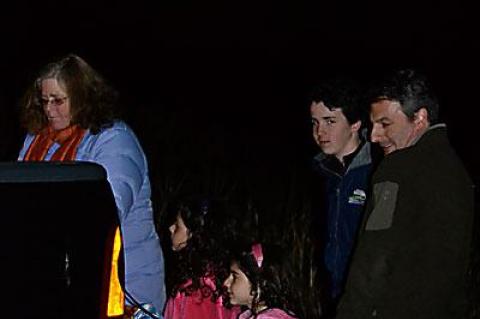
By the Light of the Fish MoonJean Dodds, secretary of the Friends of the Long Pond Greenbelt, anxiously hoped the moon would cooperate as two dozen hikers gathered in the parking lot of the South Fork Natural History Museum in Bridgehampton Friday for the monthly full moon hike she led.
Nature Notes:Saving Trees, Saving UsThe last “Nature Notes” column talked about Montauk’s ancient hardwood forest, the Point Woods. In East Hampton Town there are two other forests dominated by broad-leaved deciduous trees that have hardly been cut over and have been equally impressive during settler, colonial, and modern times.
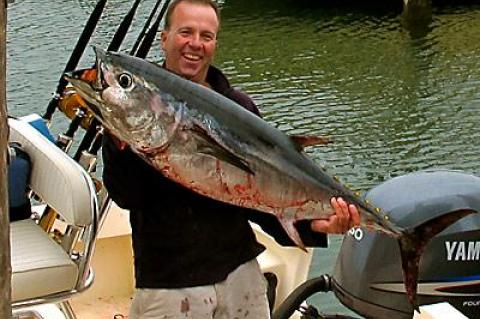
All Are Liars, Except MeAre the striped bass here or not? The rumor mill is generating excitment and perhaps a few stretched truths.
Surfcasting rods are appearing on roof racks. People who would normally drive Montauk Highway when traveling to and fro from Montauk are taking the Old Highway instead to keep eyes peeled for birds working.
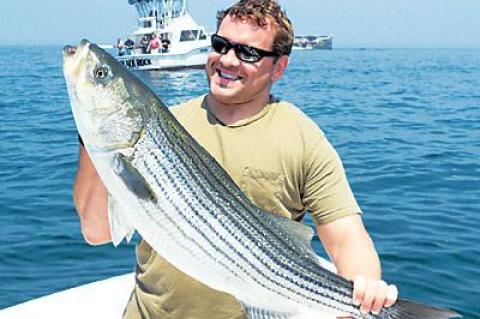
Yes, it’s an early spring, and yes, striped bass have been caught up west, but, as of Monday, the beach has been quiet so far in Montauk. East Hampton is another story.
Nature Notes: The Riches of Point WoodsSome of you may remember when Camp Hero was still in possession of the federal government and when President Ronald Reagan tried to sell it to the highest bidder. The Concerned Citizens of Montauk showed up in force at the bidding site in New York City and put the kibosh on the sale. Simultaneously, Tony Bullock was working with Senator Moynahan’s office to have it become public land. And it did!
Through a Clear LensThink of the cold air that blew into town this week as a crystal clear lens provided for viewing the night sky, especially on Monday in Montauk, where there is virtually no ground light to interfere.
The crescent moon was bright enough to make you squint, and Venus just below and to the right nearly so. Jupiter hung directly below Venus and if one were fortunate to have a telescope or even powerful binoculars, its moons would have been visible. On Tuesday night Venus was at its farthest point from the sun.
Nature Notes: Watch for BagwormsJust when you thought you had nature by the handle, here comes one of the most bizarre creatures yet, one you had no idea of and one that is found in less than a third of the field guides and other books dealing with insects and lepidopterans, in particular, moths.
It was two weeks ago when I was walking along the Long Beach parking lot road in Noyac when Vicki Bustamante pointed to something in the dune area between Long Beach Road and the parking lot. Not good, she said.
Waiting for the AlewivesSpring, the vernal equinox, the season of rebirth, sprang in the early morning hours on Tuesday with its promise that all living things, including fish, will return for another go-round.
Every culture has celebrated the equinox — when the center of the sun is on the same plane as the earth’s equator — in one way or another, even in Amagansett. One such annual fete took place in the home of Harvey Bennett, owner of the Tackle Shop in Amagansett. According to Bennett, the solemn ceremony went like this:
Nature Notes: Signs and WondersOn Monday evening after a record high temperature for March 12 I went out at night to listen for spring peepers. Between 8:30 and 10, I visited 11 known peeper breeding sites and heard not a single peep. The sites were watery, but apparently not watery enough. Peepers and other frogs and toads that breed in water, as do all of ours on Long Island and all but one of our salamander species, generally don’t move from the ground until there’s a rain, and it hasn’t rained sufficiently for at least two weeks now.
Whither the Smoked Whiting?Where has all the smoked whiting gone? There was a time when it seemed smoked whiting was everywhere. Bars in Montauk put it out for snacks. Not putting out a smoked whiting appetizer at Christmastime was considered a grave social faux pas. In barter transactions, smoked whiting was stable currency.
MOUNTAINEERING: He Scaled McKinleyPete Spagnoli, a Sag Harbor physical therapist and adventure racer who often traverses in his wide-flung travels some forbidding terrain and has faced some of nature’s more daunting conditions, returned, as he had vowed, to Alaska’s Mount McKinley last June for a second attempt.
Good Cod, Mackerel, HerringMontauk’s fishing community was saddened by the death of Bobby Huser on Monday. Most will picture him at the wheel of his classic Nova Scotia-style lobster boat, Teddy Boy. The Muskrat, as he was known, was a popular presence on the Montauk docks for decades. He will be sorely missed.
Nature Notes: The Great MigrationThe first column I wrote for The East Hampton Star was in March of 1981. It was about Alosa pseudogarengus, the alewife, of the now-threatened river herrings. As far as Long Island post-Columbian history is concerned, the alewife ranks right up there with the quahog, steamer clam, bay scallop, oyster, and right whale. It was, perhaps, the only catadromous fish — one that leaves salt water to breed in fresh water — the first settlers could count on, as our streams and ponds were too small for the likes of the Atlantic salmon, which bred in New England rivers.
It’s just conjecture, but an early recreational fishing season seems possible given a number of signs, including the recent discovery by commercial draggers of a sizable number of porgies in 26 fathoms of water, relatively close to shore. The question is, will the fish arrive early, or did they never leave?
Nature Notes: A Woodland SparedThe weather was springlike on Friday and I had the good fortune of accompanying Howard Reisman and Vicki Bustamante to a Southampton Town preserve that I hadn’t visited since the spring of 1979. At that time the 50 acres or so of wooded bottomland on each side of a meandering stream was in private hands. It was up before the Southampton Town Planning Board as a proposed subdivision with umpteen parcels.
Nature Notes: Round and RoundAn authority on rope suggested to me that vines that climb up trees go up clockwise just as the first course of rope is laid in its manufacture. Do all vines go “right-handed,” like rope? Of course, a right-handed vine is only right-handed when looking up from the ground. Looking down from its top it is left-handed or counterclockwise.
Nature Notes: Prehistoric GreeneryIt’s the middle of winter. Except for the greens of the conifers and some evergreen hardwoods, the trees are bare and the leaves that still cling to the lower branches are a drab brown.
The lawns, whether covered with leaves or raked clean, are of an ecru hue at this time, with a few exceptions. There are some brilliantly green lawns, even in winter, and the greens come in a variety of tones, from very light to a brilliant lustrous green to a dark green that reflects little light.
Nature Notes: Living Boundary MarkersThe South Fork of Long Island and, in particular, East Hampton Town have a quasi-natural feature that few other areas in the United States can claim, the “lop tree.” Lop trees, or boundary marker trees, are scarce in Southampton Town but abundant in East Hampton, especially so in the Northwest, Springs, and Amagansett areas.
Nature Notes: Glacial ErraticsIn October, while Three Mile Harbor was being dredged by a Suffolk County contractor, Steve Brennan and Chris Martin were using side-scanning radar to follow the course of the dredging work. Side-scanning radar allows one to look sideways along the bottom of a water body and see objects that rise off the bottom such as old wrecks, sunken 55-gallon drums, and other debris. What Brennan and Martin found among other things was a very large boulder in the channel, mostly submerged but sticking up out of the bottom.
Copyright © 1996-2025 The East Hampton Star. All rights reserved.