When a tornado, or tsunami, comes from out of the blue, it rattles our collective nerves. But it’s also unsettling when what we expect of nature fails to occur.

Outdoors
Nature Notes: Bury the Power LinesMar 5, 2014
Turkey vultures were back in town as of the Monday before last. Even more surprising was the sighting of individual ospreys over Sag Harbor by Ted Schiavoni and Jean Held three and two weeks ago, respectively. Ospreys used to nest in trees. Now almost all of Long Island’s ospreys nest on platforms situated on tall poles.
 The Watering Hole
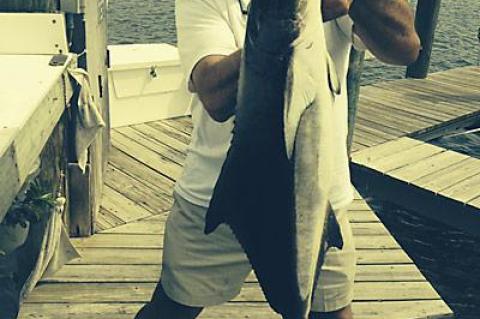
During the winter months, the Montauk Post Office is like a watering hole in the Serengeti. Residents of all stripes approach cautiously for fear of crocodiles in the form of home-heating bills. Their junk mail becomes buffalo chips to feed the fire. They drink in gossip and news of the whereabouts of others not seen at the hole of late. They bay for summer, yet speak in fear of the herds that will descend on their place as the weather warms.
 Nature Notes: A Bluebird Comeback
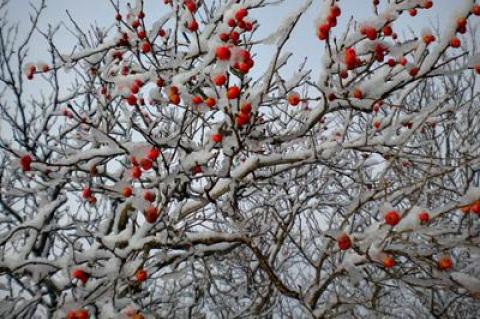
In the early 1980s there were only about seven active osprey nests on the South Fork. The osprey was still on the New York State’s endangered list. But there were even fewer eastern bluebirds on the South Fork and just a pair or two on the North Fork. The state correctly made a big hullabaloo about the sparse osprey population, but did very little to encourage the recovery of the bluebird, which, ironically, at that time had already had the distinction of being New York’s official bird for decades and decades.
Tangled Up in LuresFeb 26, 2014
Walked out onto the rock reef in front of the trailer park again the other day at super low tide to visit the life in the pools — the little black snails called rosettes, calico crabs, the gardens of red and green weed. Every 20 feet or so, I’d find a surfcaster’s lure, still snagged since the last bass season on seaweed, or trapped in the cleft of a rock.
Drifting Off to DreamlandFeb 19, 2014
At first, the sound made me bolt up out of a deep sleep and reach for something to defend the house against an intruder, but now, I simply roll over and reach again for the arms of Morpheus. It’s only a deer eating the ivy off the cedar shakes, and ivy’s not good for the shingles.
 Nature Notes: A Winter to Remember
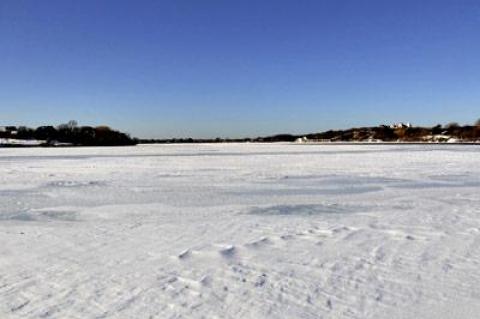
It’s been quite a winter thus far. Snowing every other day for most of February, all of the freshwater ponds frozen over solid, including Long Island’s second largest, Fort Pond in Montauk. If Lake Montauk hadn’t been opened permanently and jettied in the first half of the 20th century, it would be frozen over, too.
 A Sunday in February
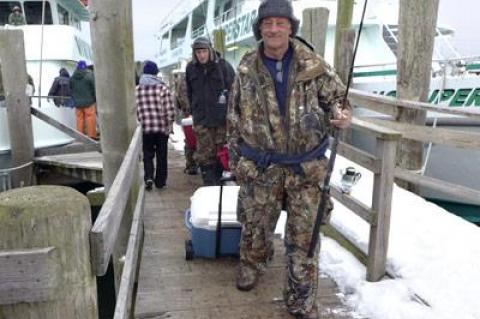
Sunday was friendly. At four in the afternoon, the Viking Starship returned to Montauk Harbor after a long day on a calm sea — cold, but calm and mostly sunny. Capt. Carl Forsberg smiled down from the Starship’s wheelhouse at the 80 booted, knit-hatted, and well-bundled anglers departing with coolers stocked with cod fillets. They had the look of a day well spent.
Nature Notes: Is It Armageddon?Feb 5, 2014
“The seas will turn red,” it prophesizes in the Bible, having to do with the anticipated Armageddon. The seas are turning red, not with blood, but with red tide phytoplankton. They’re also turning brown, purple, all of the colors in the spectrum except green for the same reason. And it all has to do with more and more nitrogen products entering the seawater with each passing day. Seven billion-plus humans, more than half of whom live only a few miles from any one of the four world oceans, produce an awful lot of nitrogen compounds as waste products.
Shtick ’Em Up, FolksFeb 4, 2014
Real life is seldom far removed from its cartoon version. The current plague of tattoos suggests the distance is shrinking.
Elmer Fudd came to mind the other day.
Cracking the CodeJan 29, 2014
On Feb. 8, the Atlantic City Boat Show will present a series of seminars on striped bass fishing. Greg Myerson will be there with the plastic mount of the striper he caught in August 2011 off the coast of Connecticut. At 81.88 pounds, and angled according to the rules of the International Game Fish Association, Myerson’s lunker bass was, and remains, the world-record catch.
Nature Notes: The Deer ConundrumJan 29, 2014
This story begins at the East Hampton Town Airport, circa 2000, while I was serving as the town’s natural resources director. The town had received a grant to construct a fence around the airport at no small cost to keep deer off the runways. A deer vs. plane collision spurred the town to take steps to prevent similar accidents in the future. The contractor put up a wonderful fence. Only one problem, the deer could walk down the road from either the north or the south and enter the airport at their leisure the way vehicles and people do.
A List of Literary LiaisonsJan 22, 2014
I suffer from multibibliophrenia, an often debilitating condition caused by reading several books at one time. I can’t help being seduced by attractive cover art or rave review blurbs even though I know I’ll be cheating on the book I’ve already opened and committed myself to.
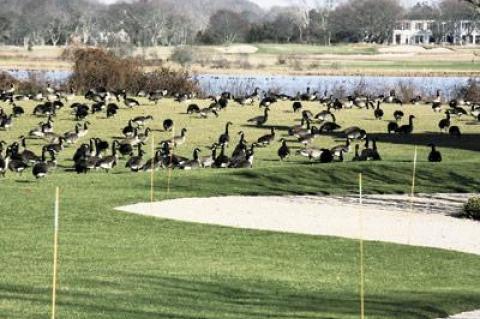 Nature Notes: Duck, Duck, Duck, Goose
Last Saturday, as a part-time participant in the New York State Waterfowl Count for the first time in years, I accompanied the Rubinstein sisters, Vicki Bustamante, and 12-year-old Hannah Mirando from Montauk. Readers may remember that Hannah also was a key observer in the 100-plus-year-old Montauk Christmas Bird Count held on Dec. 14 of last year.
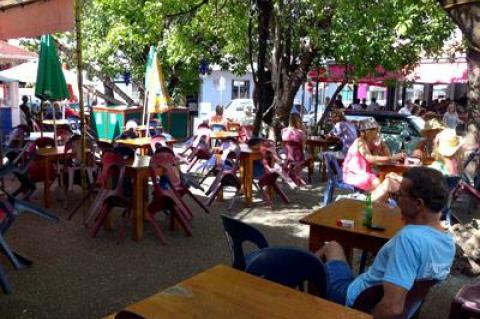 Body Armor on Lizard Island
St. Barthelemy, French West Indies
A late-afternoon tropical squall has passed through with a vengeance as though to erase the illusion, no, the truth, that this place is one of Nature’s finer creations despite its reputation as ground zero among Page Six’s archipelago of celebrity haunts.
Nature Notes: Three Firsts in Bird CountJan 15, 2014
Two weeks and 109 years ago, Roy Latham and his farmer brothers undertook the first East End Christmas bird count centered in Orient. On Dec. 28, 2013, the Orient Christmas count was re-enacted for the 100th-plus time. None of the original cast of characters is still around to take part in this century’s Christmas counts. After the Lathams did it for 50 years or so, Paul Stoutenburgh took it over and carried it on for the next 27 years.
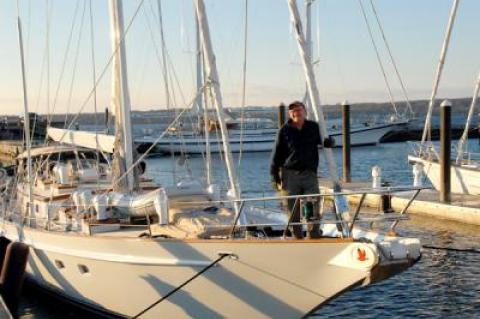 Passage by Sail From Rhode Island to Tahiti
The following, by Capt. Ed Gifford, a licensed sea captain of East Hampton, whose “Glory of Sail” photos of classic ocean racing yachts can be seen at the Bruce Tait and Associates office on Bay Street in Sag Harbor, is an account of the first leg of his voyage aboard the sloop Coro Coro from Portsmouth, R.I., to Tahiti.
In June, a shipmate friend of over 25 years, James Johnson, of Aspen, Colo., asked me to check out a boat he had been keeping his eye on, a 74-foot Royal Huisman Shipyard sloop, for a possible passage to Tahiti.
Nature Notes Gray Squirrel, Black SquirrelJan 8, 2014
At Thanksgiving time I was with my wife, Julie, staying in the Bronx looking after her mother, Grace, who is 94 years old and was recuperating from an illness at Providence Rest at the edge of Eastchester Bay just south of Pelham Bay Park. We parked in a restricted area and I stayed in the car with the motor running while Julie made a last-minute visit before we headed back to Sag Harbor. It was in a residential neighborhood called Country Club and mid-afternoon.
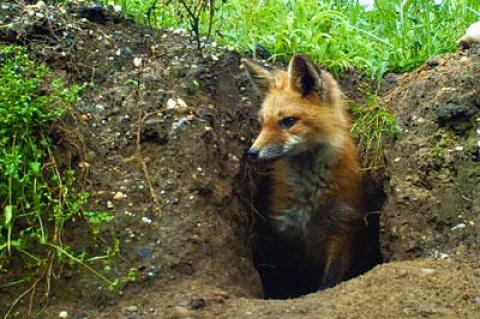 Nature Notes: Predictions and Wishes
It will be hard to top the prediction first made in this very column in the spring of 2012 for the Big One, Sandy, which came in the last days of October of that year, but here goes.
It’s been a quiet year, 2013, but expect a tumultuous change and another Big One come 2014. It won’t be as big, but it will hit while South Fork municipalities, the county, state, and feds are still deciding what to do about Sandy, so it will cause an equal amount of damage.
The Man Who Started It AllDec 31, 2013
I believe I’ve discovered the identity of the first person to ride Montauk’s waves, at least on a surfboard, and also where the surfing took place. Before I proceed, I would like to recognize this as one of those Columbus-“discovered”-America claims.
We know from 17th-century eyewitness accounts that the local Indians fished from canoes, even chased whales with them. It is inconceivable they did not use ocean swells to help propel them back to shore. And, surely they enjoyed the push — surfing defined.
 Nature Notes: Christmas Bird Count
It was a frigid, blustery, sleety, snowy morning when the participants in the 84th Montauk Christmas Bird Count left the comfort of their homes on Dec. 14 to identify and count the birds in a 15-mile-diameter circle including Montauk, three quarters of Amagansett (including Napeague), Springs, and Gardiner’s Island. Some of the counters were participating in their 30th or more Montauk count. These Christmas counts were an alternative to hunting birds with guns and began in the very first years of the 20th century in New York City.
 The Fort Pond Bay Docks Have Accommodated Many Over the Years
Piers, docks, quays, whatever you choose to call them, Montauk’s Fort Pond Bay has had many over the years. They were built to accommodate commercial fishermen, to test torpedoes, to disembark soldiers, Cunard Line passengers, and more than a few cases of bootlegged booze. One even allowed railroad cars to put to sea.
Whatever its purpose, build it and they will come — the ones with a fishing rod, a bucket, some bait, and a few hours to wile away projecting a fish dinner as an excuse.
Nature Notes: At Home Far From HomeDec 18, 2013
Last week I wrote from San Francisco, a metropolitan area with an influx of wild animals, including coyotes. Now I am at Nevada City in the foothills of the Sierra Nevadas at about 2,500 feet. There is snow on the ground from the once-a-year snow and the temperature hovers at the freezing mark each evening.
 Thoughts of Christmases Past
Funny how thoughts cascade, one tumbling into another like stones down a bluff face. This one particular tumble began when Glenn Grothmann of Paulie’s Tackle fame mentioned that herring were being caught from the pier on Montauk’s Fort Pond Bay last week, lots of them.
So, that Christmasy thought — pickled herring is a Christmas mainstay in some households — made me think of how Montauk’s old-timers recalled frost-fishing along the beach out in front of Montauk’s original downtown on Fort Pond Bay.
Drone-Hunting Season?Dec 11, 2013
It’s not uncommon to be awakened by cannon fire this time of year on the East End. Duck hunting season began on Thanksgiving Day. Open season on Amazon drones could be just around the corner.
“Cannon” was the word that came to mind when this former hunter first felt the recoil of a 12-gauge shotgun my father gave me at the age of 12.
 Nature Notes: Visiting San Francisco
Three thousand miles away in San Francisco, and the first bird I see is Corvus brachyrhynchos, the common crow, the same species that we have on the South Fork, doing what it does best here and there: raiding nests, making a lot of noise, attacking hawks and such, and in turn being chased by small birds like blackbirds away from nesting sites. The more things change, the more they stay the same.
Nature Invented It FirstDec 5, 2013
As we continue on into the tech era, after digging out from the post-industrial era, I wonder, what comes next? There are thousands of new patent applications for thousands of new inventions every week. Very few of them will ever see their way to market. Just about every past invention and every one in progress is in some way derived from from nature. Nature’s inventions are not intentional; they arise by gene mutations, adaptation, and natural selection via the process of evolution. For every success there are hundreds of failures.
 A Picasso Moment
Last week I got a call from Orla Reveille, who holds sway over at the Viking Dock in Montauk. She told me to slide by and pick up a book, “The Forsberg Empire,” a memoir by Capt. Paul G. Forsberg “as told to Manny Luftglass.”
Nature Notes: The Great WoodsNov 26, 2013
Hither Woods was hither to what? To mainland East Hampton, with respect to the Point Woods just east of the Lighthouse? While much of Montauk has changed, Hither Woods has stayed the same; it’s never been developed.
Ecologically it has run the gamut from tundra to heathland to oak hickory forest to grassland to savannah and back to oak hickory forest with a smattering of American beech, American holly, and a very large smattering of mountain laurel. In pre-Columbian days it was most likely an important hunting-gathering area for the Montauketts.
 It’s All Out of Balance
I was standing on Turtle Hill on Sunday about noon in front of the Montauk Lighthouse and beside the Lost at Sea Memorial looking down on eight seals close to shore, some floating on their backs, others with just their heads out of water looking shoreward at the few human visitors.