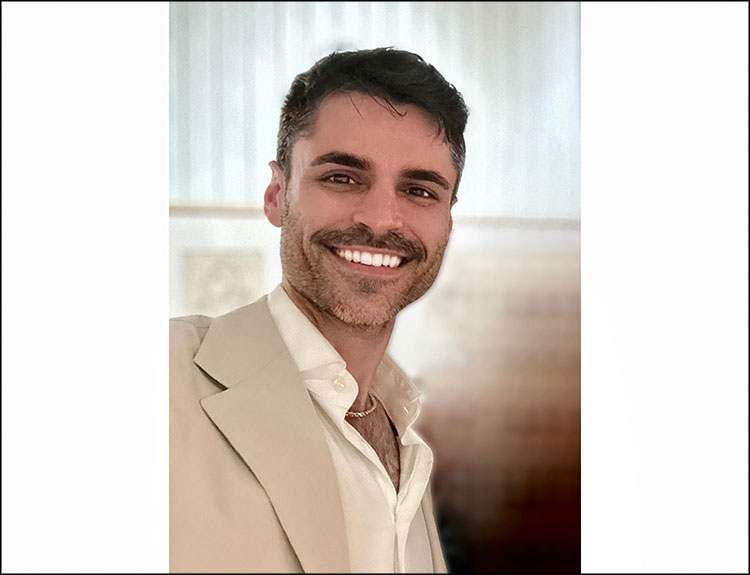
Alexander Michael DiJulio, an artist, gallerist, and food entrepreneur, will be remembered as “a free thinker, a whip-smart curator, and a naturalist deeply concerned with the environment he so lovingly foraged in and called home,” his friends wrote. They will remember him, too, “for exemplifying a life well lived where there was no boundary between art and living. His independent spirit, sharp wit, good looks, and sense of humor will live on through the memories he’s made with his many close friends and family whom he cared for and who cared for him to the end.”
Mr. DiJulio, who was 36, died at home in Springs on Feb. 4 of complications of cancer.
He was born on April 16, 1989, in Wilmington, Del., to Stephen Christopher DiJulio and the former Lynda Cousins. He lived in the greater Philadelphia area in his early years, spending “as much time as he could outside in nature and in museums,” his friends wrote. “He particularly loved the Franklin Institute in Philadelphia and the Brandywine River Museum in Chadds Ford, immersed in nature and filled with paintings and sculptures from that region, much like the home Alex would create for himself in Springs.”
His creative gifts were evident early on, and by high school, his friends said, he was already “confidently advising friends’ parents on building their art collections.”
At Garnet Valley High School, a public high school with an art major program, he thrived. He went on to attend pre-college programs in Philadelphia at the University of the Arts and the Tyler School of Art. “Though several schools offered him full scholarships, Alex characteristically trusted his instinct over others’ advice and chose to attend the Maryland Institute College of Art in Baltimore” to study sculpture, graphic design, and art history. The friends he made there “would become his chosen family.”
While still in college, Mr. DiJulio exhibited his work at museums and galleries in the Baltimore area. After college, he moved to Texas and opened That That, an exhibition space in Dallas, as part of the art collective SCAB (Socialized Contemporary Artists Bureau). He spent time in Marfa, an artists’ pilgrimage site to which he and his friends would return each year to teach art workshops and enjoy live music.
He and his friends founded Meetinghouse Arts, a nonprofit arts organization that offered workshops around the country. That work eventually drew them to the East End, whose art-historical significance resonated with Mr. DiJulio. He settled in the Maidstone Park area of Springs.
Living here, he “became enamored with the vibrant local food scene, befriending bakers, fishermen, chefs, and farmers,” his friends said. “As a natural maker, he became an avid cook, honing his interests in growing and foraging food.” He founded Hampton Hots, a condiment business that made use of produce he grew and foraged, and became director of a gallery based between East Hampton and New York City that specialized in contemporary art and midcentury works of the Abstract Expressionists who made the South Fork their home.
“Alex became recognized for his unique perspective, his approachable dialogue about artworks, his understanding of artists’ histories, and his ability to contextualize his clients’ art collections,” according to his friends.
He was interested in exhibiting art in alternative spaces — barns, beaches, and warehouses. One group exhibition, “The Body Electric,” for example, was mounted inside an old East Hampton polo barn.
An introduction made while exhibiting at the Outsider Art Fair in New York City led to the opening of his namesake gallery space in the Dimes Square neighborhood of the Lower East Side, the Alexander DiJulio gallery. There he continued to focus on showing work by strong emerging talents alongside that of lesser-known midcentury artists.
“Though his tenure was cut short by his cancer diagnosis, Alex helped launch the careers of several artists through thoughtfully curated group shows and first solo and two-person exhibitions,” his friends wrote. “He also produced a series of exhibition catalogs for the gallery.”
“Refusing to limit his creative practice to a single discipline, Alex embodied the epitome of an art-filled life where art penetrated every corner of his existence. His home in Springs became a meeting point for his circle of creative friends, musicians, and fellow artists. He was also a songwriter and musician, creating playlists for friends, and providing vocals, writing, and recording music with the band Moonlit Strays and Knaves.”
When he was diagnosed with cancer, he began developing a cookbook of recipes built around ingredients foraged around his house, titled “Found in Field.”
With friends and family, “the dinner table was always a place of creativity and laughter.” His friends “remember dinners that began with foraging walks and elaborate clambakes on the shores of Maidstone Beach.”
He is survived by his parents, Stephen and Lynda DiJulio of Garnet Valley, Pa., a sister, Melissa DiJulio, and by a circle of “chosen family and close friends who miss him dearly.”