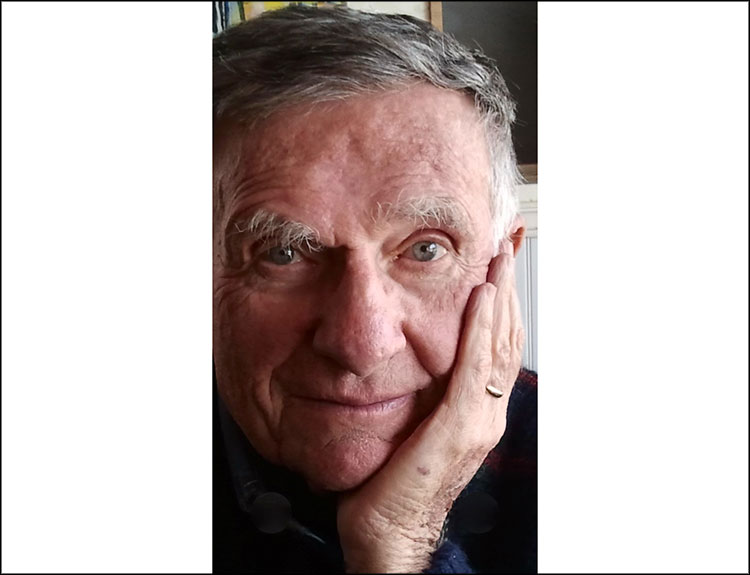
Robert Weisberg, who was instrumental in raising private money for the town youth park on Abraham’s Path in the early 1990s and building the original cable television system in East Hampton, died on Dec. 1 in Manhattan. He was 98.
Mr. Weisberg had a long and successful career in television, helping establish Home Box Office (now HBO) in 1972 and Bravo and American Movie Classics after that. He was a founder of the American Cable Association and served as chairman of the board of the Boston-based Committee for Accuracy in Middle East Reporting in America, a media watch group with offices in 11 countries, monitoring the media in English, Spanish, and Hebrew.
His first job in media was in the mailroom of a television network, according to his wife, Doris Weisberg. He went on to work for Tel-Com, “where he rose to become a film salesman to TV stations nationwide.”
In 1959, just as Fidel Castro was coming to power in Cuba, Mr. Weisberg took Jack Paar, host of NBC’s “Tonight,” to Havana to broadcast from the Tropicana nightclub along with the actor Cesar Romero, Estelita Rodriguez, the star of “Sheena, Queen of the Jungle,” and other entertainers.
It was a tumultuous time in Cuba, and Mr. Weisberg “could recall bombs going off in the Hotel Nacional,” his wife said. When he returned to Cuba several months later to send NBC’s camera equipment back to the United States, “he was heard to say on a phone call that Castro boasted about accomplishments that weren’t his. He was forcibly put on a 5 a.m. plane out of Cuba without the equipment.”
When he returned to Cuba decades later, he learned that “they had used the equipment for more than 50 years.”
While he was modest and quiet about his work, he was “a true pioneer in the emerging technology of cable and pay TV,” his wife said. Rather than run a company, he preferred to create new services.
Recognizing the potential of pay television, “he joined forces with Trans-Lux,” a company in the theater business that also ran the stock ticker found in brokerage offices, to form Stock Quotation Program Services, a cable TV channel that allowed people to watch the ticker tape in their own homes. It was a precursor to the Financial News Network and CNBC. He then founded Telemation Program Services, which became a film buyer for many of the individually owned pay TV systems in the country.
He joined forces with Charles Dolan of Sterling Communications to create HBO, where Mr. Weisberg was in charge of programming and negotiated its first satellite purchase. He also created AMC and Bravo with Mr. Dolan, and when those companies came under the ownership of Time Inc., he “saw an opportunity for Time magazine,” with its reporters around the world, to build a 24-hour cable news service called News Plus. Time decided against it, his wife said, and he instead introduced his friend Reese Schonfeld to Ted Turner, and together they founded CNN in 1980.
Mr. Weisberg won three Ace Awards for outstanding cable television shows.
Born at home in Brooklyn on July 20, 1927, to Boris Weisberg and the former Freda Schiller, he joined the Navy after graduating from high school, just two weeks after turning 18, and served in World War II on the U.S.S. Hamilton, a minesweeper operating off the East Coast. He was awarded the World War II Victory Medal and the American Campaign Medal for his service.
After his discharge, he earned a bachelor’s degree at Brooklyn College and a master’s in Chinese history at Columbia University. He and the former Doris Feldman were married on Feb. 16, 1969.
Mr. Weisberg began splitting his time between Manhattan and Amagansett in 1965, and spent part of each year in Santa Monica, Calif., starting in 1992. He maintained residences in all three places.
In East Hampton Town, he worked with Brad and Betty Marmon, then the owners of White’s Pharmacy, and Bernard Zeldin to build the first cable TV system. He also built a cable system in Kern County, Calif., where he published a newspaper.
He became involved in fund-raising for the Amagansett youth park at the behest of then-Councilman Robert Cooper, and in 1993 was recognized for his contributions by Supervisor Tony Bullock.
He was a frequent letter writer to The Star in those years, and had a strong interest in community affairs. “Amagansett Speaks,” a film he produced that was shown on LTV and to the town board, polled residents on their feelings about more development of Amagansett Square. The consensus: “They were absolutely against” it.
He was a lifelong tennis player who belonged to local clubs and a lifelong skier. He took up golf in his 70s and played regularly at Montauk Downs.
In addition to his wife, he is survived by a nephew, Jeffrey Metzger of East Hampton, Mr. Metzger’s children, Brittany Nierste of Mansfield, Mass., and Joel Metzger of Indianapolis, and many nieces, nephews, and cousins in this country and in Israel.
Rabbi Daniel Bronstein officiated at a graveside service on Dec. 5 at the Independent Jewish Cemetery in Sag Harbor.