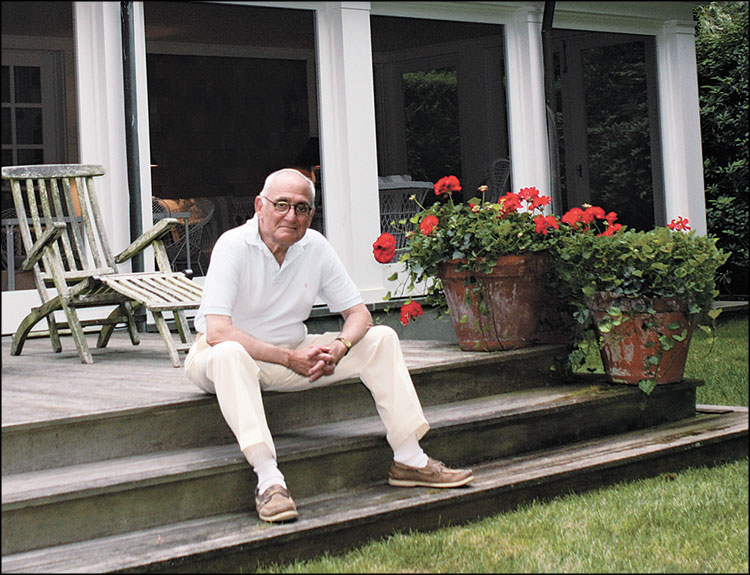
Robert A.M. Stern, a leading American architect whose forceful advocacy of Classicism and function defined his projects in East Hampton and around the world, died on Nov. 27 at 86.
Mr. Stern was credited with a revival of the Shingle Style, drawing on the villas, as he called them, built for the East Hampton summer colony beginning in the 1880s. He designed houses that could be grand without tipping over into ostentatious.
“East Hampton’s architecture provides a useful mirror in which to see the relationships between architecture, landscape, and culture that can foster rather than diminish a sense of place,” Mr. Stern wrote in a lengthy essay in “East Hampton’s Heritage: An Illustrated Architectural Record,” edited by Robert J. Hefner and published in 1982.
East Hampton, he observed, illustrated a simple thesis: “A sense of place and a sense of style need not be mutually exclusive in American architecture.”
“This sense of architectural continuity perhaps as much as any other single factor accounts for East Hampton’s continued success as a resort,” he wrote.
Mr. Stern loved East Hampton’s public spaces, he said in a 2014 interview in The East Hampton Star. “In any village you need public space,” he said. Here, besides the beach, “we have the green, a beautiful visual relief rimmed by traffic. Also, the Nature Trail. And Hook Mill.”
His overarching goal was to create buildings that fit into their surroundings, both visually and in their heritage. This philosophy was threaded through his work on projects as varied as Disney’s Yacht and Beach Club Resorts in Florida and a new children’s wing for the East Hampton Library.
The firm he ran, Robert A.M. Stern Architects, also completed a recent five-year restoration and renovation of the Guild Hall arts center in East Hampton Village. Another highly publicized effort was the 2007 layout for a new East Hampton Town Hall, incorporating a group of buildings, some dating to the early 18th century that had been donated to the town by Adelaide de Menil and Ted Carpenter, who themselves had the structures moved to a property they had owned on Further Lane in East Hampton. The objective for Mr. Stern was to create a coherent structure that respected the originals.
Former East Hampton Town Supervisor Peter Van Scoyoc, who spent many years in the Town Hall complex, observed, “History quietly watching through old timbers and bright light shining through a new glass atrium is a brilliant metaphor for how government should operate, and Robert A.M. Stern was brilliant.”
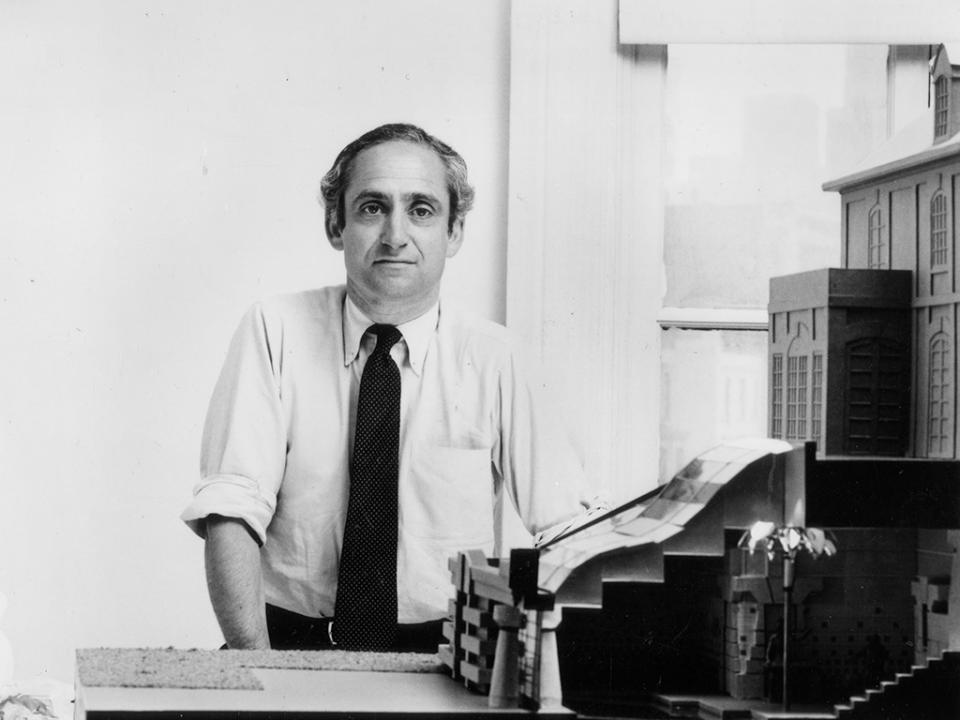
Among Mr. Stern’s celebrated work more broadly were the Museum of the American Revolution in Philadelphia and the Gerald R. Ford School of Public Policy at the University of Michigan.
At Yale University in New Haven, where Mr. Stern was dean of the architecture school from 1998 to 2016, he designed a new residential college complex drawing on the university’s existing Gothic-style buildings.
Other noted works included the Nashville Public Library and the Norman Rockwell Museum in Stockbridge, Mass. He designed the George W. Bush Presidential Center in Dallas and 15 Central Park West in Manhattan, which was hailed as a masterly blend of the city’s classic buildings with amenities to suit modern tastes.
Others included the modernist Comcast Center skyscraper in Philadelphia, a Federal Reserve bank in Atlanta, an aquatic and fitness center at Brown University, and residential towers in Chicago, Manhattan, and abroad.
Mr. Stern’s early residential designs on the South Fork included the Wiseman house in Montauk (1966), and the Norman Mercer house on Ocean Road (1974) and the Bruce Bozzi house on Cottage Avenue, both in East Hampton (1983).
Writing in 1984, Alastair Gordon, an architecture critic, was effusive: “For the past 10 years of his career, Robert A.M. Stern has played with a palette of historical styles perhaps more skillfully than any other American architect working today.”
Mr. Stern’s relationship with East Hampton Village began in the mid-1960s, when he and his then-wife, Lynn Solinger, rented and then bought a house on Lee Avenue. Additions to the property that included a semi-circular porch and a round swimming pool drew attention — and residential commissions, his son, Nicholas Stern, said in an interview.
He would bike throughout the village on an old three-speed, looking at houses, and invite small groups of his university students out to join him in a kind of rolling architectural salon.
After giving up the Lee Avenue house Mr. Stern moved to a modest ranch on Cove Hollow Road, which he renovated slowly.
“I bought a three-room house at a fiscally deprived time, in 1978,” he said in the 2014 interview in The Star. “It was a nothing house. I kept thinking, ‘This will be a halfway moment and then I’ll move on.’ But houses kept getting ahead of me, pricewise.”
That house, too, caught the public’s eye, and people would stop by from time to time to inquire about obtaining a set of plans, his son said.
The Cove Hollow Road house was both a retreat and workspace; many of his more than 20 books were written on a screened back porch. “That for him was his Hamptons downtime,” Nicholas Stern said. On Monday mornings, he would get out of bed at 4:30 a.m. to slog to the Port Jefferson ferry on his way back to his job at Yale.
He said that his father was dismayed by the divvying up of farmland in East Hampton and Southampton in the 1980s and ’90s into small, individual parcels, which would be further scarred by what he called “look-at-me houses.”
On the other hand, he loved the fact that there was a Ladies Village Improvement Society, which he saw as uniquely American counterbalance.
Mr. Stern was also a student of society, his son said. “The Great Gatsby” was his favorite book, for example, and he had a detailed knowledge of the family ties and foibles among the East Coast elite, his son said. “He had a sociological history of money and knew Long Island from top to bottom,” said the younger Mr. Stern.
Robert Arthur Morton Stern was born in Brooklyn on May 23, 1939, to Sidney Stern and the former Sonya Cohen. He attended the Manual Training School in Brooklyn. As a youngster, he was fascinated with the city, spending weekend hours wandering around Manhattan taking in the buildings.
He graduated from Columbia University in 1960 with a history degree, then earned a master’s in architecture at Yale in 1965. He and a friend from Yale, John Hagmann, launched an architectural firm in New York City in 1969.
Soon after, Mr. Stern joined the faculty of Columbia University’s Graduate School of Architecture, Planning, and Preservation. He directed its Temple Hoyne Buell Center for the Study of American Architecture from 1984 to 1988, according to his obituary in The New York Times.
He founded Robert A.M. Stern Architects, which employed a staff of up to 300 at times. He ran the firm much like a university, with lectures and a vast library of art and architecture books that the partners and staff could turn to for inspiration.
Writing for Elle Decor after Mr. Stern’s death, the interior designer David Netto said he thought of him as two Robert A.M. Sterns: “There was Bob the historian and teacher; the other, more visible Bob was the superstar architect we all know, whose love of history — and instinct for applying his knowledge of it with new relevance — gave New York and many other cities some of the most successful buildings of our time.”
In addition to his son, Mr. Stern is survived by his brother, Elliot Stern, and three grandchildren.