
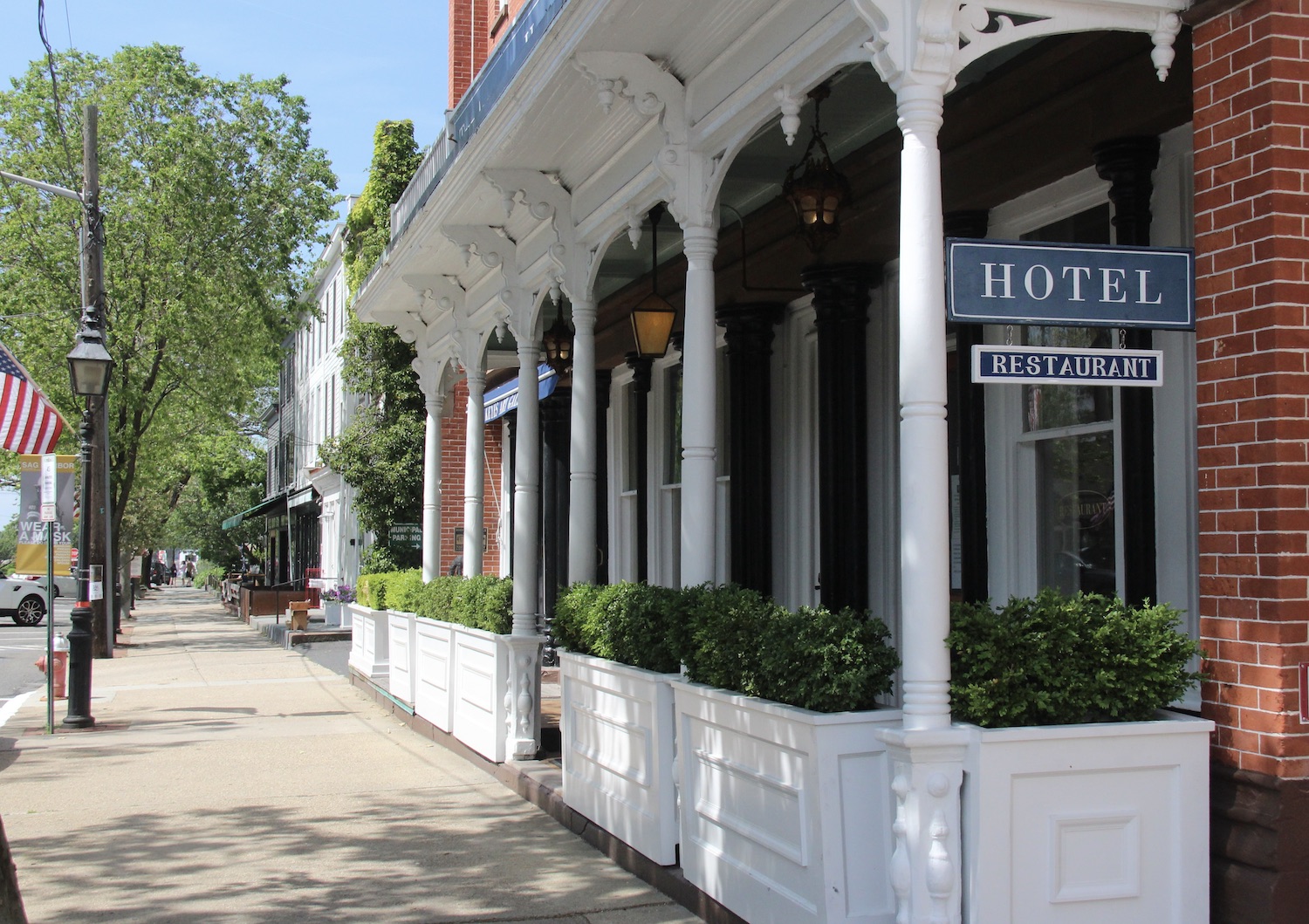
Ted Conklin’s bright, shining creation, the American Hotel in Sag Harbor, was for so many an umbilical cord connection to sophistication, stimulating conversation, fabulous food, fun — the best of times. A host of memories, fragments of 50 years, flood my mind as I consider the enormity of Ted’s passing and his contribution to our life. The patron saint of Sag Harbor.
In the late 1970s, a New York Times reporter, Judy Klemesrud, a friend and softball teammate — only a handful of women played in The Game, as it was known, Saturdays in Mashashimuet, the unpronounceable village park — invited me for drinks at the American Hotel. It was my first visit to Sag, I’d had no other reason to go to the former factory town. It seemed dreary, dumpy, run down. Grumman and Rowe Industries had closed in the early ’70s, and the Bulova watchcase factory was on its way out. The storied whaling village was ancient history. Not a Hampton. Not on your life.
I climbed the steps of an old-fashioned white filigree porch — all it needed was a swing. Inside, it was packed, the energy palpable. The strains of a piano filled the air — Hunky Page, jazz pianist extraordinaire, tinkled the ivories on a Steinway, far left, almost out of sight. After helloing everyone from our team — from the master mag writer Robert Sam Anson to Carl Bernstein, Judy introduced me to Ted Conklin, the host and owner.
Huge welcoming smile, glasses, crisp white shirt, red tie, navy blue blazer, white pocket handkerchief — a classy, country gentleman. Handsome. Charming. A gleam in his eye. I was instantly smitten, like countless others. Of course, he had a girlfriend — or was married — at least three times. Lord of the manor. I admired his club, an elegant early-American oasis.
As a writers’ hangout, it was a haven filled to the gills with scribes of many stripes — journalists from The New York Times, Newsweek, Time. Many lived in Sag. They could rent, buy, fix up a shabby fisherman’s shack dirt cheap, didn’t need land or views like the artists who went to Springs for light and space. Everyone knew everyone.
The crowded wraparound wooden bar in the next room had only one seat open. We shared. There was a rowdy round table under the moose head — the “table of tables,” according to Judy. We drank, table hopped, gathered round Hunky much later, sang. I’d found the Elaine’s of the Hamptons, writers talking the talk, letting off steam after a long, lonely day.
Summer 1991, I rented a garage turned cottage in the Wainscott backyard of the author Arthur Herzog (“The Swarm,” “Orca”). He’d bought it at an auction — “50 bucks for my 50th birthday.” One night I awoke with a start — the house was rocking and rolling. Hurricane Bob was hammering the East End hard, a series of tiny twisters upending hundreds of trees. I hied to the nearest safe fortress, East Hampton High, met up with my sister-in-law, young niece, and nephew. A harrowing eight hours later we left, scared but spared.
I headed to the Hotel. In the barroom, a bunch of survivors gathered round the fire by candlelight. Ted welcomed me with open arms. “You made it.” Always interested, a great listener, he wanted to know details. “Things were shaking, rattling, and rolling,” as I’d told a reporter for The Times just after I’d exited the school.
The Times headline the next day: “L.I. Was ‘Shaking, Rattling and Rolling,’ but It Missed the Worst.”
Ted was innovative, creative, forward-looking. He bought the air rights to the space between his southern brick wall and the Municipal Building next door, filled it in with a glass roof and cement to make room enough for seven tables — dining on air, so to speak.
He created an iconic, award-winning, world-class wine cellar. Not an oenophile, I asked my old New York neighbor, Michael Aaron, former owner of Manhattan’s storied Sherry-Lehmann Wine & Spirits, “Did Ted do it himself?”
“Yes! Absolutely! I give him a lot of credit.” Michael began to chuckle, “You’re going to love this. Sometime in the late ‘70s, we — 10 couples, 20 of us — rented out all the Hotel’s rooms — they only have about eight — for New Year’s weekend plus a dining room for the Eve. We went to town, didn’t spare the horses decorating — hats, glasses, necklaces, balloons, favors, flowers. During New Year’s Eve, three sheets to the wind, as you might expect, we formed a conga line and danced though all of the rooms, surprising the other diners who had something to say about it — not what you think. ‘Ted, how come we don’t have favors?’ This led Ted to spring for similar future seasonal festivities — return the favors.” Michael had the last laugh.
Thanks to my brother, Peter, in 2000 we celebrated Thanksgiving with Mother under the moose head. Ted made a big fuss over her, attractive and vivacious at 93. Beautiful flowers, candles, tablecloth. Mother, an aficionado of the early American, was thrilled. Loved the turkey, the vegetables, the stuffing, the pie, the ambience. Win-win.
Summer 1993. Lindsey Kane, owner of Metaphysical Books and Tools down the street, Judian Cooney, travel agent, and I had a tradition — Thursday Girls’ Night Out at the Hotel, all gussied up. Ted spied us, left a conversation deftly. “Hi, ladies. Uh-oh, here comes trouble.” He hugged us, trademark big smile — he loved pretty women.
We were early enough, 4:30 p.m., to score seats at the soon-to-be-overpopulated bar, catch the early-bird special, bacon cheeseburger, $8, best in the Hamptons then, even at $18 now. They ordered two margaritas each to max out the low prices, and Vinnie the bartender was generous. We sat next to Steve Kroft before his “60 Minutes” time.
The crowd had changed. The bar for hunting, the tables for dining, the reputation of the cuisine star-worthy — prime meat, local vegetables, fish and seafood. There were regulars plus well-heeled Wall Streeters, the new guys in town, whose wives wore New York black. The Hotel’s reputation: “the place to be in the Hamptons.” It had been found. Like the rest of Sag Harbor.
In 2017 Keyes Art replaced the Bond perfume store in the adjacent space owned by Ted, on the north side of the Hotel. Julie Keyes recalled how often Ted, “loyal friend, champion, and collaborator,” was her only customer when she’d waitressed at another restaurant on weekdays.
She added, “As glamorous as he was as a proprietor, he had a childish, prankster side. You know my husband” — the artist Nathan Slate Joseph — “likes to have a few drinks, and when he does his voice gets loud. Ted had a tasteful 8-by-12-inch message framed and hung above the receptionist counter. In times of need, when Nathan got obstreperous, he flashed it: ‘Lower voice please.’ “
Ted was passionate about supporting the town’s other restaurants, could be found dining at any one of them anytime. But I didn’t recognize him three years ago at the Dockside, my second-favorite eatery, which then shared space inside and outside the American Legion building. He was sitting with Julie and Nathan, unshaven, stubble — that scraggly, unseemly outburst of masculinity making men look worse, especially older ones — mixed with white.
“Susan, Susan,” he called across the room. We hugged for five minutes. “I’m escaping to Palm Beach. Not going to let doctors run my life. They get you in a vise. I don’t need those constant checkups and tests, plenty healthy.” No mention of bladder cancer. It was the last time I saw him. Ted made it three more years. His way.
I’ve spent five birthdays, two Christmases, four Thanksgivings, two New Year’s Eves, hundreds of brunches, lunches, drinks, early-birds, dinners, and nightcaps at the American Hotel with friends, family, alone. They were the highlights of my life in the Hamptons. Thanks for the memories.
Note: It took 50 years for Sag Harbor to become the hottest Hampton — from down and out to in — following Ted’s lead. The good news, word on the street is that his family has no plans to put the Hotel up for sale. Vinnie, the bartender for 35 years, has the rights to write the book.
Memorial services for Ted Conklin are scheduled for Tuesday in Sag Harbor at the Old Whalers Church at 1 p.m. and at Bay Street Theater from 2:30 to 5.
Susan Israelson is the author of “Water Baby,” a novel, and co-author of “Lovesick: The Marilyn Syndrome,” a self-help book. She lives in East Hampton.