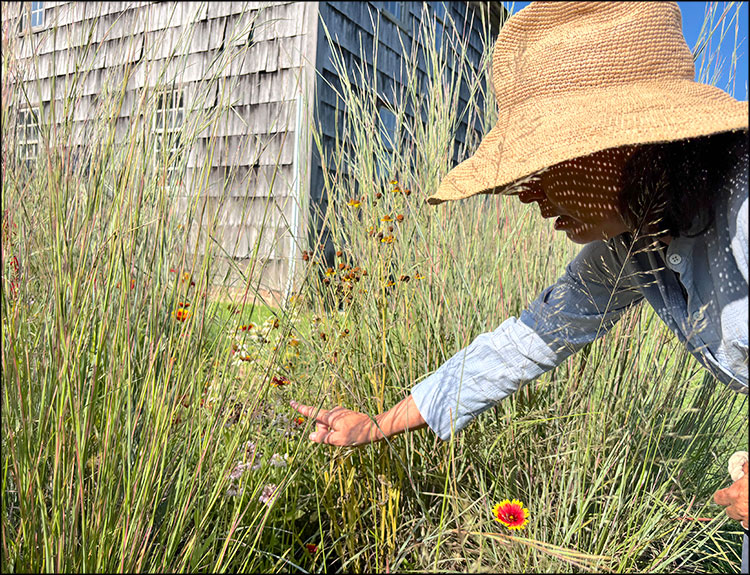
At a late-summer East Hampton Town Board work session, an audience member’s attention was steered from the poetry of resolutions on out to a window, where a middle-aged woman was taking a picture of a purple flower.
The flower wasn’t there just a few years ago. With a layout by Abby Clough Lawless, owner of Farm Landscape Design, donated help from Whitney’s Landscaping, grants from the Long Island Community Foundation and the J.M. Kaplan Fund, plus scores of volunteers, it was planted as part of a community pollinator garden. Gail Pellett and Stephan Van Dam, co-founders of ChangeHampton, which promotes biodiverse and sustainable landscaping practices, first proposed the garden and then championed it from seed to blossom.
Designed to create “both drive-by and walk-through experiences,” the previously blank sod has been replaced by native plants, flowers, and a world of insects and birds. The original garden has now expanded into eight or so distinct beds, tall meadow, short meadow, pollinator, each with its own flavor, within a larger “grassland” that includes 14,000 square feet recaptured from turf.
Soon, perhaps by Thanksgiving, said Ms. Pellett in an email, a grove of oak trees with understory ferns will add a new dimension to the thriving ecoscape.
Ms. Clough Lawless, who was walking the reinvigorated space one recent morning with her corgi, Max, spoke about the garden the way you might talk about your suddenly independent child. While she designed it four years ago, it’s only now become fully established, and alive with insects.
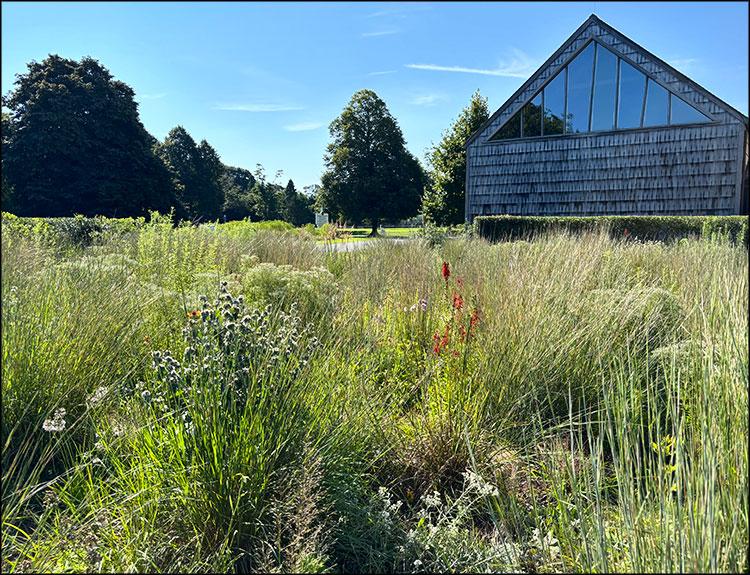
Beefy yellow flowers rise up around Bill King’s sculpture, part of the tall-grass meadow. “They’re a surprise to me,” said Ms. Clough Lawless. “It’s sneezeweed, helenium. I don’t know why they’re called that, because they don’t make anyone sneeze. Wouldn’t they look beautiful in a vase? Talk about native and gorgeous.”
She walked the edge of the garden, along a path of mowed grass. Each bed is connected by eight-foot-wide grass pathways.
“We’re trying to convince people that meadows can be charming and beautiful,” she said. “Look at this purple love grass that we seeded. It creates this scene, and then here is a bee balm jumping up out of it.” It was as if she were discussing a painting, or architecture.
Over in the short-grass meadow, bluestem had got a bit long. Just now, in September, it’s getting fuzzy seedheads. “It’ll be gorgeous” she said. “This is really cool, I’ve never used this, this is allium,” she remarked, lightly touching a purple bloom. “It’s so pretty. and I’ve never used it in meadows, but boy, I’m going to start using it now.”
“This is a mint,” she said, pointing to a plant in the pollinator garden. “A lot of what we put in here is herbal. Deer don’t like herbs. Look at the bees on it. They’re going crazy.” A bystander took out his phone, opened the Notes app, wrote “Hoary mountain mint, Pycnanthemum incanum.”
“A lot of this is just going to change, change, change,” Ms. Clough Lawless predicted, sweeping her arms toward Town Justice Court. “Every year is going to be different.”
Perhaps that’s what’s most important to appreciate about the meadows. They change. Not just stagnant squares, they’re dynamic. You may think it’s the East End’s most hated mascot — the tick — that keeps lawns low, lethargic, and lame, but according to the garden designer, there’s something even more primal.
“People like depth perception. If you’re blocked, you’re prey.” What people want from a landscaped garden is control, clean lines, she added, but that’s not how nature tends to work.
“It’s primal,” she said, shrugging. This fear of messy nature.
If they overclear their property, homeowners often have a responsibility to revegetate. The Town Hall campus could serve as a palette of plants to choose from.
“I think there’s an opportunity to remodel these revegetation situations,” Ms. Clough Lawless said. “There’s so much resistance to revegetation.”
Hummingbirds. Dragonflies (“the Devil’s darning needle.”) Bumblebees. Honeybees. Countless unnamed native bees. Monarchs. Skippers. None of them would have been here just a few years ago.
Most people experience Town Hall strictly between the hours of 9 and 5. When she was designing the garden, Ms. Clough Lawless spent time there after hours. “I was here one evening and there were all these fawns,” she said. “There’s magic hour out here. It’s almost like a park. I wish they would put in a public bathroom.”
The meadow-curious could do worse than to start with a Town Hall visit. Download the “Seek” app. Take pictures of plants you like. Identify them. Ask your local nursery to stock them. Dig up a few yards of industrial-strength lawn and trade the hum of a mower for the hum of insects. There’s a whole world out there.