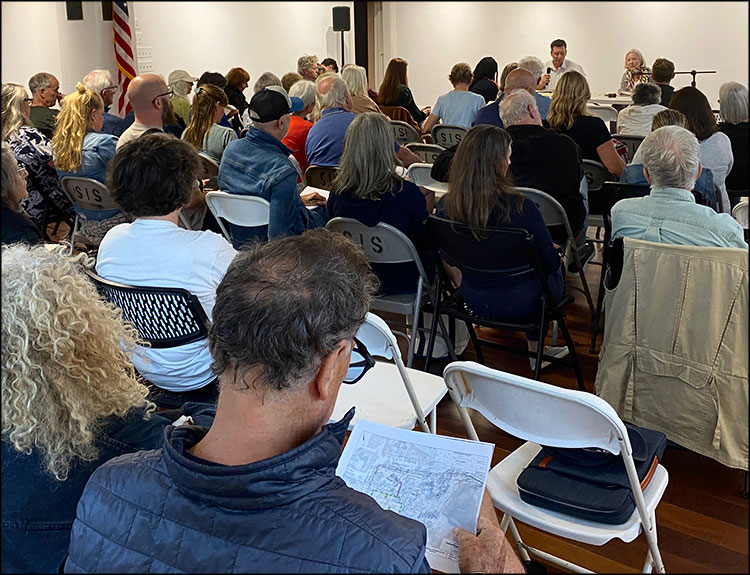
Tuesday’s meeting of the Springs Citizens Advisory Committee saw spirited argument for and against a proposed parking lot at the Springs Library.
The East Hampton Town Board announced last month that a consultancy had prepared layout options to accommodate 21 or 33 parking spaces, each plan including two additional handicap spaces. The board coalesced around the larger layout, which would require around 17,000 square feet of clearing.
Popular events like the Springs Farmers Market, held on the grounds of Ashawagh Hall on Saturday mornings in the summer, as well as art exhibitions and other events there and at the Springs Presbyterian Church, the Parsons Blacksmith Shop, and the library result in periodic shortages of parking — and, the lot’s proponents say, consequent dangerous conditions for pedestrians, cyclists, and motorists.
Councilman Ian Calder-Piedmonte, the town board’s liaison to the committee, said the current proposal is for a gravel parking lot with a natural, landscaped character that integrates it into the surrounding landscape, rather than “an ugly Home Depot parking lot.” The lot is being engineered to contain a five-inch rainfall, he said, with drainage structures in addition to a permeable gravel surface.
As he said at the Aug. 18 meeting of the town board, Mr. Calder-Piedmonte reiterated that the Springs Historic District guidelines manual calls for the area in question to be cleared, and that removing the trees there would restore a historic vista.
Access would be from Springs-Fireplace Road. “We admit, the lot won’t always be full,” Mr. Calder-Piedmonte said.
Those who work “in the triangle” — Ashawagh Hall, the church, the blacksmith shop — “all feel this is a problem that is growing,” Loring Bolger, the committee’s chairwoman, said of the lack of adequate parking.
Mary Beth LaPenna of the library, who is president of the Springs Historical Society, said the library is busier than it has ever been. “We have a lot of programming going on.” Yes, there will be “a lot of time when it’s empty,” she said of a parking lot. The plan may not be perfect, “but we need more parking spaces.”
Representatives of the church and the Springs Improvement Society also spoke in favor of the parking lot, as did Dylan Greene, a teacher at the school, and David Buda of the committee. The current “minimal parking” is “woefully inadequate” and makes for chaotic roadways, Mr. Buda said. A parking lot is a “reasonable and necessary addition” and would displace “an overgrown ramble of vine-choked, dying trees.”
But many others collectively voiced a long lament for a time before rampant development and the attendant explosion of people and traffic. “I don’t understand why every time there’s a reason to knock down the woods, they do it,” said Braden Crozier, who grew up in the hamlet. He likened the parking lot proposal to a prior town board decision that identified the wooded area bordered by Crandall Street, Lincoln Avenue, Norfolk Street, and Fort Pond Boulevard in the hamlet as the best option to site a 180-foot monopole that would house emergency and personal wireless communications equipment. An uproar among neighbors thwarted the plan, and the pole was sited elsewhere.
“Why can’t we preserve the woods we have?” Mr. Crozier asked. There are “so many options here,” he said, “and we’re going straight to building a parking lot? That’s absurd.”
Patrice Dalton, a town trustee, was among many who worried aloud about impacts to the water quality in Pussy’s Pond and Accabonac Harbor. Gravel requires removal of topsoil and application of an aggregate mix, she said. Combined with cars atop the surface, the ground will be “severely compacted, which adds to our concern.” A steep downward slope from the library to the pond “will enhance the probability that water will make its way to the pond.”
The land will be regraded to prevent that, Mr. Calder-Piedmonte later said.
Jody Sutter, representing the Accabonac Protection Committee, urged that “all reasonable alternatives are explored first, like parking in other town-owned areas.” Event spaces might collaborate so that multiple gatherings do not take place simultaneously, she suggested. Whatever is decided, the committee “urges that as small an impact is made on this very delicate environment that we all cherish.”
Krae Van Sickle insisted that a parking lot would not resolve safety concerns, but rather would “only assuage parking by a modest amount” and “create a vacuum that will be filled. . . . We’ll be back where we started.” Adding capacity to manage peak demand “involves molesting our neighborhood for 100 percent of the time” to accommodate the fraction of time when that capacity is needed. Demand can be distributed in other ways, he said, suggesting bicycle paths and parking on School Street, a short walk from event spaces.
The more people and construction, “the more we take away exactly what made it special,” Katie Reid said of the hamlet. More wildlife is killed in the streets as their habitat is developed, she said, along with trees and insects “crucial to survival of our species.” She also pointed to the school for parking.
While the plan to construct a parking lot has yet to be formalized, it is progressing, Mr. Calder-Piedmonte said. He encouraged residents who want to weigh in to contact him and his colleagues on the town board.