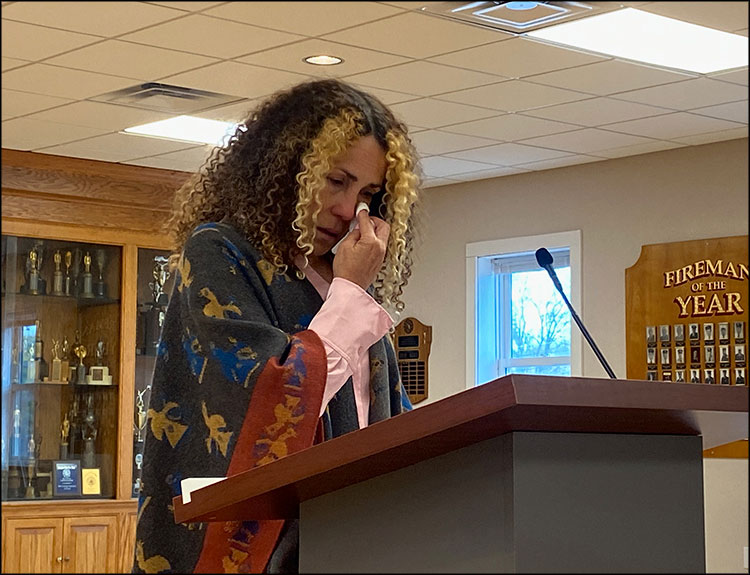
There were smiles and a few tears on April 22 when the East Hampton Village Board held a public hearing before adopting, by unanimous vote, a law establishing a new section of the code to specify that village personnel will not participate in federal Immigration and Customs Enforcement actions, nor assist civil immigration enforcement efforts, nor will village facilities be used to detain people solely for civil immigration enforcement absent a judicial warrant.
The village is the first municipality on the East End to adopt such legislation, which prohibits it from entering into Section 287(g) agreements, a partnership between ICE and local law enforcement allowing designated officers to perform immigration enforcement functions. It acknowledges the federal government’s authority to enforce immigration laws and that federal law pre-empts conflicting state or local laws. But it adds that village personnel “shall not use village resources, equipment, property, databases, or funds to investigate, detain, question, arrest, or transport any individual solely for purposes of federal civil immigration enforcement, except pursuant to a judicial warrant or as otherwise required by law.”
It also specifies that the village’s Flock license plate reader surveillance cameras shall not be accessed, queried, or shared for purposes of federal civil immigration enforcement, and creates an advisory task force “to review public safety and peace and good order concerns relating to federal immigration law enforcement activities within the village, and transparency relating to same.” The task force will comprise the mayor, the chief of police, a village trustee, and a village resident to be appointed by the board, and will provide a quarterly advisory report to the board.
The law, Mayor Jerry Larsen said at the board’s March meeting, during which a date for the public hearing was announced, “codifies what our Police Department is already doing,” but it “reassures the public that we are doing the right thing.”
The April 22 meeting included the public hearing on the proposed law, which had been recommended by Organizacion Latino Americana of Eastern Long Island, or OLA. Five people addressed the board before its vote. “Thank you all for taking what we proposed and making it stronger and better for East Hampton Village,” Minerva Perez, OLA’s executive director, told the mayor and the board. “We are very happy with this law. We hope to see it move forward.”
“This law is not about hindering federal enforcement,” Erika Padilla, OLA’s legal advocate, said. “It is about protecting the integrity of our local community and the safety of every person who lives here.” OLA, she said, has “seen reports of unidentified, masked individuals claiming to be law enforcement. This is dangerous, not just for the immigrant community but for everyone.” If residents are wary of reporting crime to the police for fear of being detained, “our entire public safety network begins to crumble.”
Immigrants, she said, do not seek special treatment. “What we’re asking for is for due process and clarity.”
“We believe that this is a balanced and legally sound approach that allows the village to exercise its local authority responsibly while remaining fully compliant with federal and state law,” said Emily Lupercio, also of OLA.
“This law,” added Andres Espinosa, OLA’s director of finance, “helps protect access to schools, health services, and other important public places, even churches, while respecting the rights of all residents.”
The law, Stephan Van Dam, a co-founder of ChangeHampton, said, “protects the most basic right that we have in the United States, which is habeas corpus. You can’t just be snatched off the road by somebody who is unidentified and who has no visible authority. For that reason alone, I think the village should adopt this legislation.”
The hearing was closed and the board voted to adopt the law. “Clearly,” Ms. Perez told the board after its vote, “this means a lot. It means a lot that you’re the first municipality to recognize how important this is.” She thanked the mayor and the board, Marcos Baladron, the village administrator, Lisa Perillo, the village attorney, and Chief Jeffrey Erickson of the Police Department.
“As the world changes around us, sometimes it’s important that we raise and clarify our voices above the din, above the confusion,” she said. “And this is that moment.”