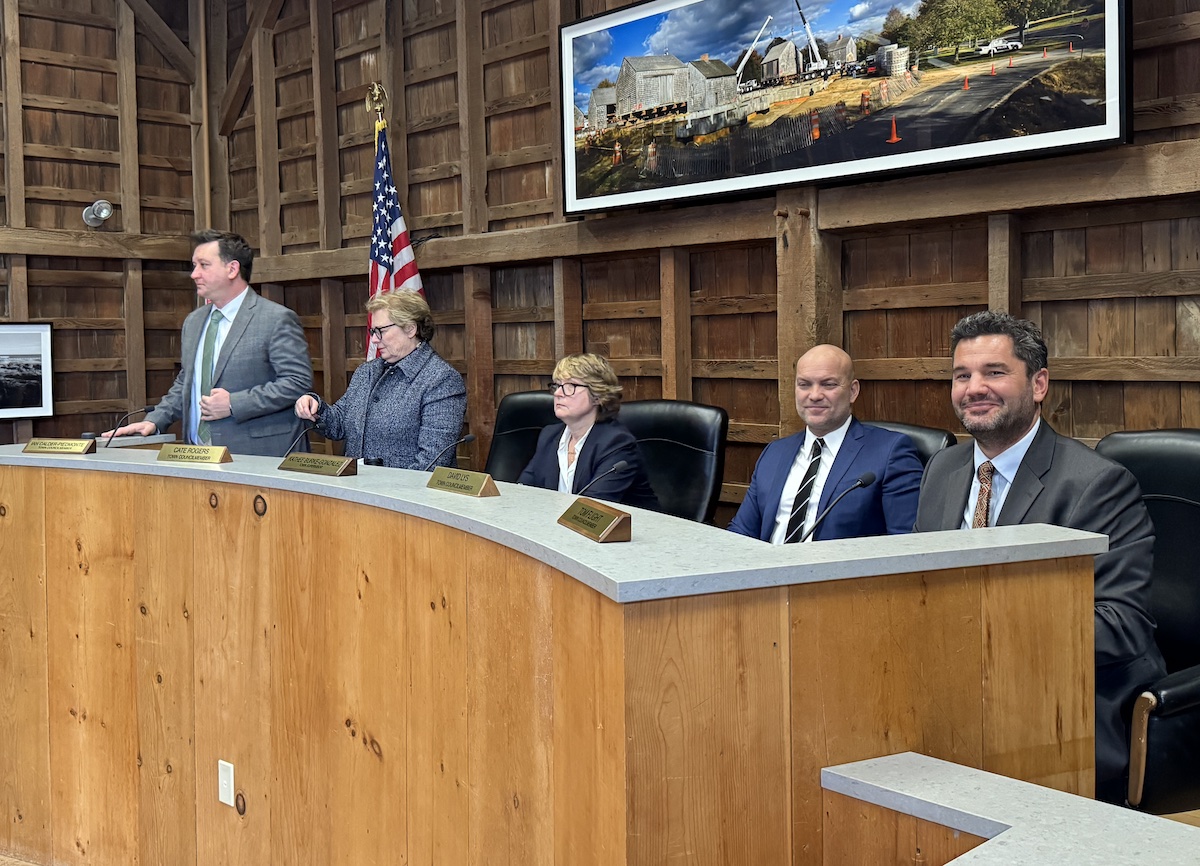
When Councilman Tom Flight and Councilwoman Cate Rogers fell into a debate last week about proposed income limits for a pilot program that would provide community housing fund grants for the construction of affordable dwelling units, or A.D.U.s, it was a sign of how far the town has come, in just the last year, to incentivize residents to build them.
Mark Morgan-Perez, the director of the office of housing and community development, suggested the board allocate $1 million from the C.H.F. and spread it over 10 loans to build the affordable units.
If a homeowner accepts the money, for example, the A.D.U.s could provide housing for tenants earning 130 percent of the “area median income,” or $197,880 for a one-or-two-person household, and rents would be stabilized at no greater than 130 percent of “fair market rent,” at present $3,092 for a one-bedroom.
The town caps the number of A.D.U.s per hamlet at 40, so that school districts aren’t overburdened. The most recent numbers show 14 have been built in Springs, 17 in East Hampton, six in Montauk, one in Amagansett, and zero in Wainscott.
Eight more are under construction in East Hampton and another four in Springs, yet more are needed.
“I started the A.D.U. committee in January 2024,” Mr. Flight said in a phone call Tuesday. “That was the platform I ran on. They’re the best solution to deliver affordable housing.” Growing up in London, he said, A.D.U.s were common and they worked.
The C.H.F. loans are interest-free, secured by a lien, and repayable to the town when the property sells.
The board settled on using New York State STAR income restrictions, meaning that as long as a family is making less than $500,000 a year, they’re allowed to receive the $100,000 grant from the town. Mr. Flight felt there should be no income restriction at all.
The C.H.F. loans are part of a wider town board strategy aimed at enticing homeowners to build more of these housing units.
For example, this winter, the board passed what’s known as the “affordable multiple residence” legislation. While not specifically targeting A.D.U.s, the law created a new use allowing for more than one residence to sit on a single parcel of land. The extra residence must be rented directly by the property owner to a town resident, while the owner could occupy the other.
The use is only permitted on properties with an affordable housing overlay and requires site plan approval and a special permit. A house could be converted into a multiple residence, with multiple units within the building, or there could be multiple detached single housing units on the lot, or a combination of the two.
So, while A.D.U.s aren’t the target of the legislation, it allows for similar units.
Previously, to be considered for the affordable housing overlay designation, a lot had to be at least 170,000 square feet. The law lowers the minimum lot area to 40,000 square feet, also known as a builder’s acre, and the smallest unit could be 300 square feet. (The town board added a provision prohibiting more than two occupants per bedroom.) The maximum lot density would be four units (one additional unit is permitted per every additional 10,000 square feet of lot area).
Another law that alters the minimum lot size required for an A.D.U. has been supported by the board, but has stalled since a public hearing was held in November. It would reduce the lot size restriction to build a single A.D.U., currently at 20,000 square feet, to 15,000 square feet.
Perhaps the problem was that it was coupled with a proposal that would allow nonresidents to construct A.D.U.s, an idea that was roundly attacked at the public hearing. Currently, code requires the builder of an A.D.U. to live on the property, which must serve as their legal primary residence. Within the same law, the board sought to allow an additional car to park on a lot that includes an A.D.U. Currently four cars are allowed, if passed, five would be permitted.
In April, the board declared itself lead agency per the New York State Environmental Quality Review Act regarding the law and it is now being mulled by the Suffolk County Planning Commission. It could finally be voted into town code in May.
So, clearly the board is working to make its zoning laws more A.D.U.-friendly. Using another strategy, it has also proposed property tax exemptions for homeowners willing to build an A.D.U.
A public hearing on that proposal was held on April 16 and received only one comment.
David Buda, owner of Bonac Tax Reduction Service, a tax grievance consultant, said the tax exemption could benefit absentee owners, who are still not allowed to build A.D.U.s in the town.
“The State Legislature did not create this new A.D.U. property tax exemption so that it could be taken advantage of by property owners who do not occupy their residence or who use it primarily or exclusively for income producing purposes,” he said.
However, if the town approves the other legislation first, it appears that the tax exemption could indeed benefit absentee owners.
More changes to A.D.U. law are in the pipeline, including pre-approved plans available through the town, which could quicken the permitting process.
“Getting individuals to deliver housing instead of government is a better methodology,” said Mr. Flight. “Affordable housing is the number-one issue for locals. We need to get younger people moving out here. Building full-scale housing developments is more challenging than encouraging people to build additional housing on their property, and we have a cap on how many can be built. That’s the fundamental oversight.”