It was mention of Vibrio vulnificus, a flesh-eating bacterium that can kill a person within 24 hours of infection, that garnered the most attention ahead of the State of the Bays symposium at the Stony Brook Southampton campus on April 24, but the viral and sensationalist nature of its social media dissemination overshadowed similarly dire news regarding degraded waterways and climate change.
The annual report delivered by Christopher Gobler, of Stony Brook University’s School of Marine and Atmospheric Sciences and the New York State Center for Clean Water Technology, focused on the dangers to human health from nitrates and harmful algal blooms along with Vibrio vulnificus, which in 2023 killed three people who swam in or had exposure to Long Island Sound. Once confined to tropical waters, the northward migration of Vibrio vulnificus is a consequence of fast-warming oceans.
Activity on land has “an incredible consequence” for water quality, Dr. Gobler said. As Long Island’s population has grown, “concentrations of nitrogen in the groundwater below our feet have progressively increased” to an average of about 3.8 milligrams per liter, while for the majority of Americans the average concentration is less than 1 milligram per liter. “This does have consequences,” he said.
The federal Environmental Protection Agency is at present studying its 10-milligrams-per-liter regulation to prevent blue baby syndrome, triggered by methemoglobinemia, or nitrate poisoning, because “there’s been a growing body of literature and papers . . . showing that high levels of nitrate in drinking water at concentrations below 10 milligrams per liter may be harmful to human health and may have consequences for increased risk of cancer.”
The World Health Organization considers nitrate a probable carcinogen, Dr. Gobler said, and research is solidifying links between nitrate in drinking water, even at levels well below the E.P.A. standard, and cancer and, potentially, birth defects.
While ecosystem-disruptive algal blooms that are not toxic to humans but can lead to fish kills and other adverse outcomes are becoming less prevalent in Long Island waters, that decline is offset by those that produce toxins, Dr. Gobler said. “Microcystis is the most common species that we see across Long Island,” he said. It makes the compound microcystin, which when first identified was called “fast death factor” because “it elicited rapid mortality in test mammals.”
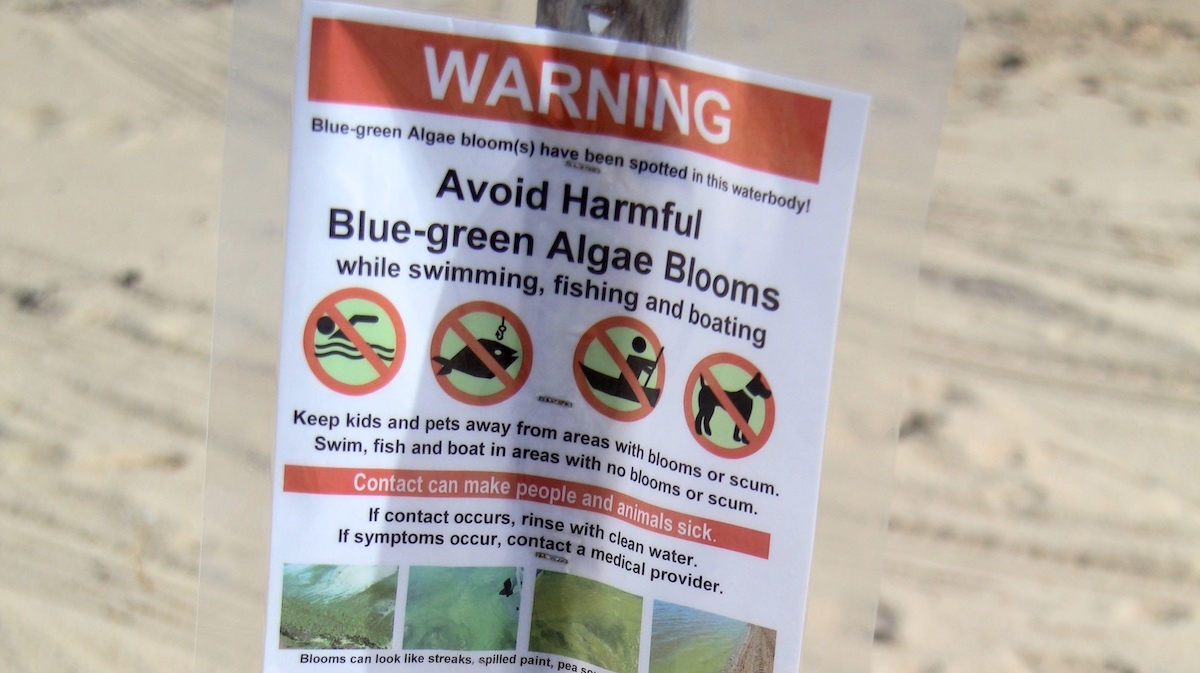
There have been hundreds of cases of dogs poisoned by cyanobacteria, or blue-green algae, in freshwater bodies, including in Georgica Pond in 2012. These, he said, likely represent a small fraction of such incidents in the United States annually. “More recent evidence is demonstrating that these particular toxins can be aerosolized and then be put in the air — that’s yet another human exposure route.”
The 252 cyanobacteria blooms in New York State in 2025 set a record. With 27 blooms, Suffolk County led the state, far ahead of the county with the next highest total — 11. “Clearly, excessive nutrient loading is probably at play here,” Dr. Gobler said. He pointed to Wainscott Pond, where the duration and intensity of such blooms have skyrocketed since it was first monitored in collaboration with the East Hampton Town Trustees in 2014. “Left to their own, these events usually don’t get better and oftentimes get worse,” he said. “And nitrogen loading can play an important role in these events.” Microcystin, “when flushed with nitrogen, makes lots of toxins.”
Turning to marine waters, Dr. Gobler noted that Saxitoxin fhaboris a potent neurotoxin produced by marine dinoflagellates like Alexandrium and is the primary cause of paralytic shellfish poisoning. “This organism is widespread in our coastal waters,” he said. Last spring, the western half of Shinnecock Bay was closed to shellfishing due to “the second-highest cell density we’d ever seen,” while Moriches Bay and Fish Cove in North Sea Harbor saw concurrent closures, the latter being the first ever in that waterway. The North Sea landfill is adjacent to Fish Cove, and a plume of high nitrogen was leaching from it, “and in doing so led to very high levels of dinoflagellates.”
The most concerning incident last year, however, happened in Jockey Creek in Southold Town, where a closure to shellfishing was soon extended to neighboring Goose Creek. “This bloom reached 10 million cells per liter, a number never seen before in New York State,” Dr. Gobler said, “by an order of magnitude.”
Intense algal blooms, in turn, lead to low oxygen conditions. The D.E.C. says that oxygen levels should not fall below 4.8 milligrams per liter, and definitely never below 3 milligrams per liter, but last summer “almost everywhere we’re monitoring at some point in the summer failed the test and went below that 3 milligrams per liter.” Hypoxia, or low dissolved oxygen, slows the growth rate of bivalves, prolonging their vulnerability to predation.
Globally, last year was the third warmest on record, Dr. Gobler said, and last month was the warmest-ever March in the United States. In the summer, “our water temperatures are increasing at threefold the global average, and that has consequences,” he said, in the form of increased rainfall. “There’s more evaporation, there’s also more rain, it becomes more tropical.” Heavy rainfall in the Northeast has increased in frequency by about 60 percent since the mid-20th century. In the 21st century, “the 100-year storm is now happening less than every five years in our neck of the woods.” The increased rainfall alone will increase nitrogen loads by one-third, “pushing more groundwater out and pushing more nitrogen in our coastal systems.”
Temperature changes also have consequences. In the ocean, organisms migrate toward the poles to stay in their thermal optimum, Dr. Gobler said, and “you can have microbes that you don’t expect showing up in your coastal waters.” Vibrio vulnificus, which is found in warm, brackish water, was “strictly a tropical phenomenon in this country,” occurring only in the Gulf of Mexico, Dr. Gobler said, but has recently migrated up the East Coast.
Contracted through open wounds or by consuming raw or undercooked shellfish, Vibrio vulnificus kills 20 percent of those infected within 48 hours, according to the federal Centers for Disease Control and Prevention. It is a “very serious human health issue,” Dr. Gobler said, but also a very low-probability one. In Galveston, Tex., “where they have a lot more of these cases because it’s a lot warmer,” the chance of infection is 0.0035 percent. “To our knowledge, in New York State, since 2023, there’s still only been those three deaths. . . . You’re 50 times more likely to drown than you are to get one of these infections.”
“It’s been a little bit of a weird week for me,” Dr. Gobler said, referring to an Instagram reel created by a News12 Long Island reporter that led with the scientist stating the 20-percent mortality statistic. For perspective, he said that his children all took swimming lessons at Tiana Beach in Hampton Bays, and he hopes his grandchildren will, too. He is an open water swimmer, and “I can’t wait for June, for the water to get a little bit warmer.”
Higher temperatures, lower salinity from increased rainfall, and excessive nitrogen combine to make Vibrio vulnificus infection more likely, Dr. Gobler said, but Long Island residents have some control over the latter cause. He indicated the E.P.A.’s successful effort to reduce nitrogen in Long Island Sound by 60 percent. A “dead zone” in the Sound is now 90-percent smaller than at the start of the century, “and that’s in the face of climate change.”
On Long Island, where there are more than 400,000 on-site septic systems “discharging directly into our drinking water source, and thereafter the groundwater discharging into surface waters,” Suffolk “has a more progressive program for addressing these problems than any other county in the United States,” Dr. Gobler said. Between state, county, and town grants, East Hampton and Southampton property owners can obtain $65,000 to upgrade to innovative/alternative septic systems that dramatically reduce nitrogen leaching. At the Center for Clean Water Technology, “we’re harnessing science to engineer clean water solutions to protect public health and the environment in New York and beyond.”
It will take time to replace conventional septic systems, and for the groundwater to flush out of the aquifer, so “in-the-water solutions” are also needed. These are emerging: The Shinnecock Bay Restoration Program, established in 2012 and focused on spawner sanctuaries and aquaculture, has revived the ecosystem, restoring the bivalve population and seagrass meadows. Hard clam landings there have seen a 40-fold increase since the program launched.
Kelp and other seaweeds take up carbon dioxide and nitrogen, produce oxygen, and combat algal blooms. “We’ve been thinking a lot about what happens when you co-grow shellfish with seaweeds,” Dr. Gobler said. By absorbing carbon dioxide, seaweeds protect bivalves from ocean acidification while oxygenating the water. They release compounds that can fend off harmful algal blooms and reduce toxins that get into bivalves.
“We even have evidence that the seaweeds themselves can be food for bivalves,” he said. “You can remove a lot of nitrogen with seaweeds and oysters.”