For Elisabeth Biondi, the curator of “A Thousand Words: Photography at The New Yorker,” on view at The Church in Sag Harbor through May 31, The New Yorker was not her first rodeo in the magazine world.
Born and educated in Germany, she began working as a photo editor for Geo magazine when it launched in the United States. While that magazine won many awards for photography and design, she subsequently moved to Vanity Fair.
During a conversation at The Church, she recalled that in 1983, 47 years after it had ceased publication, Vanity Fair was relaunched by Condé Nast. After a slow start, the company’s owner, Samuel I. Newhouse, hired a young editor from Britain who had made a success of Tatler, a British magazine focused on fashion, lifestyle, high society, and politics. That editor was Tina Brown.
“It was the time of glamour photography, movie stars, famous people,” Biondi said. “I was at Geo before and I had never done this kind of thing, but somehow when I was interviewed I thought it sounded really great and fun.” Because the emphasis at Vanity Fair was on celebrities, there was a lot of wrangling to get permission to shoot from publicists and talent agents.
“Tina was very funny. She was concerned with whether people would buy the magazine. She had a hard time getting it going, but she finally got it to break even and then it became really successful. But I got sick and tired of the celebrity things, mainly the P.R. people and all those restrictions.” After seven years there, she left.
Disenchanted with New York, Biondi decided to return to Germany and work for Stern, one of that country’s largest newsweeklies. As head of the photography department, she immersed herself in the world of news photography and worked with celebrated photographers from around the world.
“It was when the wall had come down, and Germany was sort of jubilant,” she said. “I was there for five years. It was interesting because Stern was a general interest magazine and I’m interested in journalistic stories about what’s going on in the world. It just opened up Germany to me again.”
But it was an all-consuming job, and she decided she wanted to have a different kind of life. America began to look better. “For once in my life, something fell into my lap.” It was a phone call from Brown, the former editor of Vanity Fair and, since 1992, the editor of The New Yorker. That same year Brown broke with tradition by introducing photography, and immediately named Richard Avedon as the magazine’s exclusive staff photographer.
“It was basically not workable,” said Biondi. “It was a weekly magazine, and Avedon was very busy. Because he had an exclusive contract, she had to open it up, and Avedon was fine with that.” In 1994, Biondi was named visuals editor of the magazine. “Tina needed someone who knew photography and who could build a photo department for the magazine. I thought it would be easy because I knew how Tina worked.” Pressure was part of the job, but Biondi said it was very exciting. David Remnick, until then a staff writer for the magazine, succeeded Brown in 1998.
As for “A Thousand Words,” Biondi’s friend Sheri Pasquarella, the executive director of The Church, asked her to curate an exhibition. (Since leaving The New Yorker in 2011, Biondi has worked as an independent curator, writer, and educator.)
“Sheri said, ‘You decide what you want to do.’ I wanted to do something about The New Yorker. She liked the idea and thought it would be good to reflect the time I was there.” The result is a show of work by Ruven Afanador, Mary Ellen Mark, Gilles Peress, Sylvia Plachy, Platon, Robert Polidori, Steve Pyke, Martin Schoeller, and Max Vadukul, in addition to Avedon.
Biondi made the first calls to the photographers, who, she said, didn’t need much convincing. For Avedon, who died in 2004, she chose one image: his 1963 portrait of Malcolm X, because it was the first photograph to appear in the magazine. “I wanted Avedon to be the opening image, because he was the gate.”

A recent walk through the exhibition began with a wall of photographs by Peress. A photojournalist, his big story was Iran’s revolution of 1979, but the exhibition includes several photographs from a series on the war in Kosovo taken in 1999, as well as one from 9/11, which he covered for the magazine. “He was on the Brooklyn Bridge when we got in touch with him, and he said, ‘I’m already here.’ “
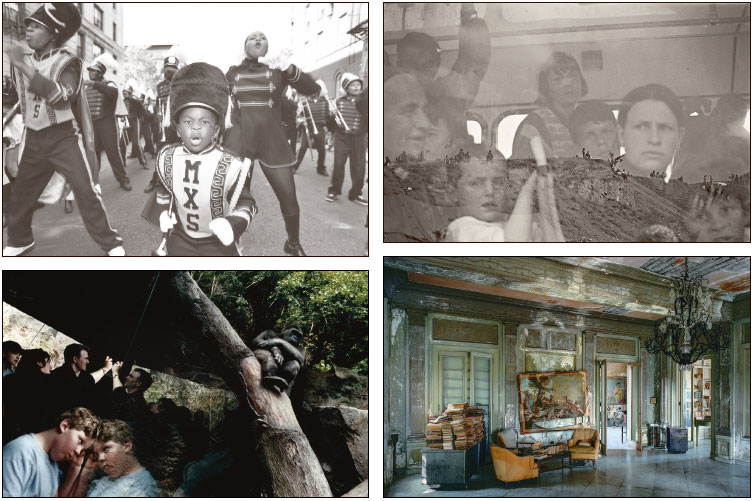
Polidori is known for his large-scale color images of architecture, urban environments, and interiors. He was engaged by the magazine to photograph Havana’s decaying architectural heritage, and the series was turned into a book. One of those photographs is in the exhibition, as is an image taken in New Orleans in the aftermath of Hurricane Katrina.
Plachy is a journalistic photographer who worked for The Village Voice as well as The New Yorker. She is represented by images from the latter’s Goings on About Town series, including a Christmas scene, a play, and a gorilla at the Bronx Zoo.
Platon approached The New Yorker with a proposal to photograph world leaders. “I asked how we were going to do that. Fly him to Italy, to Russia,” Biondi said, “not to mention how do we get permission.” It was decided that he would photograph them at the United Nations, and he set up a portable studio there. “Gaddafi walked in with female bodyguards. Each subject was photographed for five minutes. It’s amazing what he got in only five minutes, and how everyone is different.” His portraits capture Barack Obama, Vladimir Putin, Benjamin Netanyahu, Hugo Chavez, and Silvio Berlusconi, among many others.
Vadukul worked during Brown’s early days, when the magazine had lighter stories. “He worked very quickly,” Biondi said, as exemplified by a photograph of a fashion model and a cat on a roof, the cat captured in midair with tail up and paws extended.
Of Afanador, Biondi said, “When you talk to him he’s very serious, but he also had a sense of humor.” That is reflected in two pictures from a food issue of the magazine. One, a story about wine in Italy, shows a blindfolded man and woman, facing each other with a cluster of grapes hanging between them. Blind tasting? Another shows Mario Batali, the chef, with an enormous toque on his head, “because he’s a big personality.”

While Mark, like Plachy, often photographed events such as parades and circuses, the show also includes two portraits, one of Coretta Scott King and one of Michael Bloomberg. The former mayor is dressed in a suit and tie and holding an infant with an I Love NY sticker on its diaper. “This was a takeoff on the way politicians kiss babies,” said Biondi. “Bloomberg wore his own suit, but the baby had to be rented.”
Schoeller is represented by two kinds of photographs: witty situations and close-up portraits. One of the former shows Tony Hawk, the professional skateboarder, on a skateboard on his kitchen counter, surrounded by his oblivious family. In another, a woman hangs from a chandelier over Robin Williams, who’s casually reading a newspaper.
As for Schoeller’s close-ups, “They have a specific, gentle lighting that nobody else has been able to imitate. He doesn’t reveal how he does it.” The ones in the show are of Cindy Sherman and Valentino.
Pyke’s photographs of people reflect in some way who the person is. Rem Koolhaas, for example, is photographed in an architectural context. Other subjects include the actor Ed Harris, the conductor Pierre Boulez, and the writer Chinua Achebe.
On one wall of the show is a magazine rack that contains edited issues of The New Yorker inside which are the exhibited photograph or photographs from that issue. “I asked Sheri if she could think of anything that isn’t just pictures on the wall. She came up with this.” After a pause, Biondi said, “I was very fortunate to work for The New Yorker.”