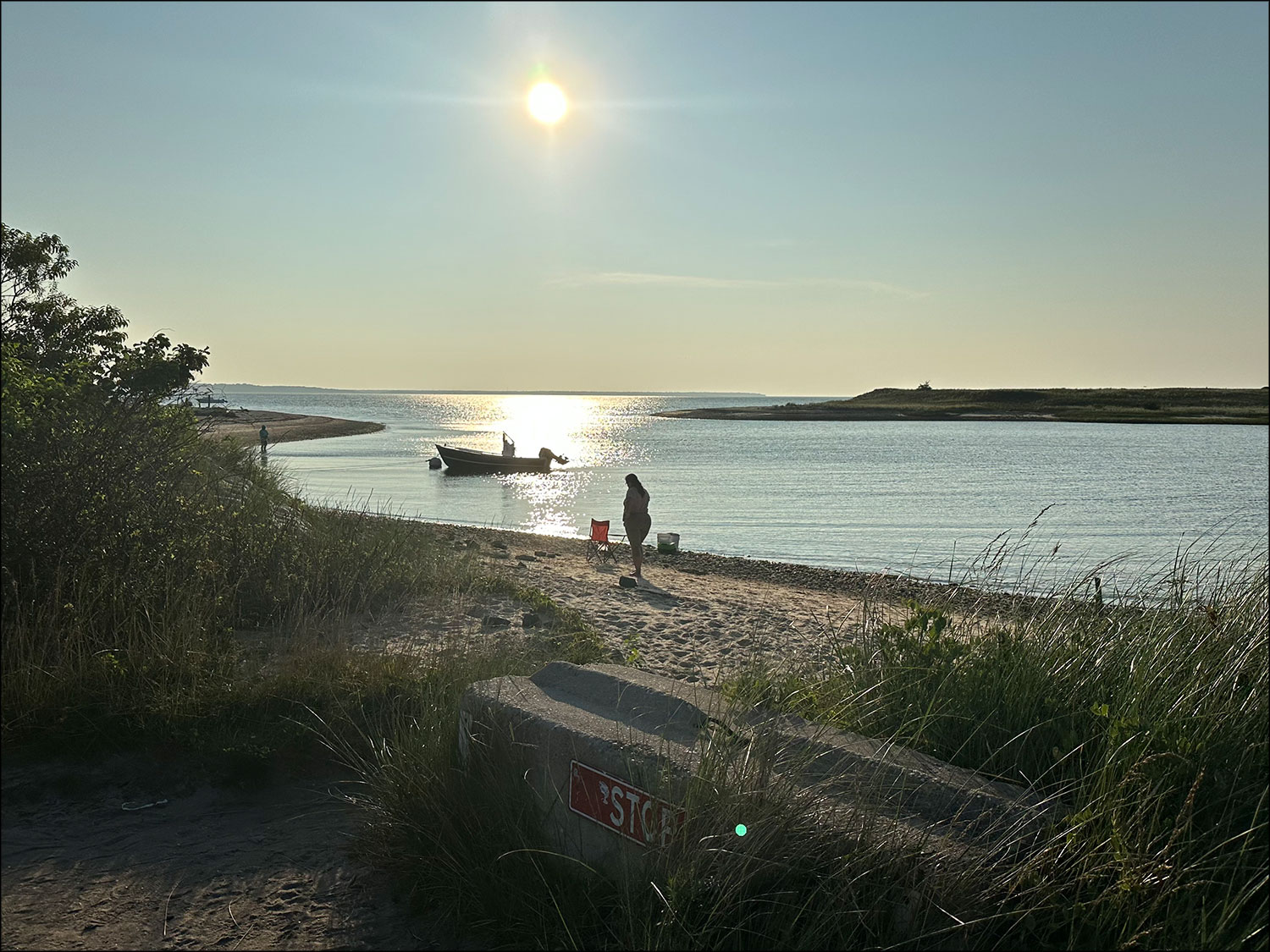
The East Hampton Town Trustees took another step forward in their long-discussed plan to reopen the east channel of Napeague Harbor, which began to close early in this century and has been completely closed since 2012.
The trustees have expressed interest in reopening the east channel to promote tidal circulation and improve water quality within Napeague Harbor, which has seen a die-off of eelgrass and a collapse, as in other waterways on the East End, of the bay scallop population. Such a project, which would involve state property, would be a multimillion-dollar venture almost surely requiring investment by multiple agencies. The trustees have mused about funding the project in part with money from the host community agreement between the developers of the South Fork Wind farm and the town and town trustees. That agreement includes almost $29 million flowing to the two entities over 25 years.
The east channel was not on the trustees’ agenda on Jan. 26, but Francis Bock, the trustees’ clerk, told his colleagues toward the meeting’s conclusion that Drew Bennett of D.B. Bennett Engineering has been working on the permitting process. The trustees had voted in November to allocate up to $25,000 to Mr. Bennett to prepare an application to the New York State Department of Environmental Conservation, which would have to sign off on the project.
“In order to get the permits, he’s going to need a baseline survey and hydrographic surveying,” Mr. Bock said.
Mr. Bennett has written a specification and solicited bids, Mr. Bock said. According to that specification, the trustees intend to reopen the east inlet by dredging an approximately 100-foot-wide by 3,500-foot-long channel at the former east inlet location, between Hicks Island and Goff Point. “The trustees also intend to close the existing west inlet located between Hicks Island and Lazy Point . . . by filling it with approximately 30,000 cubic yards of dredged sand material from the east inlet opening,” Mr. Bock read, “and supplemented with historically dredged material presently stored on Hicks Island.”
Only one inlet is naturally sustainable, according to Mr. Bennett’s specification. “The purpose of potential removing of old dredge material stored on Hicks Island and placing it on western beaches is for beach renourishment on receding beaches.”
Hydrographic surveys of the proposed east channel and the west inlet, and upland surveys of a portion of Goff Point, Hicks Island, portions of Lazy Point, including beaches at its western side, are required, according to Mr. Bennett.
John Aldred told his colleagues that one bid, from the Raynor Group of Water Mill, was for $58,900. Another, from George Walbridge Surveyors of East Hampton, was for $11,680. A third bid, from Saskas Surveyors of East Hampton, was not acted on, he said.
The trustees wondered aloud about the wide discrepancy between the bids from the Raynor Group and George Walbridge Surveyors, and Christopher Carillo, the trustees’ attorney, suggested that Mr. Bennett meet with them to discuss the matter, perhaps at their upcoming meeting, on Monday. “That might be a good idea, in part, to let the public know that this is the launch of, potentially, a rather significant project on our part,” said Celia Josephson, a trustee. “The more that we include the public, the better.”
“And we’re going to want to bring on a surveyor that is not just the cheapest or the best name,” Mr. Carillo said, “but also the best suited to the future of this project.”
In addition to the D.E.C., the federal Army Corps of Engineers would have to sign off on the project, Mr. Bock said after the meeting. The undertaking, should it be acted on, is “years away,” he said, adding that a potential roadblock beyond the securing of needed permits could come in the form of the New York State Department of Parks, Recreation, and Historic Preservation. “There was a time where the trustees controlled that inlet,” he said, “but since it has been closed for so many years, I’m concerned Parks is going to claim ownership. Then we will have to ask them to cut through their property to do this.”
“One of the other things we have to do,” he said, is “put together a coalition to pay the bill.”