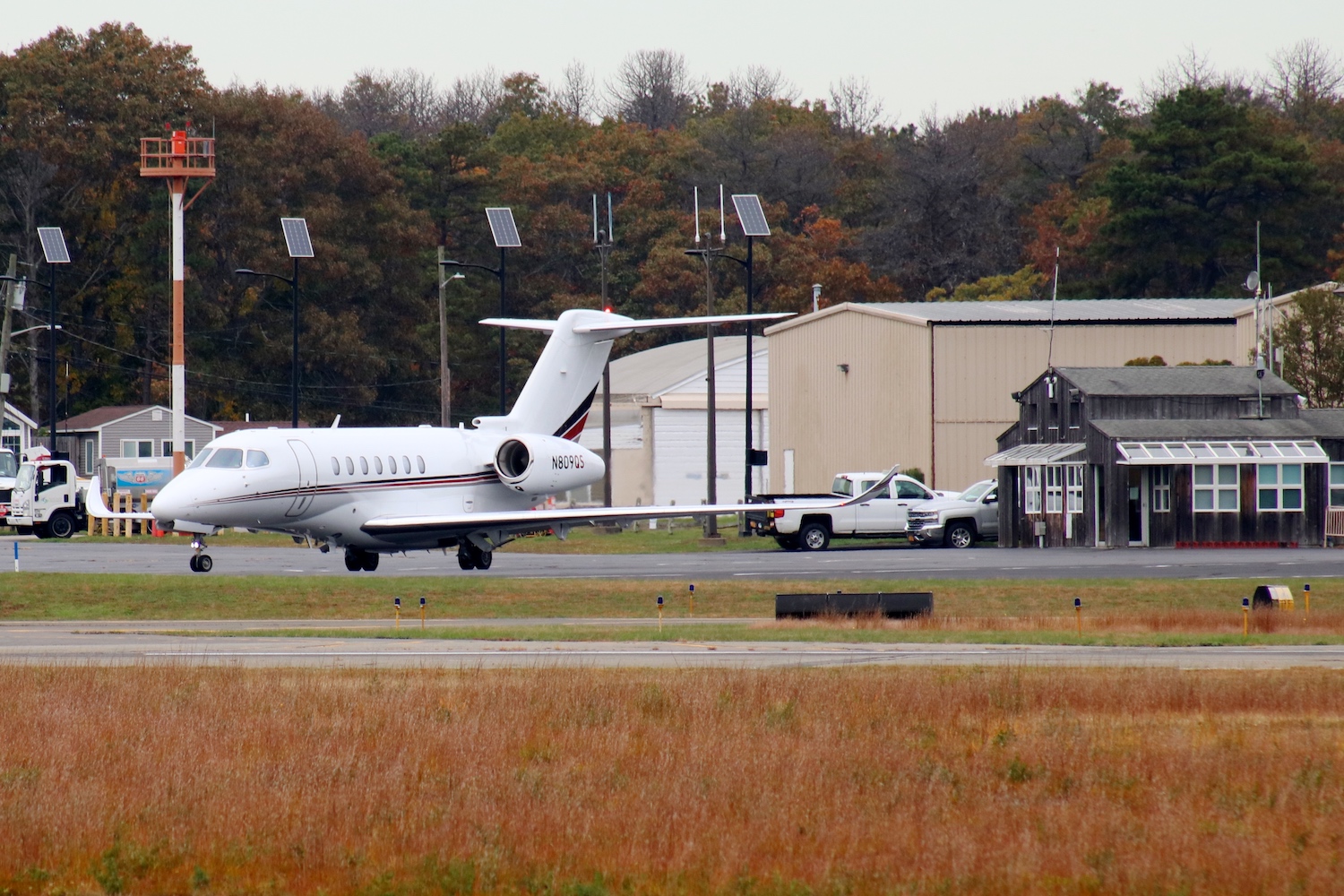
East Hampton Town Airport would get a permanent control tower, ultimately costing $6.5 million, if Jim Brundige, its director, has his wish. The town board heard his request when it met on Tuesday.
Mr. Brundige’s total wish list added up to just over $4.6 million in safety improvements (including $650,368 for first-stage siting and engineering of the proposed tower), which would be paid for with a bond.
A temporary control tower has been in place since 2011, when it was first authorized. The town has spent $6 million on the airport in the last decade.
In response, Town Supervisor Kathee Burke-Gonzalez proposed increasing landing fees by 15 percent, and fuel flowage fees by two cents per gallon, which would generate an estimated $350,000 annually for the airport fund, enough to offset the debt service on any new bonds issued to pay for the improvements. It has been at least a decade since either fee was increased.
“The fees we’re talking about, since it’s been 10 and 14 years since they were raised, I think it’s beyond timely,” said Councilwoman Cate Rogers. “It is not meant to come out of the taxpayer base; it’s meant to come out of the airport funding. I wish my fees for gas and home heating oil hadn’t gone up in the last 10 years.”
The board hopes to vote on the increases next month so they can take effect by May.
Separately, board members listened to a short presentation from Nick Rigano, a lawyer, who talked them through reversing a code change made in 2022, when the town was attempting to make the airport private. It was prevented from doing so by a State Supreme Court injunction after airport interests sued.
“The airport is now back to public use, but we have this private-use airport code on the books,” Mr. Rigano said. “We would recommend to go back to Chapter 75 in the town code, as it existed prior to the adoption of the current Chapter 75. That puts you back in the public-use world. We would recommend that the board consider going back to the world as it existed in 2022.”
Doing so would also remove an “outdate” landing fee schedule, he said, adding that the code change will allow the town board to adopt landing fee increases by resolution, as it had in the past.
“It’s a pretty innocuous recommendation,” he said.
Board members treated it as such and offered scant comment, indicating they’d revisit fee changes in a year. They agreed to hold a public hearing on the code change on March 5.
Part of the reason the board considered privatizing the airport back in 2022 was to have more control over its users. Since then, Blade Urban Air Mobility, for example, has expanded its operations, selling seats on helicopters and drawing widespread complaints from homeowners who either live near the airport or directly in Blade’s flight path.
A couple of those residents called in on Tuesday to remind the board that they are still unhappy, and asking the town to tie investments in the airport with concessions from those who sued over the attempts at privatization.
Hersey Eggington, a Wainscott resident, said improvements to the main runway, including repainting and repaving, should be used to force better behavior from the airport users “on volume and scheduling of landings and takeoffs.” He also suggested that “real-time noise-monitoring equipment” be used to supplement complaint data from residents.
Marc Frons, another Wainscott resident, took issue with the proposed control tower, saying that the seasonal tower has served the airport adequately for years.
“A permanent tower, without accompanying operational limits, signals that the town accepts year-round high-volume operations indefinitely. That would be inconsistent with this community’s long-standing concerns about noise, safety, and environmental impact,” he said. “If aviation interests are about to receive significant public investment, the community deserves to know what we’re getting in return.”
But Erin Sweeny, executive director of the East Hampton Community Alliance, a pro-airport group, called to thank the board for the maintenance proposals and for not increasing landing fees on local pilots (who are exempt from landing fees but not fuel fees).
The most expensive proposed improvement, at $2,709,955, calls for a complete repaving and repainting of runway 16/34, which is primarily used by smaller aircraft. Another $534,330 would go to repair and repaint the main runway, 10/28.
The runways get their names from compass headings, Mr. Brundige explained.
“It just makes sense,” Councilman David Lys said, beaming.
“Even though the numbers are large, this is a conservative list of safety improvements,” Ms. Rogers said. “There’s not one amenity improvement. We’re not building V.I.P. rooms. Everything is critical for airport safety, and I don’t think that’s negotiable.”
“One reason the town has to float a bond is because they’re not getting fair market value for some of the land surrounding the airport,” Barry Raebeck said, citing the well-below-market Maidstone Gun Club lease.
“An accommodation of the airport users at the expense of everyone else continues,” added Mr. Raebeck, the director of the Coalition to Transform East Hampton Airport. “Meanwhile, the board stated in the past that they would never again take F.A.A. money.” (Re-adopting the 2022 legislation seems to leave open the possibility of accepting F.A.A. grants.) “They’re hedging on that, which I think is really disturbing. It’s a combination of misfeasance and malfeasance.”