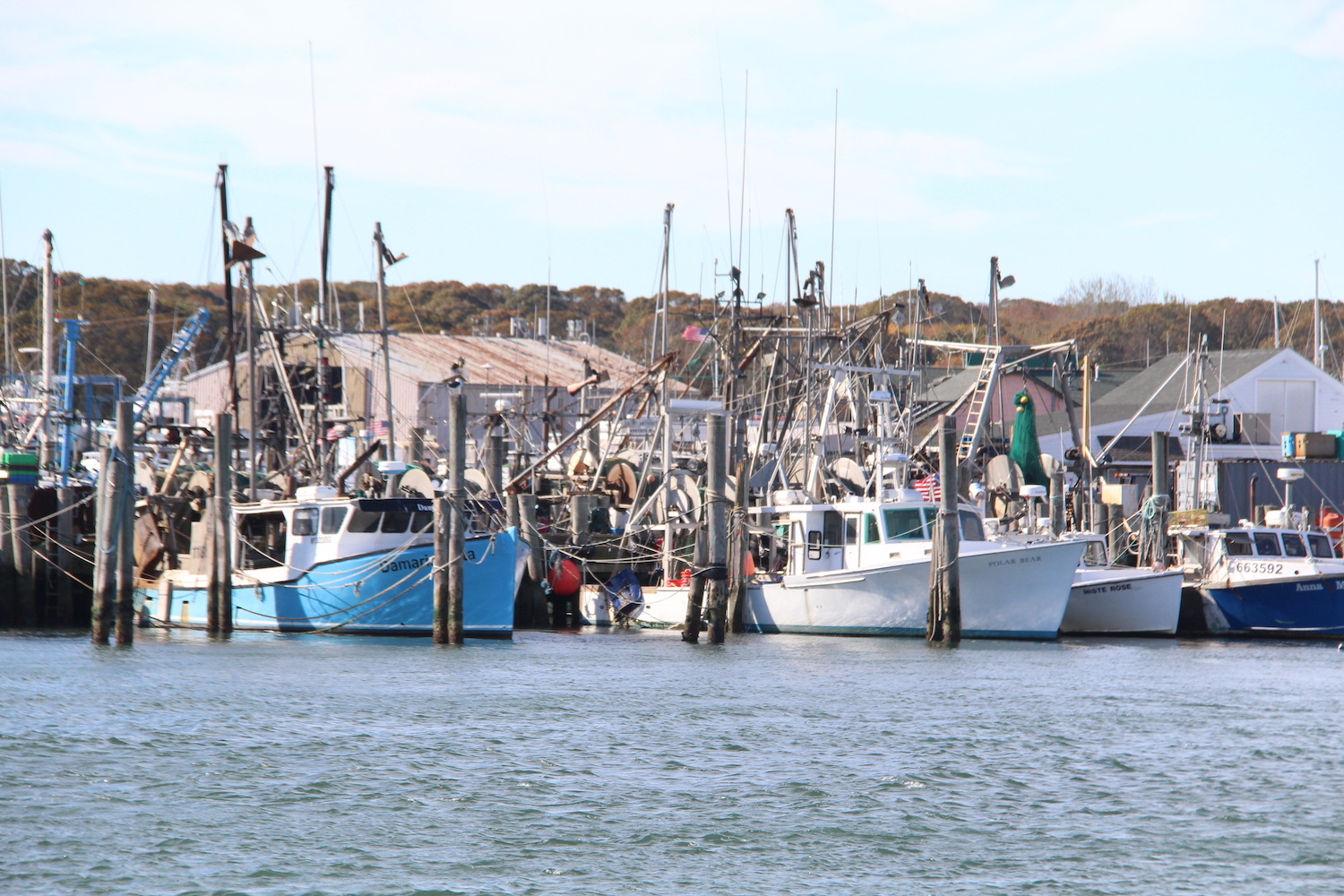
The Trump administration’s move this month to allow commercial fishing in the Northeast Canyons and Seamounts Marine National Monument, 130 miles off Cape Cod, was welcomed by commercial fishing interests last week.
The monument’s creation was a recent development, established by President Barack Obama in the last months of his administration in 2016, with a multiyear phaseout allowed only for American lobster and Atlantic deep-sea red crab fisheries. The area in question covers nearly 5,000 square miles and
“Because of the complex topography and oceanography within the monument, and the resulting high food production, there is a rich diversity of fishes” there, according to the U.S. Fish and Wildlife Service, which manages the site with the National Oceanic and Atmospheric Administration. “Scientists consider the monument a biodiversity hotspot for deep-sea fishes.” Fish and Wildlife cites a 2003 study that found almost 600 fish species living below 650 feet in the New England shelf region of the monument.
Its canyons are home to various species of flounder, hake, skate, ocean pout, cusk, grenadier, and eel, some occurring in dense aggregations. “Larger pelagic fish like swordfish, tuna, and sharks also use the monument,” according to Fish and Wildlife.
The Trump administration’s latest reversal “is really huge for us,” Marty Scanlon, president of the Blue Water Fishermen’s Association, said last week, “because it’s such a huge area and it’s right in the middle of our prime fishing ground in the Northeast from June through November.” Static closures, Mr. Scanlon said, “are not the answer to regulating policy, because of the nature of fish,” which are migratory.
To close the Northeast Canyons and Seamounts to commercial fishing was in fact contrary to the intention in creating the monument, he said. “The area they are closing to protect species actually increases the take of species,” he said, “because we have a higher interaction rate west of this area. Forcing us to fish in the mid-Atlantic Bight increases our chance of interacting with protected species. So the argument fails, on top of the fact that static closures are proven to not be the answer to regulating this fishery.”
Mr. Scanlon pointed to politics as behind the monument’s creation. “The problem we have in the pelagic long-line industry is not the bycatch we have,” he said. “It’s that the big high-money rollers in the recreational industry don’t want us interacting there. Mega-sportfishing guys don’t want us out there.”
Like Mr. Scanlon, Bonnie Brady of Montauk, who is president of the Long Island Commercial Fishing Association, pointed to the Magnuson-Stevens Fishery Conservation and Management Act, originally enacted in 1976 to assert control of foreign fisheries that were operating within 200 nautical miles of the United States coast and twice amended to address overfishing and overcapacity. “All the [Trump] administration did was correct the wrong that began with the Obama administration pretending that an area that has been utilized by fishermen for decades was suddenly somehow sacrosanct,” she said this week, “even though the Magnuson-Stevens Act regulated it since the 1980s, protecting fisheries and habitat, regulated by both the mid-Atlantic and the New England fishery management councils.”
“These areas are being regulated sustainably,” Mr. Scanlon said. “To jam [commercial fishers] into other areas puts incredible pressure on those areas, making them difficult to sustain.”
According to The New York Times, environmentalists argue that the president’s reversal of the ban on commercial fishing in the area is in violation of the Antiquities Act, “which gives presidents the power to create national monuments but not to reverse the designations of their predecessors.”
Neither Gov. Kathy Hochul’s office nor the Nature Conservancy had replied to emails seeking comment by press time.