The treacherous surrounds of Long Island can be difficult for even the nimblest of seafaring vessels to navigate, so imagine the difficulty faced by massive ships with multiple masts trying to do the same. Much to the chagrin of her captain, the Elmiranda never stood a chance once she was caught in one of our area’s thick fogs.
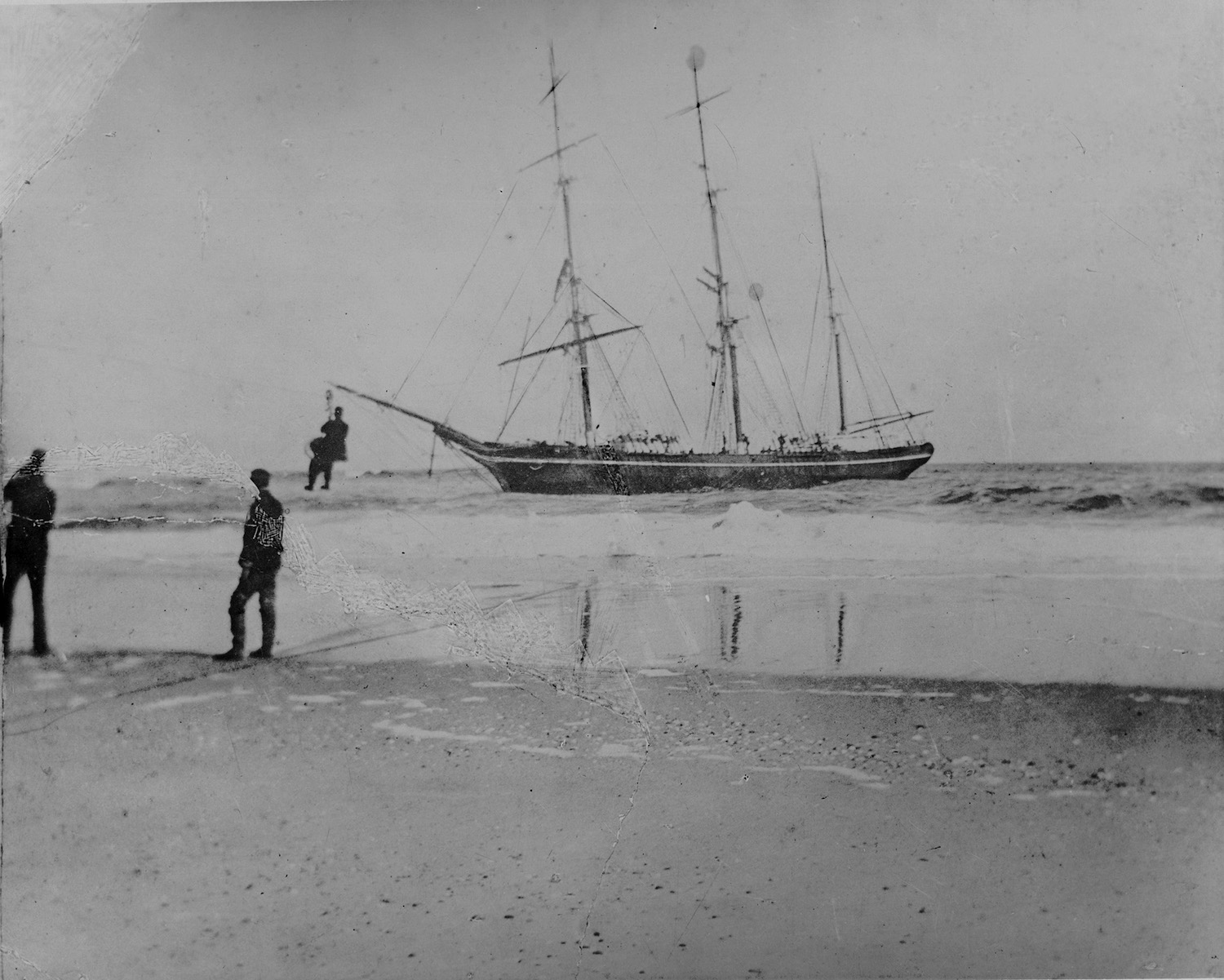
Between midnight and 2 a.m. on April 21, 1894, the bark Elmiranda became stuck on two sandbars off Wainscott opposite Wainscott Pond (between Town Line Beach and the beach at Beach Lane). The time of beaching differs among accounts, but all accounts agree that it was too dark to commence lifesaving operations until the morning.
Luckily, members of the Georgica Life-Saving Station spotted the vessel soon after it ran aground, and by daylight on the 22nd all 11 crew members had been safely brought ashore, along with a monkey and a parrot. The parrot cursed profusely and with great skill, and as a result was purchased for $2 by Condit Miller (1868-1917), a member of the lifesaving crew.
This image, from The East Hampton Star’s photo archive, shows the three-masted bark as it looked on the morning of April 22, 1894. A crew member can be seen using a breeches buoy to come ashore. A breeches buoy was a lifesaving device that worked somewhat like a zip line, with sailors sitting in a pair of leather breeches attached to a life ring and sliding from the distressed ship to shore.
Hailing from Portland, Me., the Elmiranda was carrying a load of coal weighing between 600 and 1,100 tons (accounts vary) from Georgetown, S.C., to Providence, R.I. A week after the wreck, a tugboat from the I.J. Merritt salvage company came to tow the Elmiranda to New York City, where it was auctioned off for scrap for $1,500.
—
Julia Tyson is a librarian and archivist in the Long Island Collection.