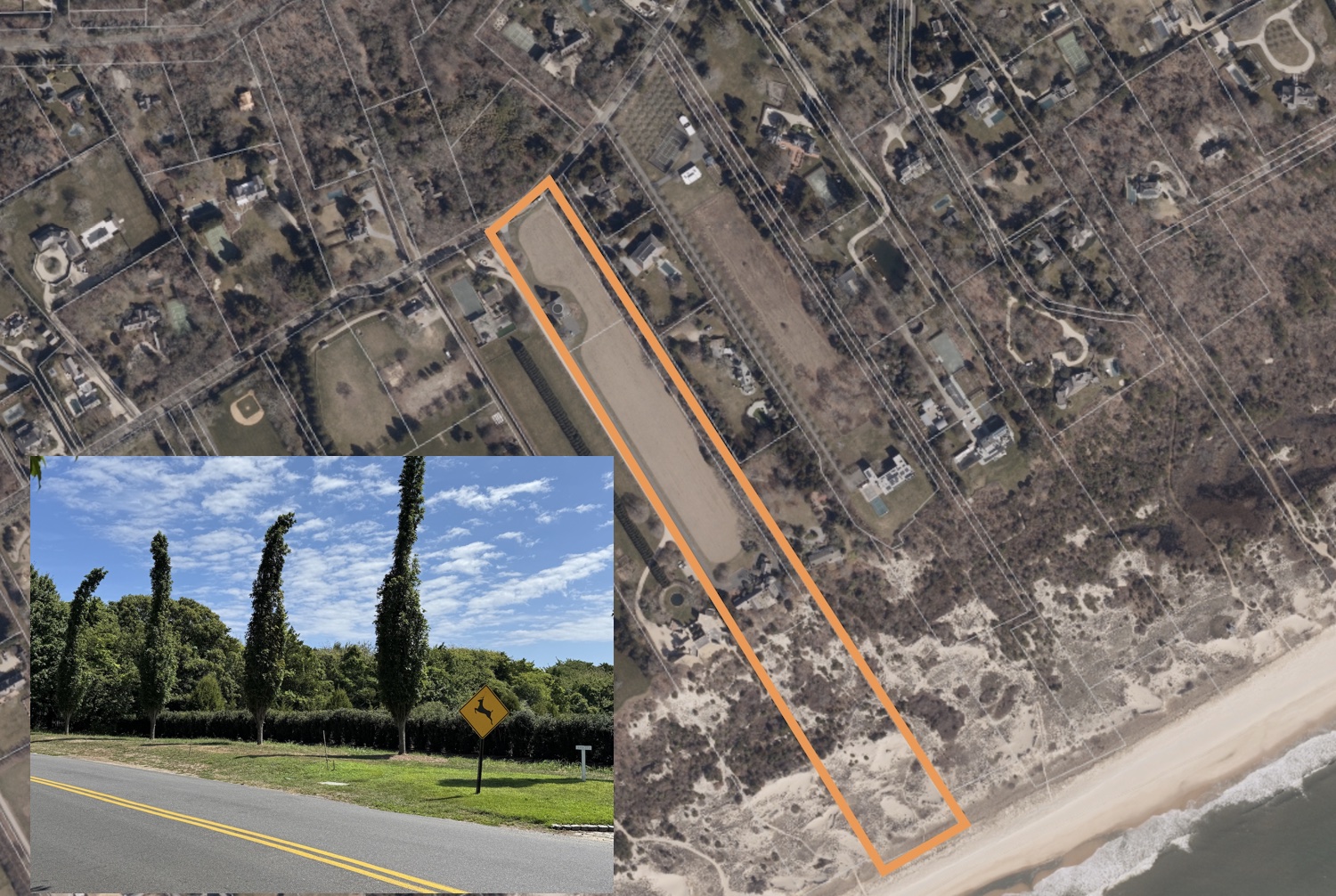
East Hampton Town appears to have stepped down in a fight against a Further Lane homeowner who neighbors say is violating a decades-old scenic easement on their lands.
The new owner of the two properties at 370 and 372 Further Lane,, whose name is hidden behind separate limited liability companies — Further Lane EH and Further Lane Barn — has planted a multilayered holly hedge with mature trees along the road, blocking the view of a scenic easement that has been respected since the late 1980s when the land was first subdivided.
“The town is viewing this as a private dispute,” said Joan McGivern, the attorney representing the neighbors — Birch Tree Partners, L.L.C., Kristin Sara Fine, Scott Fine, Michael Black, Gregory Harmon and James MacMillan — in a lawsuit against both the town and the new owner.
The town has “abdicated its role in protecting open space; protection that was provided in determinations by two of its own land-use boards,” she said. “To me, it represents an affront to those boards’ authority.”
In fact, at the end of November, Jake Turner, the town attorney, asked the Suffolk County Supreme Court to dismiss the case altogether.
On Monday, Ms. McGivern amended the lawsuit to make clear the neighbors’ role, as East Hampton Town taxpayers, in enforcing the law. The easement, says the suit, is a public amenity, meant to continue in perpetuity (not the kind that allows one neighbor to pass through another’s property to get to their own).
Numbers 370 and 372 Further Lane were purchased last winter for $70 million from their original owners, the Little family. When the Littles first decided to build on the land in the late ‘80s, they agreed with the town to a series of easements, restricting what could and could not be done there. They respected the easements for their entire tenure on the property.
Last year, in a Wall Street Journal article about the listing, Judith Little was quoted as saying, “I know it’s crazy, but I really would like to sell it to a person who gets the dream we had.”
But shortly after the new owner closed on the parcels, the hedge was planted, destroying the longstanding scenic easement and infuriating the neighbors, who sued in Suffolk County Supreme Court. They are asking the court to have the town enforce its own laws and make the neighbor remove the offending shrubs.
Mr. Turner, in a phone call, laid out the town’s defense.
“The plaintiffs allege that the town failed to prosecute,” he said. “Prosecution requires bringing a criminal case in East Hampton Town Justice Court and proving a violation beyond a reasonable doubt. That requires identifying the applicable town code provisions, establishing how they were violated, and meeting the criminal standard of proof.”
“A standard zoning board of appeals determination, standing alone, is not enforceable in Justice Court,” he continued. “A Z.B.A. determination does not constitute a criminal violation.”
“Based on the facts currently available, the town does not have a prosecutable case under the criminal standard required in Justice Court. That said, compliance with the town code is essential, and no further town approvals will be granted until the properties are brought into compliance.”
Town Councilman Tom Flight relayed Mr. Turner’s explanation to the Amagansett Citizens Advisory Committee earlier this month, and to the town board at a meeting last week.
Jeffrey Bragman, a local lawyer who has held several positions within town government including as a councilman, has been keeping an eye on the lawsuit. Rather than asking that it be dismissed, he said, the town should have joined with the plaintiffs.
“This case involves the purchase of a luxury property on Further Lane,” Mr. Bragman said in a phone call. “The new owner was undoubtedly well represented, and aware of the use restrictions in the agricultural easement which was included in a title report. Having been on notice of recorded restrictions, it is impermissible to simply ignore them.”
The town, in its motion to dismiss, put forward another reason it could not move further on the case: Because the homeowner denied it access to the property. Mr. Turner notes in the motion that he contacted the landowner’s attorney, requesting that town officials have a chance to inspect the “alleged plantings.”
“Ms. Cooley [Alice Cooley, the lawyer for the Further Lane owners, at the time] explained that the town was not permitted to enter the property and that the complaints were baseless,” he wrote.
The town did not fight her on it.
Mr. Bragman, however, says that Ms. Cooley’s denial was “contradicted by the plain language of the recorded easement. That document gave the town a continuing right to inspect, to ensure compliance with the terms of the easement. It is entitled to do so on reasonable notice. If an owner refuses entry, the town can and should immediately exercise its rights by obtaining a court order to do so.”