
The best and brightest new ideas were on display in Montauk Friday, as students tested out hypotheses and performed experiments for the Montauk School Science Fair. Local politicians, including State Assemblyman Tommy John Schiavoni and County Legislator Ann Welker, served as judges, reviewing and ranking projects from studies on sleep and heart rate to what kind of bat hits a baseball farther.
Third-grader Michelle Watts won first prize for her experiment called “Eggy Power!” In fourth grade, Nina Joeckel and Mila McLaughlin won for their exploration of magnetism. Fifth-grader Tallulah Somero won for her project, Growing Gummies. In the sixth grade, Jack Crocker was the winner for testing “how quickly fish learn.” Maggie Shea and Charlotte Vickers won first prize among the seventh graders for comparing the strength of various paper towels, and eighth-grader Alexander Uihlein won for his project, Microalgae: A Breath of Fresh Air.
“They worked really hard. I know some kids put dozens of hours into these projects. They’ve rehearsed their speeches. They’ve prepared for the judges,” said Josh Odom, the district superintendent. “They have a tangible product they’re proud of, and they should be proud of it. It’s pretty cool.”
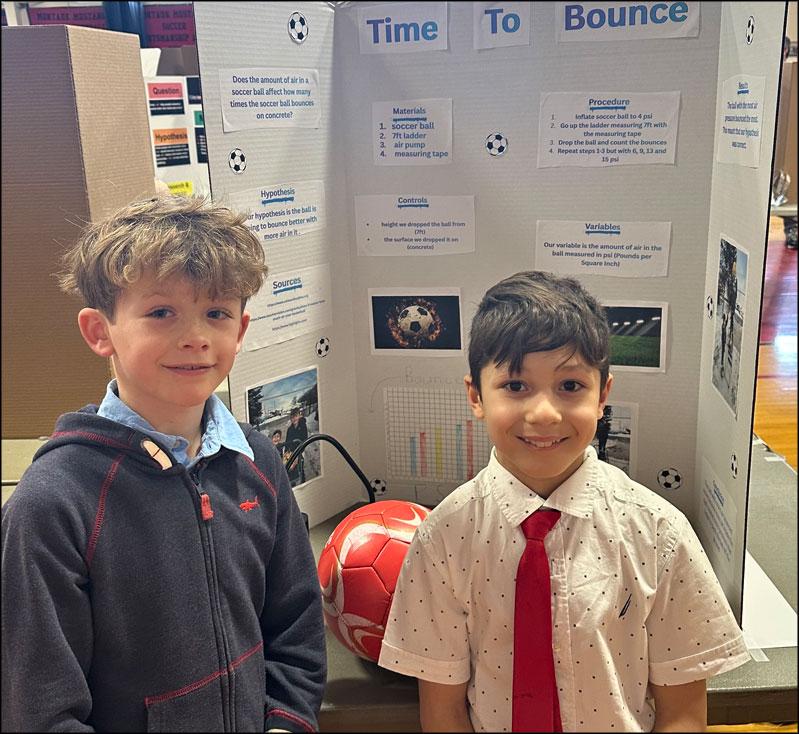
Oscar Watson and Kiran Ortiz took second place among the third graders. Their project questioned how the amount of air in a soccer ball affects how many times the ball bounces on concrete. They hypothesized that more air is better, and they were right. After dropping soccer balls filled to four, six, nine, and 13 pounds per square inch onto concrete from a seven-foot ladder, they found that the ball with the most air pressure bounced the most.
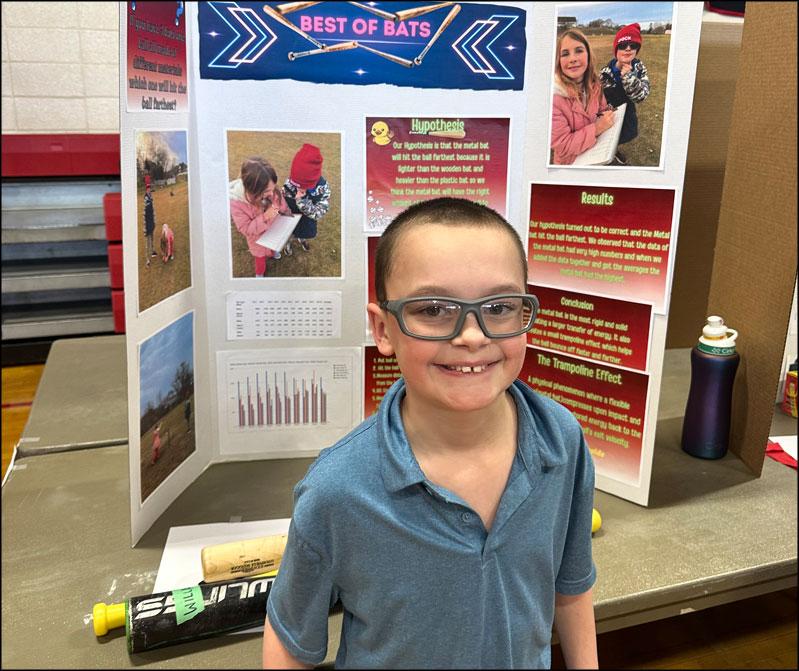
Sports experiments were also popular in the fourth grade. Mason Houston and Willa Ringelmann won second prize in their age group for conducting the baseball bat test, which compared metal, plastic, and wooden bats. They hypothesized that the metal bat would hit a baseball the farthest because it’s lighter than wood but heavier than plastic, and would have just the right amount of force. They used each bat 10 times, hitting baseballs off a tee, and measured how far the balls traveled. When they added up all the results, they discovered they were right: The metal bat sent the ball the farthest average distance.
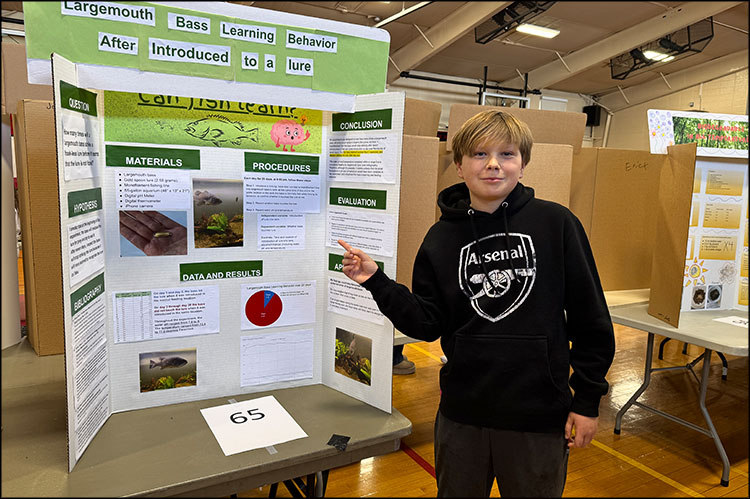
Jack Crocker’s findings could be a big help for local fishermen. The sixth grader took the prize after wondering: Can fish learn? Jack tested how many times a largemouth bass will strike a hook-less lure before it learns that the lure isn’t food. He predicted the bass would stop striking the lure after seven days, Every day, for 20 days, at 8 p.m., Jack introduced a lure into a fish tank, recorded whether the bass touched the lure, and recorded the water pH and temperature. The bass learned quicker than Jack expected — it stopped striking the lure after day two, something anglers might want to take into account.
Eighth grader Jade Winick, explored how different genres of music affect plant growth and health. Turns out, they like R&B the best.
“I really love music and I wanted to see if the soundwaves interfered with plant growth,” Jade said. “My hypothesis was that rock music would interfere with the growth the most, because the tunes are really loud. I thought that R&B would make them grow the healthiest, because it’s softer and calmer. My hypothesis was correct. In my research I saw that calmer music helps plant growth.”
Regardless of how the judges ranked their projects, the superintendent said all of the students who participated learned some great lessons. “I think what’s great about the science fair is it teaches them not only the scientific method, but it teaches them how to work at a difficult task for a long period of time and instills grit. They should be really proud of everything they’ve accomplished,” Mr. Odom said.