John Margaritis is difficult to pigeonhole, which is fine with him. In fact, “It’s almost hard for me to explain what I’m working on,” he told a visitor to SAW, the gallery he runs on his Southampton property.
SAW is as good a place as any to begin unpacking Margaritis’s practice. Several years ago he wanted a place to work, so he built a 1,500-square-foot structure with 20-foot-high ceilings. “I realized it was more space than I needed, and I had a lot of friends and local people whose work I wanted to show. I cleaned it out and turned it into a gallery.”
The first show at SAW, which opened last July, featured paintings by Jahlil Nzinga, a friend of his who lives in California. Nzinga stayed in Margaritis’s house for two months while making the work, and when the show opened 200 people turned up. The second exhibition consisted of 130 pieces of ceramics made by Carol Margaritis, John’s mother, who lives up the road from her son.
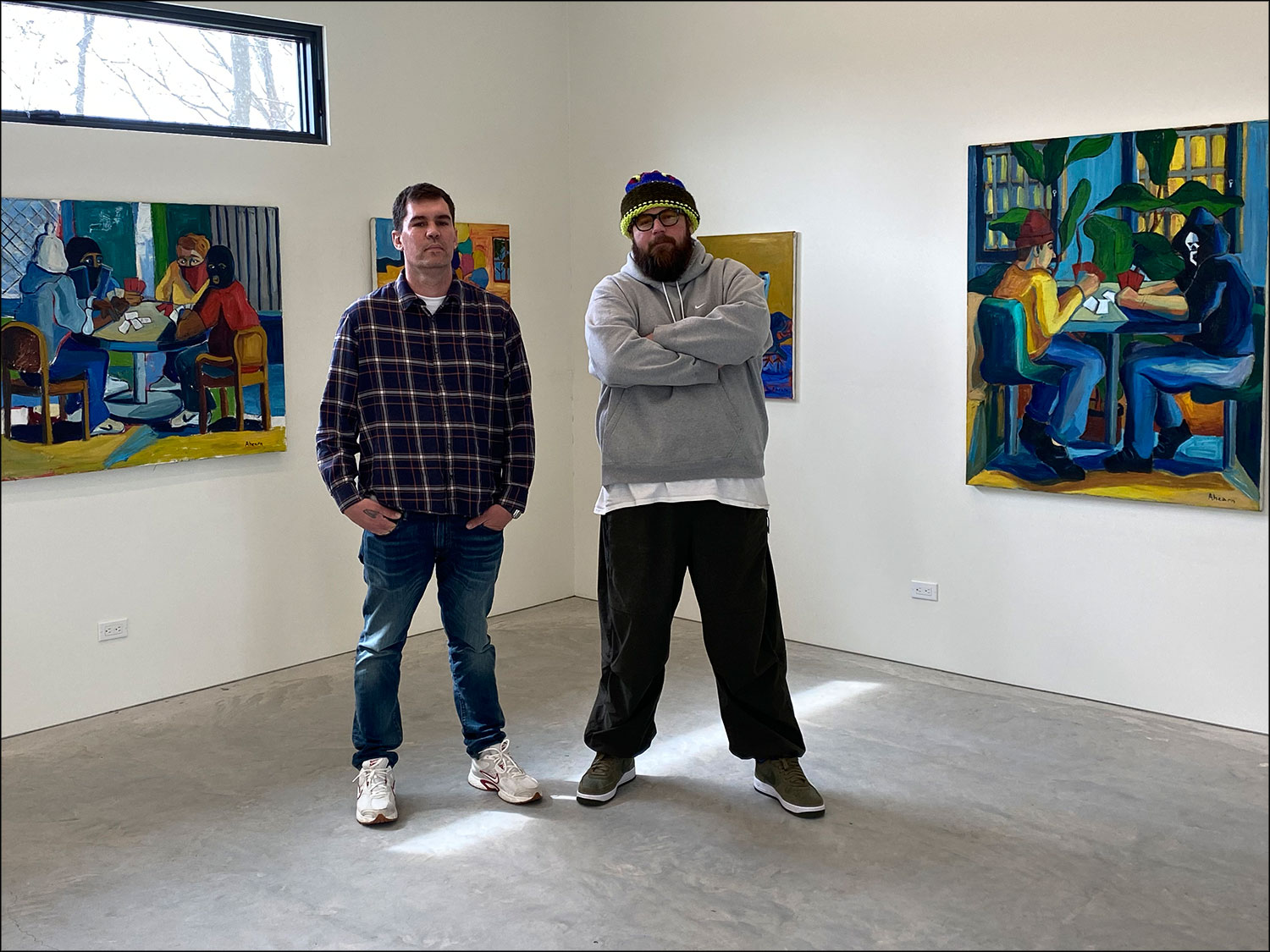
Next up is Michael P. Ahearn, a Southampton native, whose show of 23 paintings will open Saturday with a reception from 5 to 8 p.m. at SAW, which is at 431 South Magee Street in Southampton.
“It’s a full-circle moment,” Margaritis said, “because Michael’s art teacher when he was younger was Paton Miller, who lives two doors down from me.”
“I started with Paton at the age of 12 for the years until I left for college at Pratt Institute,” said Ahearn. “We’ve been in contact since then.” He was also in a show organized by Miller at 4 North Main Gallery in Southampton last December.
Ahearn’s paintings are figurative, with a touch of the surreal. They range from landscapes to portraits to objects to, in one case, a bulldozer with an elephant in its bucket. Textural and expressionistic, they are marked by vibrant colors. Of the bright colors, Ahearn said, “I think that’s coming out because I was gloomy for so many years.”
The paintings emerge in part from his experience in recovery after 12 years of confinement due to mental illness. Before he was hospitalized, he had a show at the Chelsea Hotel; his parents salvaged the paintings.
When he was released seven months ago he began to rework some of the paintings, “and they were almost too emotional for me to look at. So there’s a history behind a lot of the pieces, and in some cases that history shows through” in the form of remnants from the original artworks.
Ahearn is excited about the show. “I’ve had people reaching out to me from grade school. That’s what’s so great about it out here. The sense of community.”
Margaritis’s house and gallery both sit atop a 3,000-square-foot underground workshop he shares with his father, Albert, and members of what he calls his “install team,” the workers who help him realize his ideas. “My dad is an amazing carpenter. His challenge to me has always been, ‘If you can think of it, I can build it.’ ” The workshop, which is the home base for Margaritis’s company, New York Sunshine, is filled with machinery, serious tools, lumber, and other materials.
While he admits he never excelled at it, basketball is a sport he loves, and it figures prominently in his work. In 2018 he had the idea of putting a basketball hoop in the ocean during Art Basel in Miami. “I told my dad we had to figure out a way to do it.” They installed it first in the ocean at Flying Point in Southampton, then loaded it onto a truck, drove to Florida, backed the truck up to the beach in the middle of the night, unloaded it, sandbagged it to the bottom of the ocean, and left if there for four days before breaking it down and taking it away.
He admitted that “we weren’t necessarily involved in Art Basel, but we were doing something during it and we would tell people to come to our exhibit. It’s kind of fake it until you make it.”
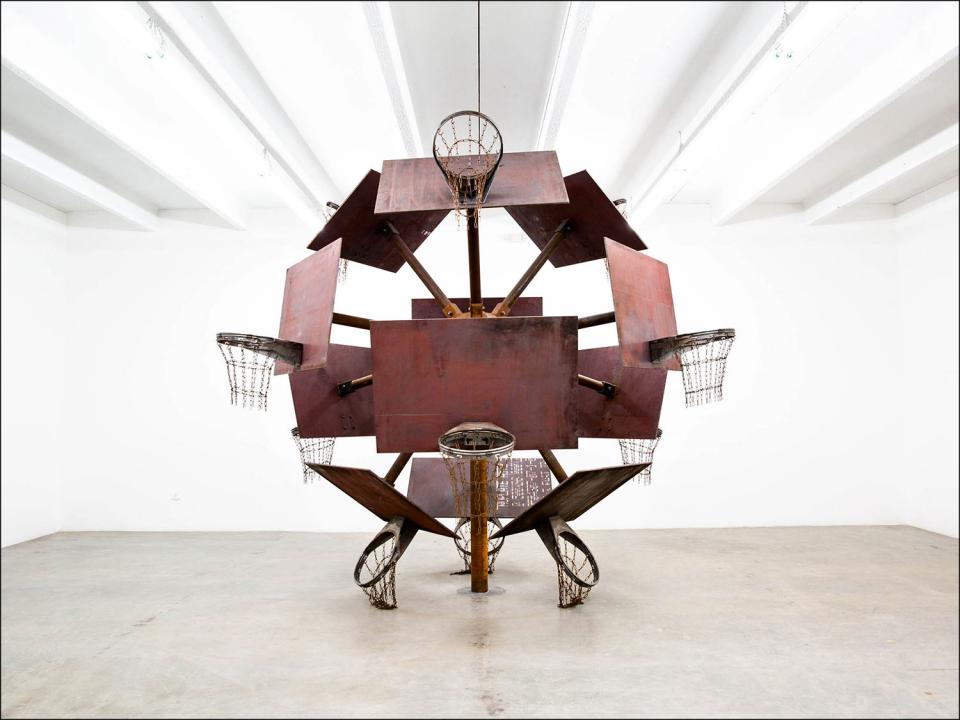
A less transitory creation is his Hoop Globe. The object consists of 12 backboards, complete with rims and nets, all made out of steel. Margaritis fabricated it working with John Degan at Liberty Iron Works in Southampton. A 12,000-pound, 19-foot-tall sphere, the globe sits on a ball bearing and revolves easily. “When it comes to bigger stuff, I’ll think about it and if it sticks with me for about a year, then I decide it’s time to invest and make it.”
The Hoop Globe was shipped to London and installed in that city’s Selfridges department store in 2019 and later that year was displayed at the Watermill Center during its summer benefit. In 2023 it was sited at Lincoln Center during a Nike basketball tournament.
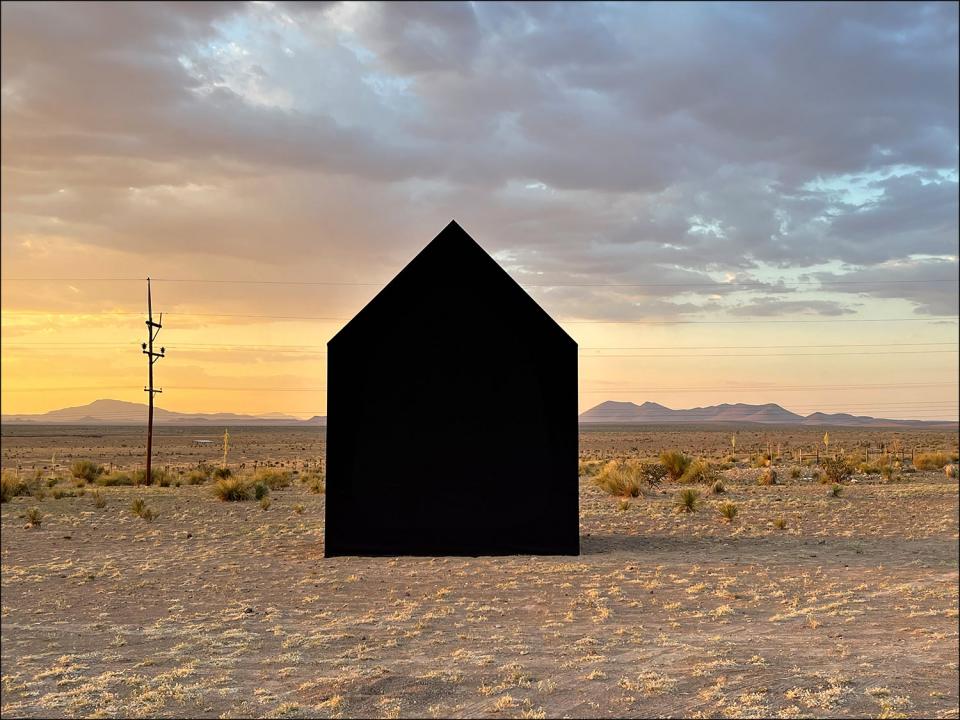
Margaritis constantly pivots between commercial projects for which he has been commissioned and more personal creations, though a project he did for the Dickies clothing brand exemplifies how the two are intertwined. Dickies, which is known for its durable workwear, engaged Margaritis for its 100th anniversary.
The company is based in Fort Worth, “But I’m a fan of [the artist] Donald Judd, so I wanted to realize my idea in Marfa,” a remote city in the high desert of West Texas that Judd made home. “I said I wanted to take their chino fabric, which they’re known for, and build a house out of that fabric in the desert and leave it there for six months. Then deconstruct it and take the fabric that’s been sun-dyed and incorporate it into new clothing.”
Limited-edition versions of the clothing featured little house labels. More commercial things like T-shirts and sweatshirts were mass-produced. “I’ve always wanted to do a billboard,” he said, and he usually does what he wants to do. The wood-framed billboards there were also the support for fabric, which in turn was made into canvas tote bags.
The “Sun-Dyed in Texas” apparel collection won the 2021 Golden Madonnina Design Prize from Designboom, a popular online magazine that covers international architecture, design, and art.
Margaritis engaged in another creative partnership with Tarmac Works, creators of over 150 premium-quality scale model cars. Each of the limited-edition toy trucks created for the company by New York Sunshine represented a member of its install team.
But the project didn’t stop there. New York Sunshine built a life-size version of the truck they created, complete with saw blade rims, fitted the inside with shelving, filled the shelves with toys, and drove it to Brooklyn, where they handed out the toys to kids in a public school where a friend of his teaches.
Over the years Miami has been a fertile ground for Margaritis. In 2019 he designed UNKNWN, a Miami-based retail destination co-founded by Lebron James, Jaron Kanfer, and Frankie Walker Jr. “I love retail and I love retail design, but I’m not an architect,” said Margaritis, so he collaborated with an architecture firm on the design of the store. “I met Lebron when he came down for the opening. It was cool.”
UNKNWN boasts “an industrial vibe that resonates with Miami’s Wynwood district” and features a Margaritis-designed water feature made of basketball goals, copper, and water, according to Designboom.
Margaritis also contributed to the design of Eric Emanuel’s original store in SoHo, and he created a massive basketball sculpture for its renovation four years later.
Among his own creations are chairs with concrete legs, a wheelbarrow chair, an eight-man rotation chair, a “detention desk,” and six-by-four-foot aluminum light boxes that frame dramatic color photographs of basketball hoops on fire at night, all of which can be purchased from the New York Sunshine website.
When Margaritis mentioned that he never went to art school, it brought to mind “bricoleur,” a concept the anthropologist Claude Lévi-Strauss introduced in his book “The Savage Mind.” Applicable to Margaritis’s father as well as himself, the term has been defined as “a person who creates, constructs, or repairs things using whatever materials and tools are immediately available. A bricoleur improvises solutions to complex problems by adapting, assembling, and rearranging diverse resources.”