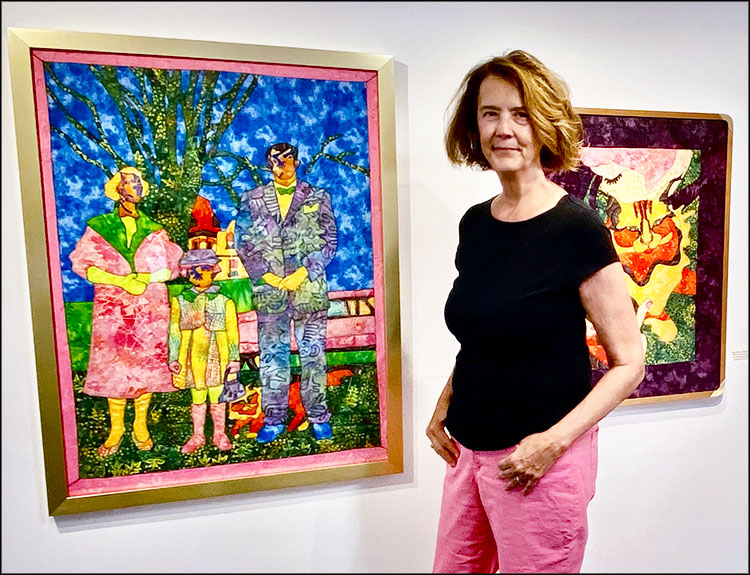
“I’ve just been very lucky in my life, in my work life, to find opportunities to make things,” Nicole A. Vanasse said during a conversation at the Women’s Art Center of the Hamptons in Bridgehampton, where her solo exhibition “Goldi” is on view.
The exhibition itself, which will be up through June 14, did indeed come about serendipitously, but more on that later. “Goldi” reimagines the tale of Goldilocks, replacing the little girl with Goldi, a cat, who explores the home of the bears, rendered as a human family across 16 batik panels.
Vanasse pivoted from the Peace Corps and C-SPAN to making art after her father died in 1993. When her mother wondered what to do with his shirts, ties, and dashikis (he had spent time in Africa), Vanasse proposed that they make a quilt.
“I learned a lot about pattern and choices and color choices and lights and darks and all the composition elements you have as a painter, just in making this one piece.” She added to the quilt an image taken from a photograph of her father as a 10-year-old holding a cat. It took her seven days and nights to create. “No other medium I’d ever worked in had been so transformative.” She has been using fabric as a medium ever since.
Fast-forward to 2012, when she learned that the National Museum of Women in the Arts in Washington, D.C., was offering grants for the creation of books as art. While until then her practice had been limited to individual works, a friend suggested she do a book. “I decided to pitch them a children’s book as art.”
One of those books, whose cover and pages are furry, with photographs of artworks affixed to each page, can be seen at the gallery. More remarkable, the 16 batik panels in the Bridgehampton exhibition were actually created in 2012, photographed for the book, and then put in a closet, where they remained unseen until now. In fact, until this show was installed, even Vanasse had never seen the artworks together.
Then luck came into play. Vanasse’s son was about to get married, and his fiancee was determined to hold the event at LongHouse Reserve in East Hampton. In need of a wedding planner, LongHouse suggested Taylor Van Deusen, co-founder of a boutique event planning firm based in New York City and East Hampton.
A meeting was set up at the Women’s Art Center where Wendy Van Deusen, Taylor’s mother, is the director. “At that point it was still about what we were trying to do with the wedding. Wendy and I connected, she then came and saw my work, and that’s how it all happened,” Vanasse said.
“The reactions have been incredible,” said Van Deusen, “and my reaction was I couldn’t believe that these were in a closet and not seen.”

As for the works on view, which are staggeringly complex and beautiful, the series began with a photograph from 1960 of Vanasse and her parents. “I thought it looked like the three bears going out for a walk, and I just ran with the idea.” While her work is very bright with vibrant colors, to challenge herself she went for a sepia tone with the first panel. For the final panel in the series, she returned to the photograph of her and her parents, brightened the colors, added Goldi the cat, and titled it “Happily Ever After.”
The panels of the series follow Goldi from the moment she opens the door with her paw to exploration of the house: tasting tea that is too hot, water that is too cold, and finally water in a vase of tulips that is “just right.” She explores a dollhouse and takes a nap before she is awakened by the voice of Dad Bear. Her discovery by Baby Bear leads to a happy ending.
In a statement, Vanasse said her technique is closer to collage than to quilting. She starts with a drawing on paper that is a pattern from which pieces are cut and shaped on the cotton batik. “Each piece of the puzzle, no matter how small or large, is ironed and hemmed for a smooth edge before being machine stitched into the composition.” There is no drawing or painting. Any nuance is found within the fabric.
“At its heart, Goldi is a meditation on home — not simply as a place, but as a feeling,” says the gallery. “It considers how comfort is recognized, how belonging is sensed, and how, sometimes, connection arrives unexpectedly. Through Goldi’s gentle trespass, we are reminded that home can be discovered in small gestures: a chair, a meal, a place to rest. A space where, even briefly, one feels welcome.”
While Vanasse divides her time between Charleston, S.C., and East Hampton, her connection to the South Fork is lifelong. She was born and raised in Northampton, Mass., where she lived “in an Ozzie and Harriet neighborhood of the ‘50s. But my parents were the bohemians on the street.”
It’s no wonder. Her father’s mother died in childbirth, and he was raised by the Young family, who also lived in Northampton and whose son, Ted, dropped his last name as a young man and adopted his middle name, Dragon. A dancer with the Paris Opera and the New York City Ballet, Ted Dragon was spotted by Alfonso Ossorio at the Tanglewood Music Festival in 1948, and the two men remained together until Ossorio’s death in 1990.
Vanasse remembers being brought down and presented to Ossorio as Dragon’s niece, in 1956, the same day Jackson Pollock was killed. “I always called Ted uncle,” Vanasse said. “I have photographs of my parents at the Creeks on their honeymoon, when Alfonso and Ted had just acquired it.”
Dragon died in 2011, and Vanasse became president of the Ossorio Foundation that same year. She and her husband live in Dragon’s former house on Pantigo Road.
Vanasse left Northampton for Saint Michael’s College in Colchester, Vt., where she majored in English and minored in fine arts. After graduation in 1976, she joined the Peace Corps, where she taught English in Benin in West Africa for two and a half years.
She returned to Washington in 1979, where she worked for 10 more years at the Peace Corps, first as director of the Peace Corps Partnership Program and then as creative services director, overseeing promotional materials for recruitment of Peace Corps volunteers, including films, print, radio, and advertising campaigns.
Because of staff term limits, Vanasse had to leave the Peace Corps in 1989 and joined C-SPAN as creative services director, tasked with unifying the network’s identity, which was perceived as being dated and inconsistent.
Not long after she left C-SPAN, her father died, and her mother asked her what they could do with his shirts, ties, and dashikis. The rest is history.
As for “Goldi,” the work is not for sale. Vanasse and Van Deusen are pitching it as a traveling exhibition. “We’ve contacted the Brooklyn Museum, a museum in Kansas, and another in California,” Van Deusen said. “We’re also in touch with Handwork 2026, which is part of the PBS series ‘Craft in America.’ “
With luck, the artworks will not return to the closet any time soon.